第10章 电功、电热与电路功率
同一只插座,接上电水壶,几分钟就能把水烧开;接上风扇,风扇转了很久,外壳也只是微微发热;接上充电器,电池里储存的能量又变成了化学能。它们都在“用电”,电能最后去了哪里,却完全不同。
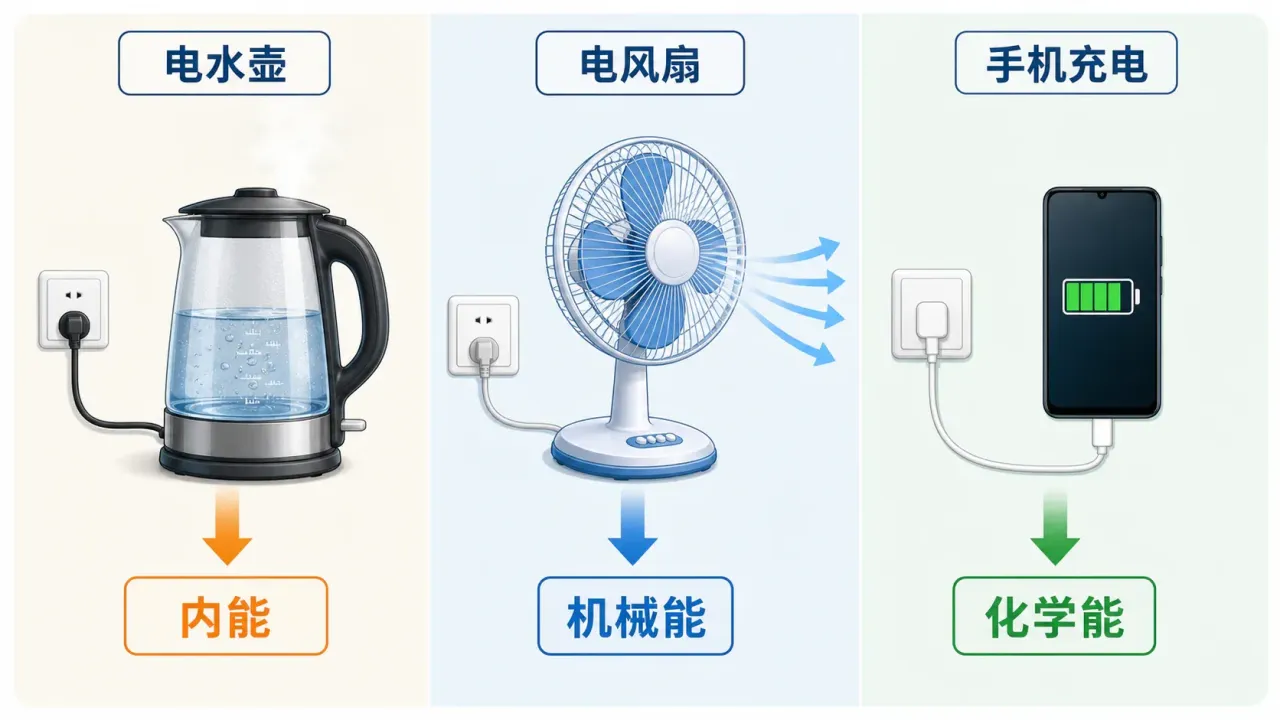
本章只研究用电器两端的能量账:电流做了多少功、做功有多快、产生了多少焦耳热,以及纯电阻和非纯电阻用电器为什么必须分开处理。电源电动势、内阻、路端电压和闭合电路的功率分配留到下一章;这里的电压 都是题目给出的用电器两端电压。
一、电流做功:电能怎样通过一段电路“交账”
电子移动得不快,能量为什么传得很快
一只电水壶接在稳定电压上工作。你当然知道它在消耗电能,可若只盯着导线里的电子,会发现电子的定向移动速度并不快。既然电子没有像快递车一样高速运送一包包“热量”,壶里的水为什么很快就热了?
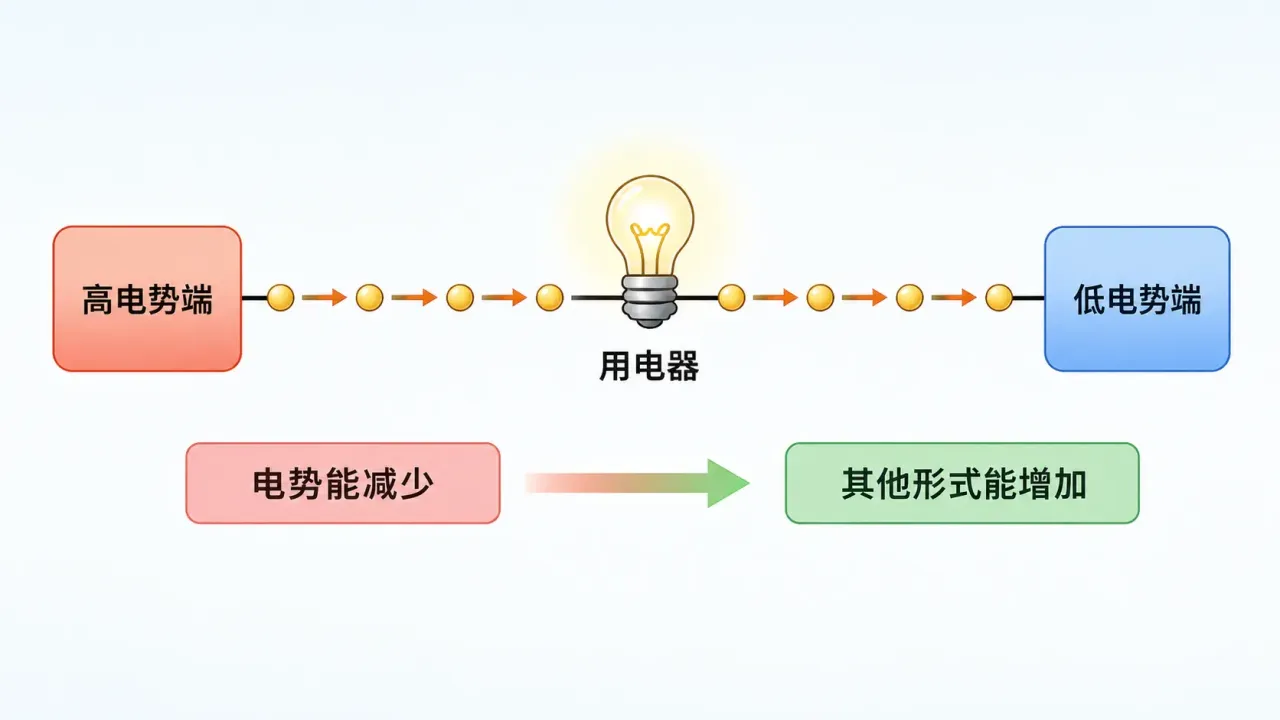
问题的关键不在单个电子跑了多远,而在电路接通后电场迅速建立,并持续对通过用电器的电荷做功。用电器两端存在电势差,电荷通过其中时,电能便转化成内能、机械能或其他形式的能。要算这笔总账,可以先问“每库仑电荷对应多少功”,再数一共通过了多少电荷。
电势差 的物理意义是:单位正电荷从一端移到另一端时,电场力所做的功。若通过用电器的电荷量为 ,电流所做的功为
恒定电流中,时间 内通过横截面的电荷量 ,于是
这就是电功。它描述电能转化为其他形式能的多少,国际单位是焦耳,符号为 。式中 用伏特、 用安培、 用秒,结果就是焦耳。对于一段电压、电流保持不变的电路,无论它把电能转化成什么, 都能计算输入这段电路的电能。
家庭电费常用“千瓦时”计量,俗称“度”。它也是能量单位,不是功率单位:
电能表读数增加 ,表示用电器累计消耗了 电能。这里的“累计”很重要:它既取决于功率,也取决于使用时间。
三个量必须属于同一个研究对象
看起来只有一次乘法,真正容易错的是对象。式中的 、 必须对应同一个用电器或同一段电路;若把总电路电压和某个支路电流拼在一起,乘积通常没有你想要的物理意义。
第二个陷阱是单位。铭牌上若写的是千瓦,时间给的是小时,直接相乘得到千瓦时;若要得到焦耳,就必须先换成瓦和秒。不能因为字母都对,就忘了单位也参与运算。
第三个陷阱是把电功直接叫作“产生的热量”。电热器正常工作时这句话往往成立,可风扇还要转动、充电电池还要储存化学能。输入的电能是总账,焦耳热只是其中一项。
一只电水壶,两种能量单位
现在算一笔生活账:一只额定功率为 的电水壶正常工作 ,若只问它消耗的电能,不讨论水吸收了多少热量,结果是多少焦耳?又是多少千瓦时?
可以先在草稿上决定采用哪套单位。若用焦耳,就把 化为 ,消耗电能
若用千瓦时,则有 。两种结果相同,是对单位换算的一次交叉检验。
在复习题中,这类计算最常丢在单位换算和研究对象上:分钟没换秒,却写出焦耳;或者把“消耗的电能”误当成“水吸收的热量”,忽略壶体散热。题目只问输入电能时,用 ;若问水温变化,还要另列能量分配关系。
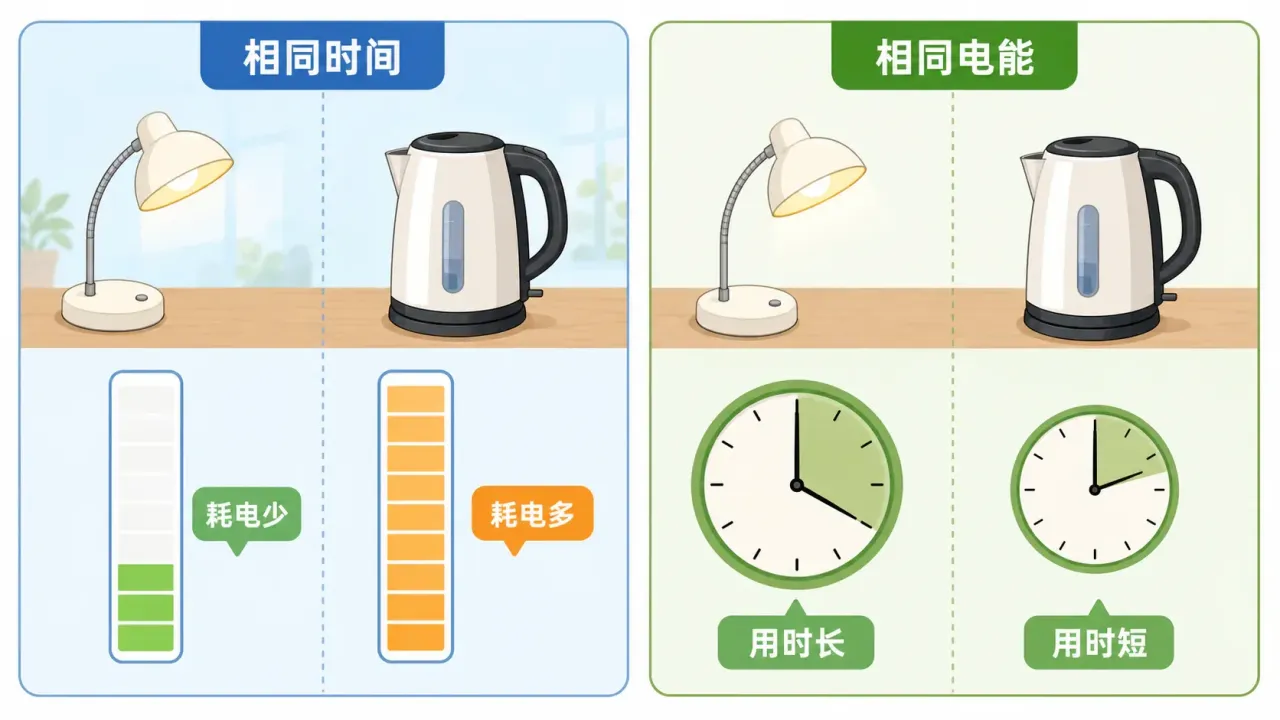
不过,同样消耗 电能,电水壶几分钟完成,小灯却可能亮几个小时。电功相同不代表用电状态相同,还需要一个量比较电流做功的快慢。
二、电功率:铭牌上的数字究竟承诺了什么
“瓦数大”不等于这次一定更费电
一只 的灯亮 ,一只 的电热器只开半小时。有人看到 就断言电热器一定更费电;另一个人盯着灯的使用时间,又说灯一定更费电。两个人都只看了能量账的一半:一个只看快慢,一个只看时间。
为了把“做了多少”和“做得多快”分开,物理上用功率描述单位时间内转化的电能。电流在一段电路中做功 ,所用时间为 ,平均电功率为
在电压和电流稳定时,代入 得
电功率表示电流做功的快慢,单位是瓦特。,意思是每秒转化 电能。功率越大,只说明单位时间转化的电能越多;总耗电量仍由 决定。
铭牌记录规定状态,不替代实际状态
用电器铭牌上的“额定电压”是它正常工作的规定电压,“额定功率”是它在额定电压下正常工作时的功率。用电器实际工作时,两端电压叫实际电压,对应的功率叫实际功率。额定值写在铭牌上,通常不随当时接入情况改变;实际值却由当时的工作状态决定。
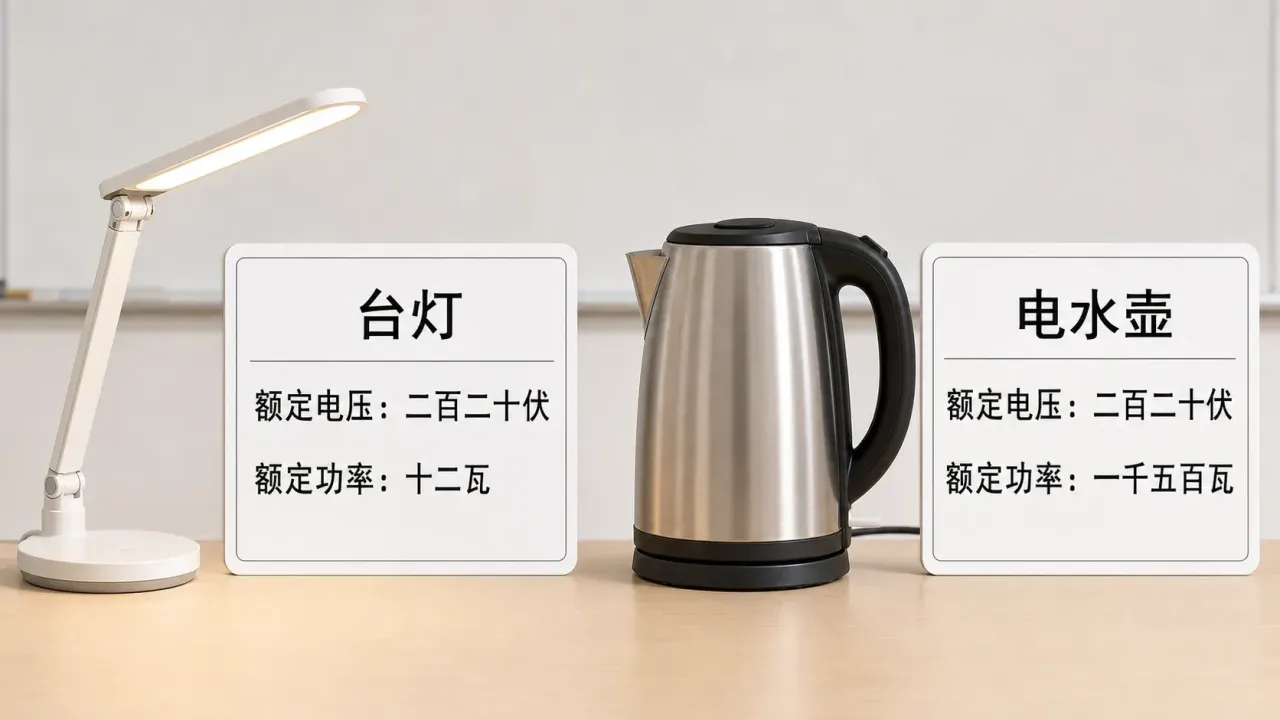
你可能会这样想:“额定功率就是设备最大的功率。”这句话不够严谨。额定功率强调的是在规定条件下正常工作的功率,并不鼓励把实际电压抬高去追求更大功率;超过额定电压可能使设备过热、损坏。
“实际电压小于额定电压,所以实际功率一定按电压的一次方减小”也不对。任何用电器都可用 ,但电流怎样随电压改变,要看用电器自身特性。只有把用电器近似成阻值不变的纯电阻时,才能进一步得到 ,这时功率才与电压的平方成正比。
同样一度电,可以花得快,也可以花得慢
回头算前面的两个用电器: 灯工作 , 电热器工作 。哪一个消耗的电能更多?
灯消耗 ;电热器消耗 。两者耗电量相同,但功率相差 倍,只是工作时间恰好按相反比例变化。这个结果正好说明:功率比较速率,电功比较累计总量,两者不能互相顶替。
在高考题里,“功率大”与“做功多”的偷换很常见。看到“更费电”,要追问比较的是相同时间还是一次完整使用;看到铭牌,要分清额定量和实际量。答题时写清 ,往往比只写一句“功率大所以费电”更能锁定给分点。
题目一会儿写 ,一会儿又写 或 。它们并不是三条彼此独立的规律:第一条适用范围最广,后两条要借助欧姆定律。先在下面的交互中切换元件类型,看看公式何时保持等价、何时必须停用。
三、焦耳定律:输入的电能有多少真正变成了热
为什么大电流格外容易把导线烧热
细铜线接大电流时会明显发热,电炉丝的电阻却比铜导线大得多,也能被烧得通红。电流产生的热量到底由电流决定,还是由电阻决定?如果只抓住其中一个量下结论,换一种连接方式,答案甚至可能反过来。
焦耳定律把电流、电阻和时间锁在同一条关系里:电流通过导体产生的热量,跟电流的二次方、导体电阻和通电时间成正比,
这就是焦耳定律,适用于任何电路中电热的计算。对应的热功率为
电流增为原来的 倍,而 、 不变时,热量变为原来的 倍;通电时间增为 倍,热量只变为原来的 倍。电流的平方效应,正是大电流会让接触不良处、细导线迅速升温的原因。
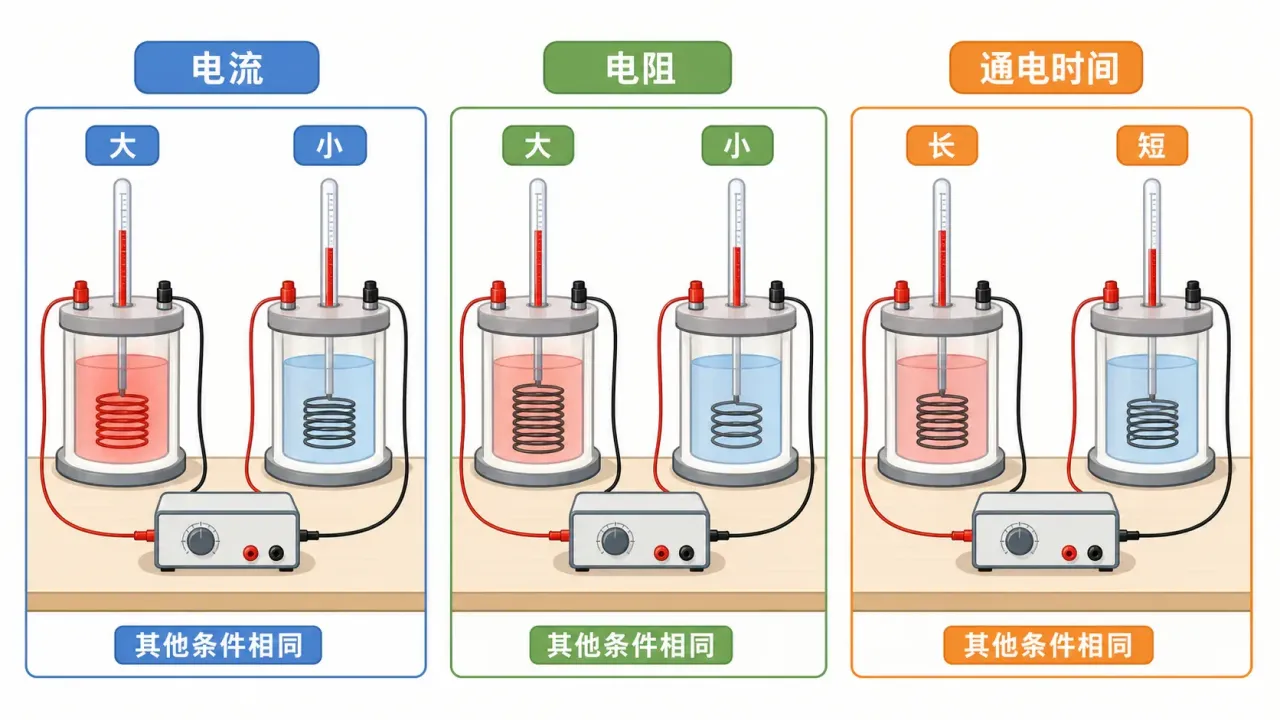
比较谁更热,先找共同不变量
“电阻越大,发热越多”必须带条件。若比较的是串联导体,同一时刻电流和通电时间相同,由 可知电阻大的发热多;若两个纯电阻并联在同一稳定电压下,电压和时间相同,利用 ,反而是电阻小的发热多。先找共同不变量,再选公式。
还要注意, 里的 是这段导体在该工作状态下的电阻。灯丝温度升高时电阻会改变;若题目明确“电阻随温度变化”,就不能把初始电阻当成全程不变的常量硬算。
是任何电路都可用的焦耳热公式。 和 只有在输入电能全部转化为内能的纯电阻电路中才成立。看到公式相似,先看能量去向,不要只看字母能否约出来。
同一对电热丝,换个接法结论就反转
设两根电热丝的电阻分别为 和 ,通电时间相同。串联时哪一根产生的热量多?若改成并联在同一电压上,结论又怎样?
串联时两者电流相同,由 , 电热丝产生的热量是 电热丝的 倍。并联时两端电压相同,对纯电阻可写 ,于是 电热丝产生的热量反而是 电热丝的 倍。不是焦耳定律变了,而是比较时保持不变的量变了。
复习题常把这两个情境并排放置。失分往往不是不会公式,而是没写“串联同电流、并联同电压”的前提。阅卷时只写“电阻大所以热量大”无法说明推理链;先指出不变量,再列对应公式,结论才有依据。
对于电热丝,电流做的功全部变成内能,电功与电热可以画等号。可电动机一边发热一边转动,若仍写 ,机械能便无处入账。焦耳热交互之后,我们就沿着这个矛盾进入纯电阻与非纯电阻的分界。
四、纯电阻与非纯电阻:别把总账和热账混成一本
一组不肯服从 的数据
把一台小电动机接在 电源两端,正常转动时电流为 ,线圈电阻为 。若直接用欧姆定律算,会得到 ,与实测值差了六倍。仪表没坏,电阻也没抄错;错误出在把正常转动的电动机当成了纯电阻。
区分两类用电器,最稳妥的办法不是背名称,而是追踪电能去了哪里。
只有全部变成焦耳热,公式才能完全等价
纯电阻用电器把输入电能全部转化为内能,如理想定值电阻和只考虑发热作用的电热器。它的能量关系是
所以
功率关系相应为
其中后两个变式用了 ,只属于纯电阻电路。
非纯电阻用电器会把电能同时转化为焦耳热和其他形式的能。一般情况下,应先写成
=I^2R+P_{\text{其他}}$$ 对正常转动的电动机,$E_{\text{其他}}$ 可能包含对外输出的机械能,也可能包含机械摩擦、铁耗、声音等途径带走的能量。只有题目明确“忽略除线圈焦耳热以外的其他损耗”,才可把非焦耳能量全部当成机械输出,写成 $$E_{\text{其他}}=W_{\text{机械}}$$ $$UIt=I^2Rt+W_{\text{机械}}$$ 若工作状态稳定,除线圈焦耳热外转化为其他形式能的功率为 $$P_{\text{其他}}=UI-I^2R$$ 这里仍有输入功率 $P_{\text{电}}=UI$,仍有线圈热功率 $P_{\text{热}}=I^2R$,但二者不再相等。因此不能对正常转动的电动机写 $U=IR$,也不能拿 $U^2/R$ 计算它的总输入功率。 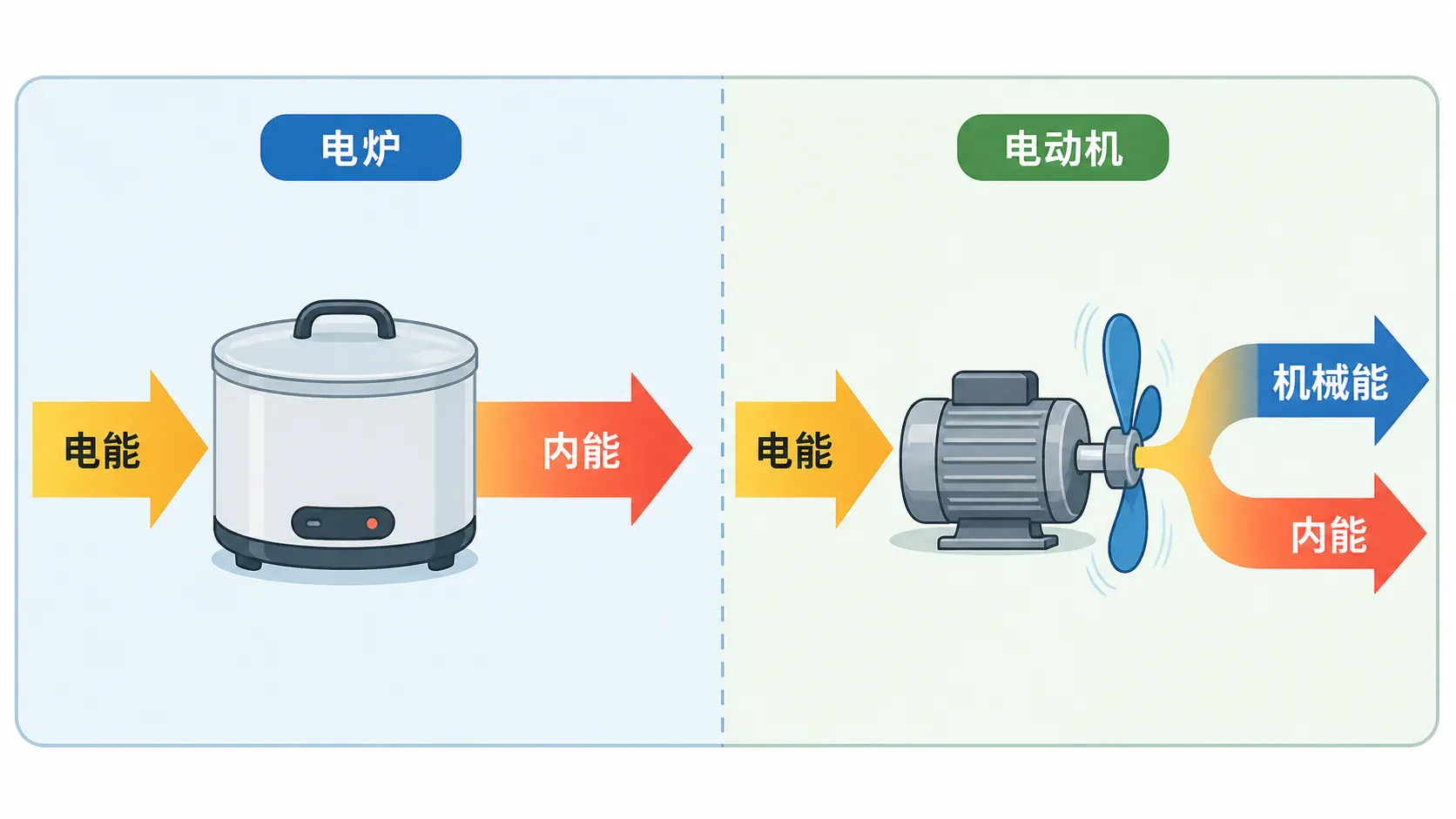 ### 非纯电阻仍有电阻,也仍会发热 “非纯电阻”不是说它没有电阻,也不是说它不发热。电动机线圈有电阻,所以一定有 $I^2Rt$ 的焦耳热;它与纯电阻的区别,是输入电能还会沿其他路径转化。充电设备也类似:输入电能除了转化为内能,还会转化为化学能。 若电动机被卡住而停止转动,在中学简化模型中没有机械能输出,输入电能几乎全部变成线圈内能,此时可近似按纯电阻处理,电流显著增大。注意,这是危险的堵转状态,不是正常工作状态;不能用它反推正常转动时也满足 $U=IR$。 ### 给 $6\ \text{V}$ 小电动机做一次功率审计 回到开头那台小电动机:$U=6\ \text{V}$、$I=0.50\ \text{A}$、线圈电阻 $R=2\ \Omega$。现在补充条件——忽略机械摩擦、铁耗、声音等其他损耗。你可以先分别算输入功率和线圈热功率,再看剩余的机械输出有多少。 输入功率为 $$P_{\text{电}}=UI=6\times0.50=3.0\ \text{W}$$ 热功率 $$P_{\text{热}}=I^2R=0.50^2\times2=0.50\ \text{W}$$ 题目已说明忽略其他损耗,所以机械输出功率 $P_{\text{机械}}=3.0-0.50=2.5\ \text{W}$,效率为 $$\eta=\frac{P_{\text{机械}}}{P_{\text{电}}}\times100\%\approx83.3\%$$ 高考复习中,非纯电阻题的核心给分点常是先写能量守恒,再分别计算输入功率和热功率。若一上来就写 $I=U/R$,后面即使算术无误,物理模型已经错了。另一个常见扣分点是无条件把 $UI-I^2R$ 全叫成“机械输出功率”;它首先表示非焦耳部分的功率,只有忽略其他损耗时才等于对外机械输出功率。 这类题可以形成一张三行账本:输入 $UI$,发热 $I^2R$,其他 $UI-I^2R$。若算出“其他功率”为负数,说明给定数据、单位或模型至少有一处不相容。下面的交互会把三项能量同时显示出来,并在数据矛盾时阻止继续计算。 <div dangerouslySetInnerHTML={{ __html: "<div style=\"margin:20px 0\"><p style=\"text-align:right;font-size:14px\"><a href=\"https://media.edu-free.com/uploads/gaokao_physics_compulsory_3_ch10_motor_ledger_b14137219fbe_f216f19e0b.html\" target=\"_blank\" rel=\"noopener\">独立打开交互 ↗</a></p><iframe title=\"电机提升:输入电能去了哪里?\" data-source=\"https://media.edu-free.com/uploads/gaokao_physics_compulsory_3_ch10_motor_ledger_b14137219fbe_f216f19e0b.html\" data-sha256=\"b14137219fbec22efbd3460edfd740c76197de73262f879fd26abe89dc4ac7c7\" srcdoc=\"<!doctype html><html lang="zh-CN"><head><meta charset="utf-8"><meta name="viewport" content="width=device-width,initial-scale=1"><title>电机提升:输入电能去了哪里?</title><style>*{box-sizing:border-box}body{margin:0;background:#f7f5ef;color:#253c45;font:15px/1.55 'Microsoft YaHei',sans-serif}main{max-width:1080px;margin:auto;padding:18px}header small{color:#60776e;letter-spacing:1px}h1{font-size:25px;margin:8px 0}p{margin:8px 0}.task{padding:12px 15px;background:#e8efe9;border-left:4px solid #3d7770;border-radius:8px}.layout{display:grid;grid-template-columns:minmax(330px,1.1fr) minmax(285px,1fr);gap:15px;margin-top:14px}.bench,.panel{border:1px solid #ded8cb;border-radius:18px;background:#fffdf8;padding:12px}.bench{background:linear-gradient(145deg,#f7f1e5,#ece7dc)}svg{display:block;width:100%;height:auto}svg text{font-family:'Microsoft YaHei',sans-serif;font-size:14px;fill:#253c45}button,select,input{font:inherit}button,select{border:1px solid #bcbeb0;border-radius:10px;padding:10px 13px;background:#fffdf8;color:#253c45}button{cursor:pointer}button.primary{background:#326f65;border-color:#326f65;color:white}button:disabled{opacity:.45;cursor:not-allowed}button:focus-visible,input:focus-visible,select:focus-visible{outline:3px solid #e2a748;outline-offset:3px}.buttons{display:flex;gap:8px;flex-wrap:wrap;margin:12px 0}.readings{display:grid;grid-template-columns:1fr 1fr;gap:8px}.reading{background:#f2eee4;border-radius:10px;padding:10px}.reading b{display:block;font-size:21px;font-weight:600}.caption{color:#69746d;font-size:13px}.bar{height:18px;background:#e8e0d2;display:flex;border-radius:6px;overflow:hidden}.heat{background:#bc7952}.other{background:#4d9384}.panel h2{font-size:18px;margin:2px 0 12px}.answer{background:#fffdf8;border:1px solid #ded8cb;border-radius:14px;padding:14px;margin-top:14px}input{width:130px;border:1px solid #9ca99e;border-radius:8px;padding:10px}.feedback{padding:10px;background:#eee8d9;border-radius:8px;min-height:44px}.finish{background:#e2eee7;padding:14px;border-radius:12px;margin-top:12px}[hidden]{display:none!important}.meter-note{font-size:13px;padding-top:6px}.badge{display:inline-block;padding:3px 10px;background:#e4ddd0;border-radius:30px}footer{font-size:13px;color:#69746d;margin-top:14px}@media(max-width:700px){main{padding:12px}.layout{grid-template-columns:1fr}h1{font-size:22px}.bench{padding:8px}.panel{padding:12px}.readings b{font-size:20px}}</style></head><body><main><header><small>自在学 · 第10章 · 能量审计</small><h1>电机提升:输入电能去了哪里?</h1><p class="task">观察卷筒提升物体,同时记录线圈热和机械输出。匀速、轻绳,忽略其他损耗。</p></header><div class="layout"><section class="bench"><svg id="scene" viewBox="0 0 360 390" role="img" aria-label="电路装置与同钟读数"></svg><p id="clock"></p><p id="viewnote" class="caption"></p></section><section class="panel"><h2>① 选条件 → 通电 → 定格取证</h2><label>实验条件 <select id="setting"><option value="default">12 V · 2 A · 线圈1 Ω</option></select></label><p class="caption" id="variantNote">主任务条件</p><div class="buttons"><button class="primary" id="run">启动卷扬机</button><button id="pause" disabled>暂停观察</button><button id="view">查看能量边界</button></div><p id="status" aria-live="polite"></p><div class="readings" id="readings"></div><p id="energy"></p><div class="bar"><span class="heat" id="heatbar"></span><span class="other" id="otherbar"></span></div><p class="caption">铜色:焦耳热 绿色:非焦耳部分</p><button id="record" disabled>记录本次证据</button><p class="caption" id="history">切换条件会清除当前判断;记录保留供比较。</p></section></div><section class="answer"><h2 style="font-size:18px">② 用证据作判断</h2><label for="answer">终点机械输出能量 / J </label><input id="answer" type="number" step="any" inputmode="decimal"><button id="check" disabled>核对判断</button><p id="feedback" class="feedback" aria-live="polite">通电完成后开放判断。</p><div class="finish" id="finish" hidden><b>知识收束</b><p>电能=线圈焦耳热+机械输出;忽略其他损耗且匀速时,UI=I²R+mgv。正常电机不能套 U=IR。</p><p>再操作可换接法或档位;变式会真正改变物理条件。</p></div><div class="buttons"><button id="again">重新操作</button><button id="variant">切换变式条件</button></div></section><footer>稳定直流、阻值恒定的简化模型;电机参数为给定工作点,忽略除线圈焦耳热外的损耗。20秒模型过程压缩为4秒播放。功能观察不等同于课堂学习效果。</footer></main><script>const MODE=3,SUMMARY="电能=线圈焦耳热+机械输出;忽略其他损耗且匀速时,UI=I²R+mgv。正常电机不能套 U=IR。",HINT="先扣线圈热:机械功率为 UI−I²R,再乘时间。直接用 UI 会漏掉发热。",VARIANT="重物加倍至4 kg,电学工作点不变";\nconst $=s=>document.querySelector(s);let t=0,running=false,ready=false,variant=false,view=false,tries=0,last=0;let setting=MODE===1?'heater':MODE===2?'series':MODE===4?'6':'default';\nfunction model(){let U=6,I=0.5,R=12,m=2; if(MODE===0){I=variant?1:.5;R=U/I}if(MODE===1){R=2;I=setting==='motor'?.5:3;if(variant){U=8;I=setting==='motor'?1:4}}if(MODE===2){let A=variant?3:2,B=variant?9:4;I=U/(A+B);let ia=setting==='series'?I:U/A,ib=setting==='series'?I:U/B;return{U,I,R:A,B,ia,ib,P:U*(setting==='series'?I:ia+ib),H:ia*ia*A,Hb:ib*ib*B,O:0,ratio:setting==='series'?B/A:A/B}}if(MODE===3){U=12;I=2;R=1;m=variant?4:2}if(MODE===4){U=+setting;R=6;I=U/R}let P=U*I,H=I*I*R,O=P-H;return{U,I,R,P,H,O,m,v:O/(m*10)}}\nfunction wire(points,color='#435b61'){return '<polyline points="'+points+'" fill="none" stroke="'+color+'" stroke-width="4" stroke-linecap="round" stroke-linejoin="round"/>'}\nfunction terminal(x,y,c='#b68a44'){return '<circle cx="'+x+'" cy="'+y+'" r="5" fill="'+c+'" stroke="#f8e8ba" stroke-width="2"/>'}\nfunction coil(x,y,w,n=12){let p='';for(let i=0;i<n;i++){let X=x+i*w/n;p+='M '+X+' '+y+'q '+w/n/2+' -22 '+w/n+' 0q '+(-w/n/2)+' 22 '+(-w/n)+' 0'}return '<rect x="'+(x-6)+'" y="'+(y-25)+'" width="'+(w+12)+'" height="50" rx="12" fill="#e7d7ac" stroke="#b7a682"/><path d="'+p+'" stroke="'+(t>0?'#b66c42':'#859590')+'" stroke-width="2" fill="none"/>'}\nfunction meter(val,max,label,x=180,y=100){let a=Math.PI+(val/max)*Math.PI,tx=x+74*Math.cos(a),ty=y+74*Math.sin(a),s='<rect x="'+(x-112)+'" y="'+(y-103)+'" width="224" height="135" rx="18" fill="url(#metal)" stroke="#81928c"/><path d="M '+(x-100)+' '+(y+19)+'V '+(y-70)+'Q '+(x-100)+' '+(y-92)+' '+(x-78)+' '+(y-92)+'H '+(x+78)+'Q '+(x+100)+' '+(y-92)+' '+(x+100)+' '+(y-70)+'V '+(y+19)+'Z" fill="#fffced"/>';for(let k=0;k<=20;k++){let b=Math.PI+k/20*Math.PI; s+='<line x1="'+(x+79*Math.cos(b))+'" y1="'+(y+79*Math.sin(b))+'" x2="'+(x+(k%5?85:90)*Math.cos(b))+'" y2="'+(y+(k%5?85:90)*Math.sin(b))+'" stroke="#71847f"/>';if(k%5===0)s+='<text x="'+(x+63*Math.cos(b))+'" y="'+(y+63*Math.sin(b)+5)+'" text-anchor="middle">'+(max*k/20).toFixed(max<=1?2:1)+'</text>'}return s+'<line data-needle="'+val+'" data-max="'+max+'" x1="'+x+'" y1="'+y+'" x2="'+tx+'" y2="'+ty+'" stroke="#bd704b" stroke-width="3"/><circle cx="'+x+'" cy="'+y+'" r="5" fill="#536b68"/><text x="'+x+'" y="'+(y+22)+'" text-anchor="middle">'+label+'</text>'}\nfunction scene(){let z=model(),s='<defs><linearGradient id="metal"><stop stop-color="#8fa5a1"/><stop offset=".45" stop-color="#e0e5df"/><stop offset="1" stop-color="#819895"/></linearGradient><linearGradient id="copper" x2="0" y2="1"><stop stop-color="#e4be79"/><stop offset="1" stop-color="#b37c43"/></linearGradient></defs>';if(MODE===2){s+='<text x="20" y="25">'+(setting==='series'?'串联 · 两丝同电流':'并联 · 两丝同电压')+'</text>';s+=wire('10,110 10,330 120,330')+wire('220,330 325,330 325,305','#b96e4e')+wire('325,280 325,110','#b96e4e')+wire('325,305 '+(t>0?'325':'300')+',280','#b96e4e')+terminal(325,305)+terminal(325,280);if(setting==='series'){s+=wire('10,110 90,110')+coil(90,110,60)+wire('150,110 215,110')+coil(215,110,60)+wire('275,110 325,110');s+='<text x="95" y="65">A '+z.R+' Ω</text><text x="223" y="65">B '+z.B+' Ω</text>'}else{for(let[y,r,n]of[[100,z.R,'A'],[185,z.B,'B']])s+=wire('10,'+y+' 130,'+y)+coil(130,y,100)+wire('230,'+y+' 325,'+y)+'<text x="140" y="'+(y-33)+'">'+n+' '+r+' Ω</text>';s+=wire('10,100 10,185')+wire('325,100 325,185')}s+='<rect x="120" y="304" width="100" height="43" rx="8" fill="url(#copper)"/><text x="170" y="331" text-anchor="middle">− 6 V +</text>';let qa=z.H*t,qb=z.Hb*t,max=Math.max(z.H,z.Hb)*20;s+='<text x="20" y="252">Q_A '+qa.toFixed(1)+' J</text><text x="190" y="252">Q_B '+qb.toFixed(1)+' J</text><rect x="20" y="267" width="'+(130*qa/max)+'" height="16" fill="#b67a53"/><rect x="190" y="267" width="'+(130*qb/max)+'" height="16" fill="#4b8d80"/>';}\nelse if(MODE===3){let h=variant?2.5:5,Y=310-z.v*t/20*160;s+='<text x="18" y="24">匀速提升 · g=10 m/s²</text><rect x="30" y="75" width="150" height="64" rx="10" fill="url(#metal)"/><path d="M35 146H190" stroke="#787f74" stroke-width="9"/>';for(let x=45;x<165;x+=13)s+='<line x1="'+x+'" y1="88" x2="'+x+'" y2="127" stroke="#798e88"/>';s+='<circle cx="207" cy="105" r="32" fill="#dec399" stroke="#6b7b76" stroke-width="8"/><g transform="rotate('+t*90+' 207 105)"><path d="M183 105H231M207 81V129" stroke="#6b7b76" stroke-width="5"/></g>'+wire('239,105 239,'+Y)+'<rect x="214" y="'+Y+'" width="50" height="40" rx="5" fill="url(#copper)"/><text x="239" y="'+(Y+26)+'" text-anchor="middle">'+z.m+' kg</text><text x="18" y="180">输入 '+z.P.toFixed(1)+' W</text><text x="18" y="210">线圈热 '+z.H.toFixed(1)+' W</text><text x="18" y="240">提升 '+z.O.toFixed(1)+' W</text><text x="18" y="270">v='+z.v.toFixed(2)+' m/s</text><path d="M290 140V340" stroke="#bcb5a5" stroke-dasharray="3 4"/><text x="18" y="355">上升 '+(z.v*t).toFixed(1)+' m · 位移压缩示意</text>'}\nelse{s+=meter(t?z.I:0,MODE===1?5:MODE===4?2.5:1.2,'A · 电流');s+=wire('120,355 42,355 42,160 125,160 125,140')+terminal(125,140,'#657e79')+terminal(235,140,'#b96e4e')+wire('235,140 235,160 280,160 280,175 80,175 80,220 105,220')+wire('220,355 318,355 318,305','#b96e4e')+wire('318,280 318,220','#b96e4e')+wire('318,305 '+(t>0?'318':'293')+',280','#b96e4e')+terminal(318,305)+terminal(318,280)+wire('255,220 318,220');if(MODE===1&&setting==='motor'){s+='<rect x="105" y="180" width="150" height="80" rx="20" fill="url(#metal)"/><circle cx="180" cy="220" r="30" fill="#d6dbce" stroke="#82958d"/><g transform="rotate('+t*100+' 180 220)"><path d="M180 192V248M152 220H208" stroke="#728a82" stroke-width="7"/></g>'}else s+=coil(105,220,150);s+=terminal(105,220)+terminal(255,220)+'<text x="180" y="285" text-anchor="middle">'+(MODE===1&&setting==='motor'?'正常电机 · R='+z.R+' Ω':'定值电阻 · R='+z.R+' Ω')+'</text><rect x="120" y="331" width="100" height="43" rx="8" fill="url(#copper)"/>'+terminal(120,355,'#667f7a')+terminal(220,355,'#b96e4e')+'<text x="170" y="358" text-anchor="middle">− '+z.U+' V +</text>';if(MODE===4)s+='<text x="180" y="315" text-anchor="middle">铭牌 12 V · 24 W</text>';}\nif(view){const b=MODE===2?[18,40,290,185]:MODE===3?[20,60,230,95]:[98,173,164,94];s+='<rect x="'+b[0]+'" y="'+b[1]+'" width="'+b[2]+'" height="'+b[3]+'" rx="12" fill="none" stroke="#448b7c" stroke-width="2" stroke-dasharray="5 4"/>'}$('#scene').innerHTML=s;$('#clock').textContent='模型时间 '+t.toFixed(1)+' / 20.0 s';$('#clock').className='badge';let P=z.P,H=z.H,O=z.O;$('#readings').innerHTML=[['两端电压',z.U.toFixed(1)+' V'],['工作电流',(MODE===2?(setting==='series'?z.I:z.ia+z.ib):z.I).toFixed(2)+' A'],['输入功率',P.toFixed(2)+' W'],[MODE===2?'热量比 B/A':'通过电荷',(MODE===2?z.ratio.toFixed(2): (z.I*t).toFixed(1)+' C')]].map(x=>'<div class="reading">'+x[0]+'<b>'+x[1]+'</b></div>').join('');$('#energy').innerHTML='输入电能 <b>'+(P*t).toFixed(1)+' J</b><br>焦耳热 <b>'+((MODE===2?P:H)*t).toFixed(1)+' J</b>'+(MODE!==2?'<br>非焦耳能量 <b>'+(O*t).toFixed(1)+' J</b>':'');$('#heatbar').style.width=(MODE===2?100:H/P*100)+'%';$('#otherbar').style.width=(MODE===2?0:O/P*100)+'%';$('#status').textContent=ready?'证据已定格:填写判断,核对能量边界。':running?'正在通电;可以暂停核对指针与累计量。':'先选择条件,再接通观察;电压是用电器两端电压。';$('#check').disabled=!ready;$('#run').disabled=running||ready;$('#pause').disabled=(!running&&t===0)||ready;$('#pause').textContent=running?'暂停观察':'继续通电';$('#setting').disabled=running;$('#record').disabled=!ready;$('#viewnote').textContent=view?'能量边界:框内为用电器,输入电能分为焦耳热与其他形式。':'装置不按实物比例;表针、热量和运动共享模型时间。';}\nfunction reset(){running=false;t=0;ready=false;tries=0;$('#feedback').textContent='通电完成后开放判断。';$('#finish').hidden=true;$('#answer').value='';scene()}\n$('#run').onclick=()=>{running=true;last=performance.now();scene()};$('#pause').onclick=()=>{running=!running;last=performance.now();scene()};$('#setting').onchange=e=>{setting=e.target.value;reset()};$('#view').onclick=()=>{view=!view;scene()};$('#again').onclick=reset;$('#variant').onclick=()=>{variant=!variant;$('#variantNote').textContent=variant?VARIANT:'主任务条件';if(MODE===4){setting=variant?'9':'6';$('#setting').value=setting}reset()};$('#record').onclick=()=>{let z=model();$('#history').textContent='固定记录:'+$('#setting').selectedOptions[0].text+';W='+(z.P*t).toFixed(1)+' J'+(MODE===2?',B/A='+z.ratio.toFixed(2):',Q='+(z.H*t).toFixed(1)+' J')};\nfunction expected(){let z=model();return MODE===0?z.P*20:MODE===1?z.O*20:MODE===2?z.ratio:MODE===3?z.O*20:z.P}\n$('#check').onclick=()=>{let a=Number($('#answer').value),e=expected();if($('#answer').value.trim()&&Math.abs(a-e)<=Math.max(.015,e*.005)){ $('#feedback').textContent='判断成立:'+e.toFixed(2)+'。'+SUMMARY;$('#finish').hidden=false}else{tries++;$('#feedback').textContent=HINT+(tries>=2?' 提示:'+(MODE===0?'W=UI×20。':MODE===1||MODE===3?'其他能量=(UI−I²R)×20。':MODE===2?'串联比为 RB/RA;并联比为 RA/RB。':'P=U²/6。'):'')+(tries>=3?' 答案与关键推理:本次正确数值 '+e.toFixed(2)+';'+SUMMARY:'')}};\nfunction tick(now){if(running){t=Math.min(20,t+(now-last)/1000*5);if(t>=20){running=false;ready=true}scene()}last=now;requestAnimationFrame(tick)}scene();requestAnimationFrame(tick);\n</script><script>(()=>{const f=window.frameElement;if(!f)return;const size=()=>{const h=Math.ceil(document.body.scrollHeight)+6;if(Math.abs(parseFloat(f.style.height||0)-h)>3)f.style.height=h+"px"};new ResizeObserver(size).observe(document.body);addEventListener("load",size);requestAnimationFrame(size)})();</script></body></html>\" style=\"box-sizing:border-box;width:100%;height:1100px;display:block;border:1px solid #ded8cf;border-radius:16px\" sandbox=\"allow-scripts allow-same-origin\"></iframe></div>" }} /> ## 五、额定与实际、机械输出:把公式放回具体对象 ### 电压减半,功率为什么可能只剩四分之一 一盏标有“$220\ \text{V}\quad100\ \text{W}$”的白炽灯接到 $110\ \text{V}$ 电压上。有人说电压减半,所以功率减半,灯应还有 $50\ \text{W}$;另一个人说电阻不变,功率应变成四分之一。两种说法的分歧不在算术,而在是否声明了元件模型。 若题目明确把灯丝看成阻值不变的纯电阻,才可以从额定状态求出其电阻: $$R=\frac{U_{\text{额}}^2}{P_{\text{额}}}$$ 实际电压为 $U_{\text{实}}$ 时 $$P_{\text{实}}=\frac{U_{\text{实}}^2}{R} =\left(\frac{U_{\text{实}}}{U_{\text{额}}}\right)^2P_{\text{额}}$$ 电压变为一半,功率变为四分之一,即 $25\ \text{W}$。但真实灯丝电阻会随温度变化,所以这个平方比例只是在“电阻不变”的理想条件下成立。若题目给出伏安特性曲线,就应从实际工作点读取 $U$、$I$,再用 $P=UI$。 ### 平方比例背后藏着“恒定电阻” 额定值不能直接拿来代替实际值。用额定电压和额定功率求出的电阻,是题目采用纯电阻且电阻不变近似时的模型参数;对电动机、充电设备等非纯电阻用电器,不能照搬 $R=U_{\text{额}}^2/P_{\text{额}}$ 来描述正常运行。 额定与实际功率的辨析还会与机械输出相遇。若电动机提升重物,已知它的输入电功率和线圈热功率,剩余功率还不一定全部等于 $mgv$;只有题目说明其他损耗忽略、重物匀速提升时,才能写 $$UI=I^2R+mgv$$ “匀速”保证重物所受合力为零,使机械输出功率为 $Fv=mgv$;“忽略其他损耗”保证能量账没有漏项。 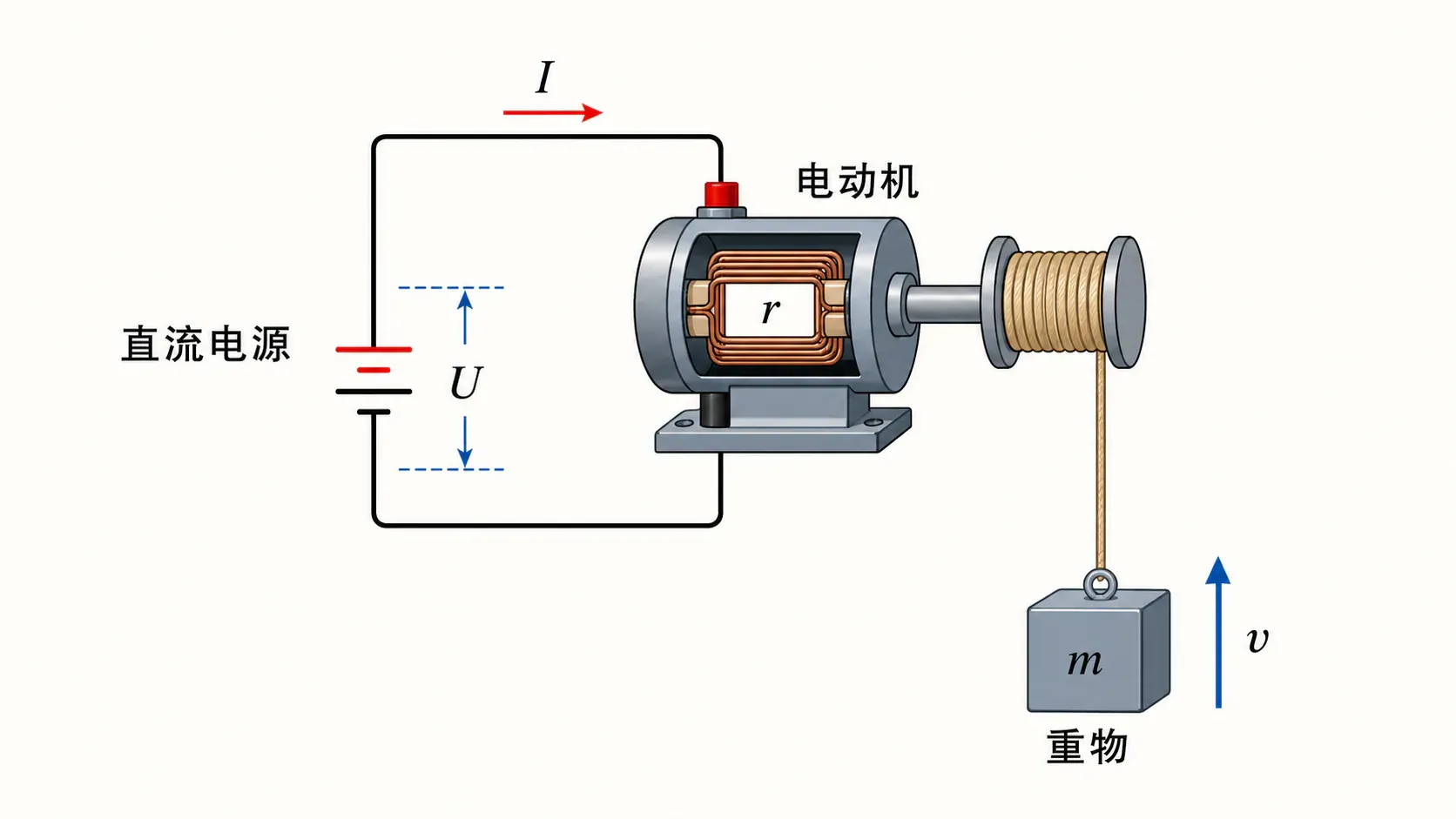 ### 从电功率走到提升速度 一台电动机两端电压为 $12\ \text{V}$,电流为 $2.0\ \text{A}$,线圈电阻为 $1.0\ \Omega$。它匀速提升质量为 $2.0\ \text{kg}$ 的物体,忽略其他损耗,取 $g=10\ \text{m/s}^2$。提升速度是多少? 这里的两个条件各有任务:“忽略其他损耗”允许把非焦耳功率视为机械输出,“匀速”允许把机械输出功率写成 $mgv$。先算输入功率 $P_{\text{电}}=UI=24\ \text{W}$,再扣除线圈热功率 $P_{\text{热}}=I^2R=4\ \text{W}$,得到机械输出功率 $20\ \text{W}$,于是 $$v=\frac{20}{2.0\times10}=1.0\ \text{m/s}$$ 这类高考题常见两处漏项:只算 $UI$ 就全部等同于机械功率,忘了线圈发热;或者看到 $R$ 就直接用 $U/R$ 求电流,忽略电动机是非纯电阻。完整得分链应是“输入功率—焦耳热功率—机械输出功率—运动关系”。 本章所有计算都把用电器两端的 $U$ 当作已知。真实电源接上用电器后,为什么端电压会随电流变化?电源内部损耗怎样进入总能量账?那需要引入电动势和内阻,并对完整闭合电路列方程。下一章再把电源这一侧接上来。结束本章前,可以在下面改变实际电压,观察额定量不变、实际功率随工作状态改变的全过程。 <div dangerouslySetInnerHTML={{ __html: "<div style=\"margin:20px 0\"><p style=\"text-align:right;font-size:14px\"><a href=\"https://media.edu-free.com/uploads/gaokao_physics_compulsory_3_ch10_rated_voltage_a711edcfda0e_a438a1ad9a.html\" target=\"_blank\" rel=\"noopener\">独立打开交互 ↗</a></p><iframe title=\"铭牌不变,实际功率怎样改变?\" data-source=\"https://media.edu-free.com/uploads/gaokao_physics_compulsory_3_ch10_rated_voltage_a711edcfda0e_a438a1ad9a.html\" data-sha256=\"a711edcfda0e320578e94a14957c5771f2d426e2edafc39885d5636bc75bd671\" srcdoc=\"<!doctype html><html lang="zh-CN"><head><meta charset="utf-8"><meta name="viewport" content="width=device-width,initial-scale=1"><title>铭牌不变,实际功率怎样改变?</title><style>*{box-sizing:border-box}body{margin:0;background:#f7f5ef;color:#253c45;font:15px/1.55 'Microsoft YaHei',sans-serif}main{max-width:1080px;margin:auto;padding:18px}header small{color:#60776e;letter-spacing:1px}h1{font-size:25px;margin:8px 0}p{margin:8px 0}.task{padding:12px 15px;background:#e8efe9;border-left:4px solid #3d7770;border-radius:8px}.layout{display:grid;grid-template-columns:minmax(330px,1.1fr) minmax(285px,1fr);gap:15px;margin-top:14px}.bench,.panel{border:1px solid #ded8cb;border-radius:18px;background:#fffdf8;padding:12px}.bench{background:linear-gradient(145deg,#f7f1e5,#ece7dc)}svg{display:block;width:100%;height:auto}svg text{font-family:'Microsoft YaHei',sans-serif;font-size:14px;fill:#253c45}button,select,input{font:inherit}button,select{border:1px solid #bcbeb0;border-radius:10px;padding:10px 13px;background:#fffdf8;color:#253c45}button{cursor:pointer}button.primary{background:#326f65;border-color:#326f65;color:white}button:disabled{opacity:.45;cursor:not-allowed}button:focus-visible,input:focus-visible,select:focus-visible{outline:3px solid #e2a748;outline-offset:3px}.buttons{display:flex;gap:8px;flex-wrap:wrap;margin:12px 0}.readings{display:grid;grid-template-columns:1fr 1fr;gap:8px}.reading{background:#f2eee4;border-radius:10px;padding:10px}.reading b{display:block;font-size:21px;font-weight:600}.caption{color:#69746d;font-size:13px}.bar{height:18px;background:#e8e0d2;display:flex;border-radius:6px;overflow:hidden}.heat{background:#bc7952}.other{background:#4d9384}.panel h2{font-size:18px;margin:2px 0 12px}.answer{background:#fffdf8;border:1px solid #ded8cb;border-radius:14px;padding:14px;margin-top:14px}input{width:130px;border:1px solid #9ca99e;border-radius:8px;padding:10px}.feedback{padding:10px;background:#eee8d9;border-radius:8px;min-height:44px}.finish{background:#e2eee7;padding:14px;border-radius:12px;margin-top:12px}[hidden]{display:none!important}.meter-note{font-size:13px;padding-top:6px}.badge{display:inline-block;padding:3px 10px;background:#e4ddd0;border-radius:30px}footer{font-size:13px;color:#69746d;margin-top:14px}@media(max-width:700px){main{padding:12px}.layout{grid-template-columns:1fr}h1{font-size:22px}.bench{padding:8px}.panel{padding:12px}.readings b{font-size:20px}}</style></head><body><main><header><small>自在学 · 第10章 · 铭牌实验</small><h1>铭牌不变,实际功率怎样改变?</h1><p class="task">定值电阻铭牌 12 V · 24 W。选实际电压档位,观察表针与实际发热功率。</p></header><div class="layout"><section class="bench"><svg id="scene" viewBox="0 0 360 390" role="img" aria-label="电路装置与同钟读数"></svg><p id="clock"></p><p id="viewnote" class="caption"></p></section><section class="panel"><h2>① 选条件 → 通电 → 定格取证</h2><label>实验条件 <select id="setting"><option value="6">6 V · 半额定电压</option><option value="12">12 V · 额定电压</option><option value="9">9 V · 四分之三电压</option></select></label><p class="caption" id="variantNote">主任务条件</p><div class="buttons"><button class="primary" id="run">接通实际电压</button><button id="pause" disabled>暂停观察</button><button id="view">查看能量边界</button></div><p id="status" aria-live="polite"></p><div class="readings" id="readings"></div><p id="energy"></p><div class="bar"><span class="heat" id="heatbar"></span><span class="other" id="otherbar"></span></div><p class="caption">铜色:焦耳热 绿色:非焦耳部分</p><button id="record" disabled>记录本次证据</button><p class="caption" id="history">切换条件会清除当前判断;记录保留供比较。</p></section></div><section class="answer"><h2 style="font-size:18px">② 用证据作判断</h2><label for="answer">该档实际功率 / W </label><input id="answer" type="number" step="any" inputmode="decimal"><button id="check" disabled>核对判断</button><p id="feedback" class="feedback" aria-live="polite">通电完成后开放判断。</p><div class="finish" id="finish" hidden><b>知识收束</b><p>本实验明确 R 不随温度改变:R=12²/24=6 Ω。实际功率=(实际电压/额定电压)²×额定功率。真实灯丝不能无条件沿用恒阻近似。</p><p>再操作可换接法或档位;变式会真正改变物理条件。</p></div><div class="buttons"><button id="again">重新操作</button><button id="variant">切换变式条件</button></div></section><footer>稳定直流、阻值恒定的简化模型;电机参数为给定工作点,忽略除线圈焦耳热外的损耗。20秒模型过程压缩为4秒播放。功能观察不等同于课堂学习效果。</footer></main><script>const MODE=4,SUMMARY="本实验明确 R 不随温度改变:R=12²/24=6 Ω。实际功率=(实际电压/额定电压)²×额定功率。真实灯丝不能无条件沿用恒阻近似。",HINT="电压按一次方变化,恒阻电流也按一次方变化;UI 因而按平方变化。",VARIANT="实际电压改为9 V,额定量不变";\nconst $=s=>document.querySelector(s);let t=0,running=false,ready=false,variant=false,view=false,tries=0,last=0;let setting=MODE===1?'heater':MODE===2?'series':MODE===4?'6':'default';\nfunction model(){let U=6,I=0.5,R=12,m=2; if(MODE===0){I=variant?1:.5;R=U/I}if(MODE===1){R=2;I=setting==='motor'?.5:3;if(variant){U=8;I=setting==='motor'?1:4}}if(MODE===2){let A=variant?3:2,B=variant?9:4;I=U/(A+B);let ia=setting==='series'?I:U/A,ib=setting==='series'?I:U/B;return{U,I,R:A,B,ia,ib,P:U*(setting==='series'?I:ia+ib),H:ia*ia*A,Hb:ib*ib*B,O:0,ratio:setting==='series'?B/A:A/B}}if(MODE===3){U=12;I=2;R=1;m=variant?4:2}if(MODE===4){U=+setting;R=6;I=U/R}let P=U*I,H=I*I*R,O=P-H;return{U,I,R,P,H,O,m,v:O/(m*10)}}\nfunction wire(points,color='#435b61'){return '<polyline points="'+points+'" fill="none" stroke="'+color+'" stroke-width="4" stroke-linecap="round" stroke-linejoin="round"/>'}\nfunction terminal(x,y,c='#b68a44'){return '<circle cx="'+x+'" cy="'+y+'" r="5" fill="'+c+'" stroke="#f8e8ba" stroke-width="2"/>'}\nfunction coil(x,y,w,n=12){let p='';for(let i=0;i<n;i++){let X=x+i*w/n;p+='M '+X+' '+y+'q '+w/n/2+' -22 '+w/n+' 0q '+(-w/n/2)+' 22 '+(-w/n)+' 0'}return '<rect x="'+(x-6)+'" y="'+(y-25)+'" width="'+(w+12)+'" height="50" rx="12" fill="#e7d7ac" stroke="#b7a682"/><path d="'+p+'" stroke="'+(t>0?'#b66c42':'#859590')+'" stroke-width="2" fill="none"/>'}\nfunction meter(val,max,label,x=180,y=100){let a=Math.PI+(val/max)*Math.PI,tx=x+47*Math.cos(a),ty=y+47*Math.sin(a),s='<rect x="'+(x-112)+'" y="'+(y-103)+'" width="224" height="135" rx="18" fill="url(#metal)" stroke="#81928c"/><path d="M '+(x-100)+' '+(y+19)+'V '+(y-70)+'Q '+(x-100)+' '+(y-92)+' '+(x-78)+' '+(y-92)+'H '+(x+78)+'Q '+(x+100)+' '+(y-92)+' '+(x+100)+' '+(y-70)+'V '+(y+19)+'Z" fill="#fffced"/>';for(let k=0;k<=20;k++){let b=Math.PI+k/20*Math.PI; s+='<line x1="'+(x+79*Math.cos(b))+'" y1="'+(y+79*Math.sin(b))+'" x2="'+(x+(k%5?85:90)*Math.cos(b))+'" y2="'+(y+(k%5?85:90)*Math.sin(b))+'" stroke="#71847f"/>';if(k%5===0)s+='<text x="'+(x+63*Math.cos(b))+'" y="'+(y+63*Math.sin(b)+5)+'" text-anchor="middle">'+(max*k/20).toFixed(max<=1?2:1)+'</text>'}return s+'<line data-needle="'+val+'" data-max="'+max+'" x1="'+x+'" y1="'+y+'" x2="'+tx+'" y2="'+ty+'" stroke="#bd704b" stroke-width="3"/><circle cx="'+x+'" cy="'+y+'" r="5" fill="#536b68"/><text x="'+x+'" y="'+(y+22)+'" text-anchor="middle">'+label+'</text>'}\nfunction scene(){let z=model(),s='<defs><linearGradient id="metal"><stop stop-color="#8fa5a1"/><stop offset=".45" stop-color="#e0e5df"/><stop offset="1" stop-color="#819895"/></linearGradient><linearGradient id="copper" x2="0" y2="1"><stop stop-color="#e4be79"/><stop offset="1" stop-color="#b37c43"/></linearGradient></defs>';if(MODE===2){s+='<text x="20" y="25">'+(setting==='series'?'串联 · 两丝同电流':'并联 · 两丝同电压')+'</text>';s+=wire('10,110 10,330 120,330')+wire('220,330 325,330 325,305','#b96e4e')+wire('325,280 325,110','#b96e4e')+wire('325,305 '+(t>0?'325':'300')+',280','#b96e4e')+terminal(325,305)+terminal(325,280);if(setting==='series'){s+=wire('10,110 90,110')+coil(90,110,60)+wire('150,110 215,110')+coil(215,110,60)+wire('275,110 325,110');s+='<text x="95" y="65">A '+z.R+' Ω</text><text x="223" y="65">B '+z.B+' Ω</text>'}else{for(let[y,r,n]of[[100,z.R,'A'],[185,z.B,'B']])s+=wire('10,'+y+' 130,'+y)+coil(130,y,100)+wire('230,'+y+' 325,'+y)+'<text x="140" y="'+(y-33)+'">'+n+' '+r+' Ω</text>';s+=wire('10,100 10,185')+wire('325,100 325,185')}s+='<rect x="120" y="304" width="100" height="43" rx="8" fill="url(#copper)"/><text x="170" y="331" text-anchor="middle">− 6 V +</text>';let qa=z.H*t,qb=z.Hb*t,max=Math.max(z.H,z.Hb)*20;s+='<text x="20" y="252">Q_A '+qa.toFixed(1)+' J</text><text x="190" y="252">Q_B '+qb.toFixed(1)+' J</text><rect x="20" y="267" width="'+(130*qa/max)+'" height="16" fill="#b67a53"/><rect x="190" y="267" width="'+(130*qb/max)+'" height="16" fill="#4b8d80"/>';}\nelse if(MODE===3){let h=variant?2.5:5,Y=310-t/20*160;s+='<text x="18" y="24">匀速提升 · g=10 m/s²</text><rect x="30" y="75" width="150" height="64" rx="10" fill="url(#metal)"/><path d="M35 146H190" stroke="#787f74" stroke-width="9"/>';for(let x=45;x<165;x+=13)s+='<line x1="'+x+'" y1="88" x2="'+x+'" y2="127" stroke="#798e88"/>';s+='<circle cx="207" cy="105" r="32" fill="#dec399" stroke="#6b7b76" stroke-width="8"/><g transform="rotate('+t*90+' 207 105)"><path d="M183 105H231M207 81V129" stroke="#6b7b76" stroke-width="5"/></g>'+wire('239,105 239,'+Y)+'<rect x="214" y="'+Y+'" width="50" height="40" rx="5" fill="url(#copper)"/><text x="239" y="'+(Y+26)+'" text-anchor="middle">'+z.m+' kg</text><text x="18" y="180">输入 '+z.P.toFixed(1)+' W</text><text x="18" y="210">线圈热 '+z.H.toFixed(1)+' W</text><text x="18" y="240">提升 '+z.O.toFixed(1)+' W</text><text x="18" y="270">v='+z.v.toFixed(2)+' m/s</text><path d="M290 140V340" stroke="#bcb5a5" stroke-dasharray="3 4"/><text x="18" y="355">上升 '+(z.v*t).toFixed(1)+' m · 位移压缩示意</text>'}\nelse{s+=meter(t?z.I:0,MODE===1?4:MODE===4?2:1.2,'A · 电流');s+=wire('120,355 42,355 42,160 125,160 125,140')+terminal(125,140,'#657e79')+terminal(235,140,'#b96e4e')+wire('235,140 235,160 280,160 280,175 80,175 80,220 105,220')+wire('220,355 318,355 318,305','#b96e4e')+wire('318,280 318,220','#b96e4e')+wire('318,305 '+(t>0?'318':'293')+',280','#b96e4e')+terminal(318,305)+terminal(318,280)+wire('255,220 318,220');if(MODE===1&&setting==='motor'){s+='<rect x="105" y="180" width="150" height="80" rx="20" fill="url(#metal)"/><circle cx="180" cy="220" r="30" fill="#d6dbce" stroke="#82958d"/><g transform="rotate('+t*100+' 180 220)"><path d="M180 192V248M152 220H208" stroke="#728a82" stroke-width="7"/></g>'}else s+=coil(105,220,150);s+=terminal(105,220)+terminal(255,220)+'<text x="180" y="285" text-anchor="middle">'+(MODE===1&&setting==='motor'?'正常电机 · R='+z.R+' Ω':'定值电阻 · R='+z.R+' Ω')+'</text><rect x="120" y="331" width="100" height="43" rx="8" fill="url(#copper)"/>'+terminal(120,355,'#667f7a')+terminal(220,355,'#b96e4e')+'<text x="170" y="358" text-anchor="middle">− '+z.U+' V +</text>';if(MODE===4)s+='<text x="180" y="315" text-anchor="middle">铭牌 12 V · 24 W</text>';}\nif(view){const b=MODE===2?[18,40,290,185]:MODE===3?[20,60,230,95]:[98,173,164,94];s+='<rect x="'+b[0]+'" y="'+b[1]+'" width="'+b[2]+'" height="'+b[3]+'" rx="12" fill="none" stroke="#448b7c" stroke-width="2" stroke-dasharray="5 4"/>'}$('#scene').innerHTML=s;$('#clock').textContent='模型时间 '+t.toFixed(1)+' / 20.0 s';$('#clock').className='badge';let P=z.P,H=z.H,O=z.O;$('#readings').innerHTML=[['两端电压',z.U.toFixed(1)+' V'],['工作电流',(MODE===2?(setting==='series'?z.I:z.ia+z.ib):z.I).toFixed(2)+' A'],['输入功率',P.toFixed(2)+' W'],[MODE===2?'热量比 B/A':'通过电荷',(MODE===2?z.ratio.toFixed(2): (z.I*t).toFixed(1)+' C')]].map(x=>'<div class="reading">'+x[0]+'<b>'+x[1]+'</b></div>').join('');$('#energy').innerHTML='输入电能 <b>'+(P*t).toFixed(1)+' J</b><br>焦耳热 <b>'+((MODE===2?P:H)*t).toFixed(1)+' J</b>'+(MODE!==2?'<br>非焦耳能量 <b>'+(O*t).toFixed(1)+' J</b>':'');$('#heatbar').style.width=(MODE===2?100:H/P*100)+'%';$('#otherbar').style.width=(MODE===2?0:O/P*100)+'%';$('#status').textContent=ready?'证据已定格:填写判断,核对能量边界。':running?'正在通电;可以暂停核对指针与累计量。':'先选择条件,再接通观察;电压是用电器两端电压。';$('#check').disabled=!ready;$('#run').disabled=running||ready;$('#pause').disabled=(!running&&t===0)||ready;$('#pause').textContent=running?'暂停观察':'继续通电';$('#setting').disabled=running;$('#record').disabled=!ready;$('#viewnote').textContent=view?'能量边界:框内为用电器,输入电能分为焦耳热与其他形式。':'装置不按实物比例;表针、热量和运动共享模型时间。';}\nfunction reset(){running=false;t=0;ready=false;tries=0;$('#feedback').textContent='通电完成后开放判断。';$('#finish').hidden=true;$('#answer').value='';scene()}\n$('#run').onclick=()=>{running=true;last=performance.now();scene()};$('#pause').onclick=()=>{running=!running;last=performance.now();scene()};$('#setting').onchange=e=>{setting=e.target.value;reset()};$('#view').onclick=()=>{view=!view;scene()};$('#again').onclick=reset;$('#variant').onclick=()=>{variant=!variant;$('#variantNote').textContent=variant?VARIANT:'主任务条件';if(MODE===4){setting=variant?'9':'6';$('#setting').value=setting}reset()};$('#record').onclick=()=>{let z=model();$('#history').textContent='固定记录:'+$('#setting').selectedOptions[0].text+';W='+(z.P*t).toFixed(1)+' J'+(MODE===2?',B/A='+z.ratio.toFixed(2):',Q='+(z.H*t).toFixed(1)+' J')};\nfunction expected(){let z=model();return MODE===0?z.P*20:MODE===1?z.O*20:MODE===2?z.ratio:MODE===3?z.O*20:z.P}\n$('#check').onclick=()=>{let a=Number($('#answer').value),e=expected();if($('#answer').value.trim()&&Math.abs(a-e)<=Math.max(.015,e*.005)){ $('#feedback').textContent='判断成立:'+e.toFixed(2)+'。'+SUMMARY;$('#finish').hidden=false}else{tries++;$('#feedback').textContent=HINT+(tries>=2?' 提示:'+(MODE===0?'W=UI×20。':MODE===1||MODE===3?'其他能量=(UI−I²R)×20。':MODE===2?'串联比为 RB/RA;并联比为 RA/RB。':'P=U²/6。'):'')+(tries>=3?' 答案与关键推理:本次正确数值 '+e.toFixed(2)+';'+SUMMARY:'')}};\nfunction tick(now){if(running){t=Math.min(20,t+(now-last)/1000*5);if(t>=20){running=false;ready=true}scene()}last=now;requestAnimationFrame(tick)}scene();requestAnimationFrame(tick);\n</script><script>(()=>{const f=window.frameElement;if(!f)return;const size=()=>{const h=Math.ceil(document.body.scrollHeight)+6;if(Math.abs(parseFloat(f.style.height||0)-h)>3)f.style.height=h+"px"};new ResizeObserver(size).observe(document.body);addEventListener("load",size);requestAnimationFrame(size)})();</script></body></html>\" style=\"box-sizing:border-box;width:100%;height:1100px;display:block;border:1px solid #ded8cf;border-radius:16px\" sandbox=\"allow-scripts allow-same-origin\"></iframe></div>" }} /> ## 一页收束:先认对象,再选公式 - 任何电路的电功:$W=UIt$;任何电路的输入功率:$P=UI$。 - 任何电路的焦耳热:$Q=I^2Rt$;热功率:$P_{\text{热}}=I^2R$。 - 纯电阻满足 $W=Q$,才可写 $P=UI=I^2R=U^2/R$。 - 非纯电阻满足 $W=Q+E_{\text{其他}}$,正常工作的电动机不能用 $U=IR$。 - 额定量来自规定的正常工作状态,实际量由当时的工作状态决定。 - 千瓦时是能量单位,$1\ \text{kW}\cdot\text{h}=3.6\times10^6\ \text{J}$。 ## 课后练习 ### 1. 电功的适用公式 <SingleChoiceQuestion number={1} question="一段电路两端电压恒为 12 V,通过的电流恒为 0.50 A,通电 20 s,电流做功为多少?" options={["6 J", "12 J", "120 J", "240 J"]} answer={2} explanation="电功 W=UIt=12×0.50×20=120 J。这个公式计算输入该段电路的总电能。" /> ### 2. 千瓦时换算 <FillBlankQuestion number={2} question="0.25 千瓦时等于 ____ 焦耳。" answer={["9×10^5", "9×10^5 J", "900000", "900000 J"]} placeholder="填写数值" explanation="1 千瓦时等于 3.6×10^6 焦耳,所以 0.25 千瓦时等于 9×10^5 焦耳。" /> ### 3. 功率与电能 <MultipleChoiceQuestion number={3} question="关于电功和电功率,下列说法正确的是?" options={["电功率越大,任何情况下消耗的电能都越多", "电功率表示电流做功的快慢", "相同时间内,功率大的用电器消耗电能多", "千瓦时是功率单位"]} answers={[1, 2]} explanation="总电能由 W=Pt 决定;只有时间相同,功率越大才意味着耗电越多。千瓦时是能量单位。" /> ### 4. 铭牌信息 <TrueFalseQuestion number={4} question="某灯标有‘220 V 60 W’,说明它接在任何电压下的实际功率都是 60 W。" answer={false} explanation="60 W 是灯在额定电压 220 V 下正常工作时的额定功率,实际功率随实际工作状态改变。" /> ### 5. 焦耳定律 <SingleChoiceQuestion number={5} question="某导体电阻不变,电流增为原来的 3 倍,通电时间减为原来的一半,产生的焦耳热变为原来的多少倍?" options={["1.5 倍", "3 倍", "4.5 倍", "9 倍"]} answer={2} explanation="由 Q=I²Rt,热量倍数为 3²×(1/2)=4.5。" /> ### 6. 串联电热比较 下面这幅图把串联与并联的连接方式放在一起。先判断哪一个物理量相同,再完成第 6、7 题。 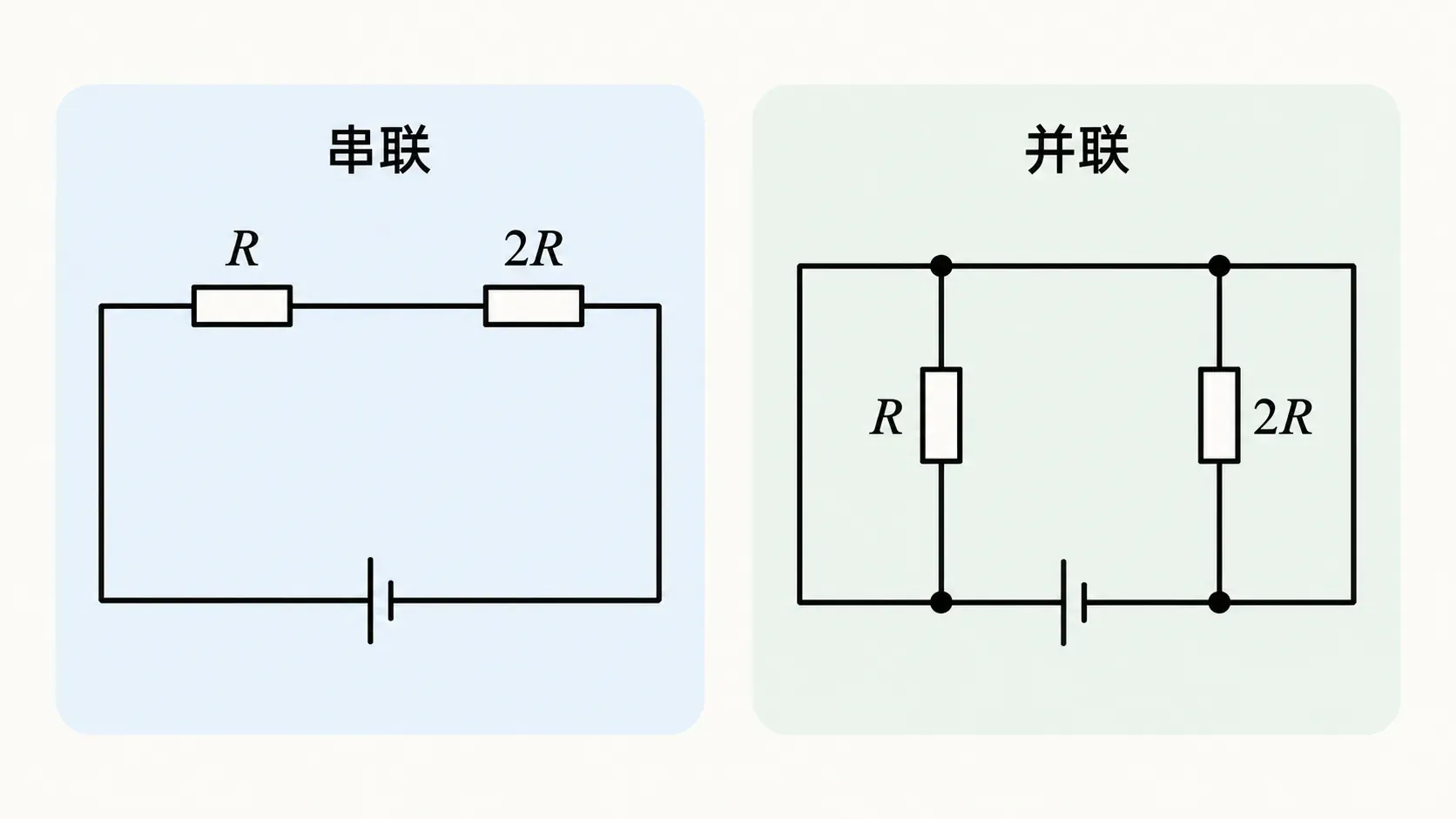 <SingleChoiceQuestion number={6} question="电阻 R 和 3R 串联后通电,相同时间内两者产生的焦耳热之比 Q_R∶Q_3R 为多少?" options={["1∶1", "1∶3", "3∶1", "1∶9"]} answer={1} explanation="串联电流相同,Q=I²Rt,所以焦耳热与电阻成正比,结果为 1∶3。" /> ### 7. 并联电热比较 <SingleChoiceQuestion number={7} question="纯电阻 R 和 3R 并联在同一稳定电压上,相同时间内两者产生的焦耳热之比 Q_R∶Q_3R 为多少?" options={["1∶1", "1∶3", "3∶1", "9∶1"]} answer={2} explanation="并联电压相同,对纯电阻用 Q=U²t/R,焦耳热与电阻成反比,结果为 3∶1。" /> ### 8. 公式适用条件 <MultipleChoiceQuestion number={8} question="关于用电器的功率公式,下列说法正确的是?" options={["P=UI 可用于正常工作的电动机", "P热=I²R 可计算电动机线圈的热功率", "正常工作的电动机一定满足 U=IR", "P=U²/R 可无条件用于一切用电器"]} answers={[0, 1]} explanation="UI 是用电器的输入功率,I²R 是其电阻部分的热功率;非纯电阻用电器正常工作时不能直接使用 U=IR 或 U²/R 计算总功率。" /> ### 9. 电动机的能量账 一台电动机两端电压为 $10\ \text{V}$,通过的电流为 $2.0\ \text{A}$,线圈电阻为 $1.0\ \Omega$。电动机正常工作,忽略除线圈发热以外的损耗。求输入功率、热功率、机械输出功率和效率。 <ClickToShow showText="查看第 9 题解析"> 输入功率 $P_{\text{电}}=UI=20\ \text{W}$;热功率 $P_{\text{热}}=I^2R=4.0\ \text{W}$;机械输出功率 $P_{\text{机}}=20-4.0=16\ \text{W}$;效率 $\eta=16/20\times100\%=80\%$。不能用 $U/R$ 重新计算电流,因为正常转动的电动机是非纯电阻用电器。 </ClickToShow> ### 10. 额定功率与实际功率 一只标有“$12\ \text{V}\quad24\ \text{W}$”的纯电阻用电器,题目认为其电阻保持不变。求它的电阻;若接在 $6\ \text{V}$ 电压上,实际功率是多少? <ClickToShow showText="查看第 10 题解析"> 额定状态下 $R=U_{\text{额}}^2/P_{\text{额}}=12^2/24=6\ \Omega$。接在 $6\ \text{V}$ 电压上,$P_{\text{实}}=U_{\text{实}}^2/R=6^2/6=6\ \text{W}$,是额定功率的四分之一。 </ClickToShow> ### 11. 堵转判断 <MultipleChoiceQuestion number={11} question="一台直流电动机正常转动时突然被卡住,外加电压不变,按中学简化模型判断,下列说法正确的是?" options={["机械输出功率变为零", "可近似按纯电阻处理", "电流通常显著增大", "线圈发热一定减小"]} answers={[0, 1, 2]} explanation="堵转后没有机械能输出,输入电能几乎全部转化为线圈内能;在电压不变时电流往往显著增大,发热更强,存在烧毁风险。" /> ### 12. 综合提升模型 一台电动机以 $U=24\ \text{V}$、$I=2.0\ \text{A}$ 的状态工作,线圈电阻为 $2.0\ \Omega$。它通过轻绳匀速提升 $3.0\ \text{kg}$ 的物体,取 $g=10\ \text{m/s}^2$,忽略其他损耗。求物体上升速度;若工作 $30\ \text{s}$,线圈产生多少热量? <ClickToShow showText="查看第 12 题解析"> 输入功率为 $UI=48\ \text{W}$,热功率为 $I^2R=8\ \text{W}$,机械输出功率为 $40\ \text{W}$。匀速提升时 $mgv=40\ \text{W}$,所以 $v=40/(3.0\times10)=4/3\ \text{m/s}$。工作 $30\ \text{s}$ 产生的焦耳热为 $Q=I^2Rt=2.0^2\times2.0\times30=240\ \text{J}$。 </ClickToShow>