时间、日程与约定
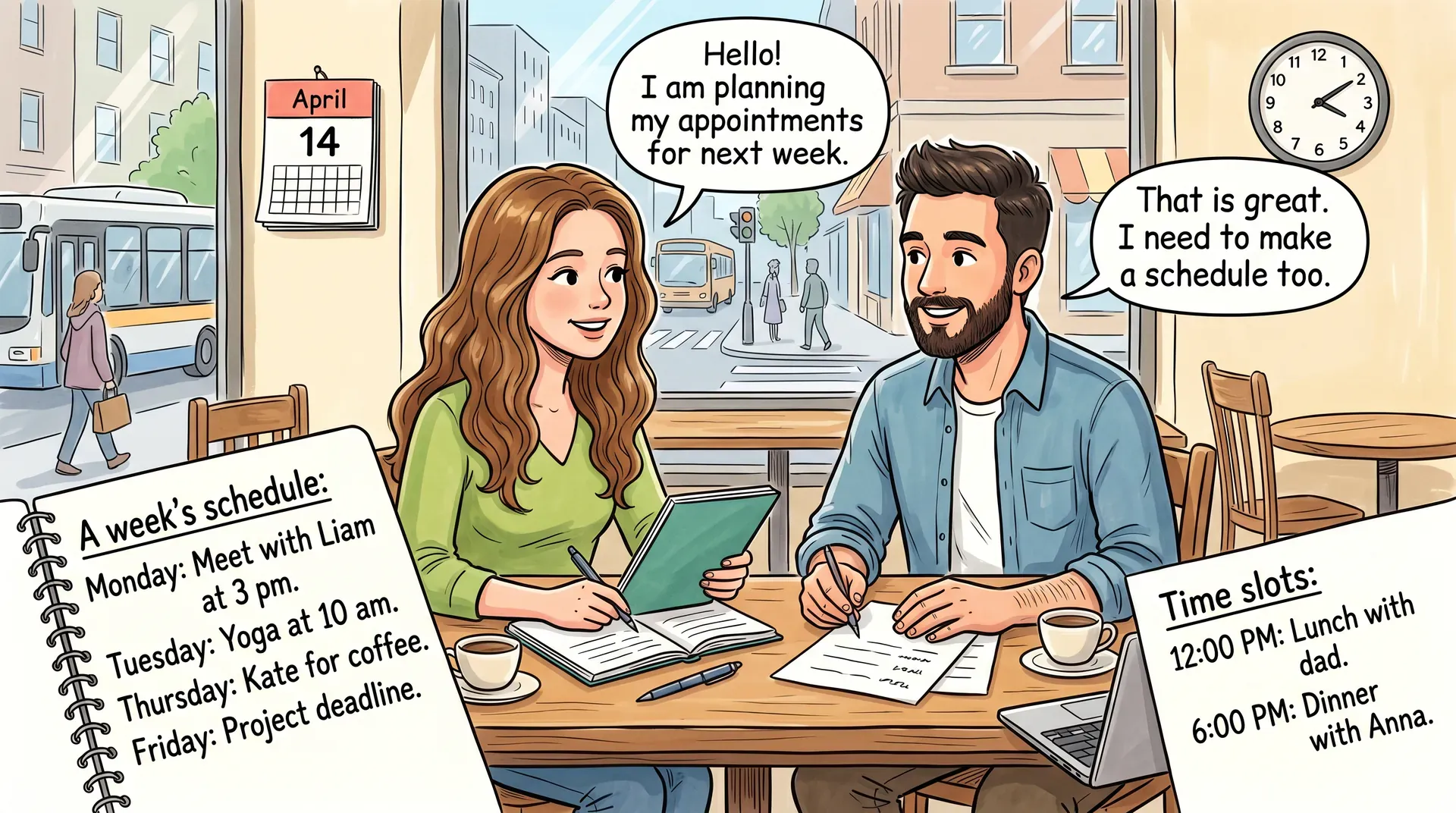
“你周五有空吗?”“我们定在几点?”——这类关于时间和约定的对话在日常英语中出现的频率极高。不论是在工作中安排会议,还是在生活中和朋友约饭、看电影,都离不开这些基本表达。学会用英语自如地询问时间、提议约定、确认细节、以及礼貌地取消或推迟约定,对于提高日常交流能力非常有帮助。
例如,如何优雅地询问对方何时有空?如何主动提出备选时间?如何确认具体的日程?又或者在临时有变时,怎样表达歉意并建议改期?掌握这些技能,能让你的沟通更高效、得体,也给对方留下好印象。无论是职场安排还是私人聚会,时间相关的表达都是英语中非常实用的一环。本章将系统梳理这些实用表达与常见情景,帮助你在各种需要沟通日程的场合都能自信应对。
询问与告知时间
最基础的问时间方式有:
“What time is it?” — 现在几点?
“Do you have the time?” — 你知道现在几点吗?
“Could you tell me what time it is?” — 能告诉我现在几点吗?
“Excuse me, do you happen to know the time?” — 不好意思,请问现在几点?
这些表达在日常生活中都非常常见,有些更正式或更礼貌一些。
“Do you have the time?” 其实问的是“你知道现在几点吗?”,不是“你有时间吗?”——初学者常误解为“Are you free?”。实际在英语中,“Do you have the time?” 相当于 “Could you tell me the time?”,是一种客气的询问方式。
如果你想要询问“你有时间/空闲吗?”,正确的表达应该是 “Are you free?” / “Do you have some free time?” / “Can I have a minute of your time?”,和上面问几点是不一样的。
告知时间的表达:
“It's 3 o'clock.” — 现在是3点整
“It's half past two.” — 现在是两点半(2:30)
“It's a quarter past four.” — 现在是四点一刻(4:15)
“It's a quarter to six.” — 现在是差一刻六点(5:45)
“It's about ten to eight.” — 大约快8点了(7:50左右)
“It's five minutes past nine.” — 现在是9点05分
“It's ten past eleven.” — 现在是11点10分
“It's twenty-five to seven.” — 现在是6点35分(离7点还差25分钟)
“It's almost noon.” — 快到中午了
“It's just after three.” — 刚过三点
补充一点:
- 当问“现在几点”时,英文里不需要用具体的morning/afternoon/evening(上午/下午/晚上),但如果有歧义(如6点是早上还是晚上),可以主动加上“A.M.”(上午)或“P.M.”(下午/晚上)。
- 另:“on the dot”表示“准时、恰好在所说时刻”,不限于整点,如 “Let’s meet at 10 on the dot.”(我们10点整见。)
你也可以说具体的数字,比如 “Two thirty”(2:30)、“Seven fifty-five” (7:55),这种说法在口语中更快、更直接,但常规表达一定要掌握。
提议和确认见面时间
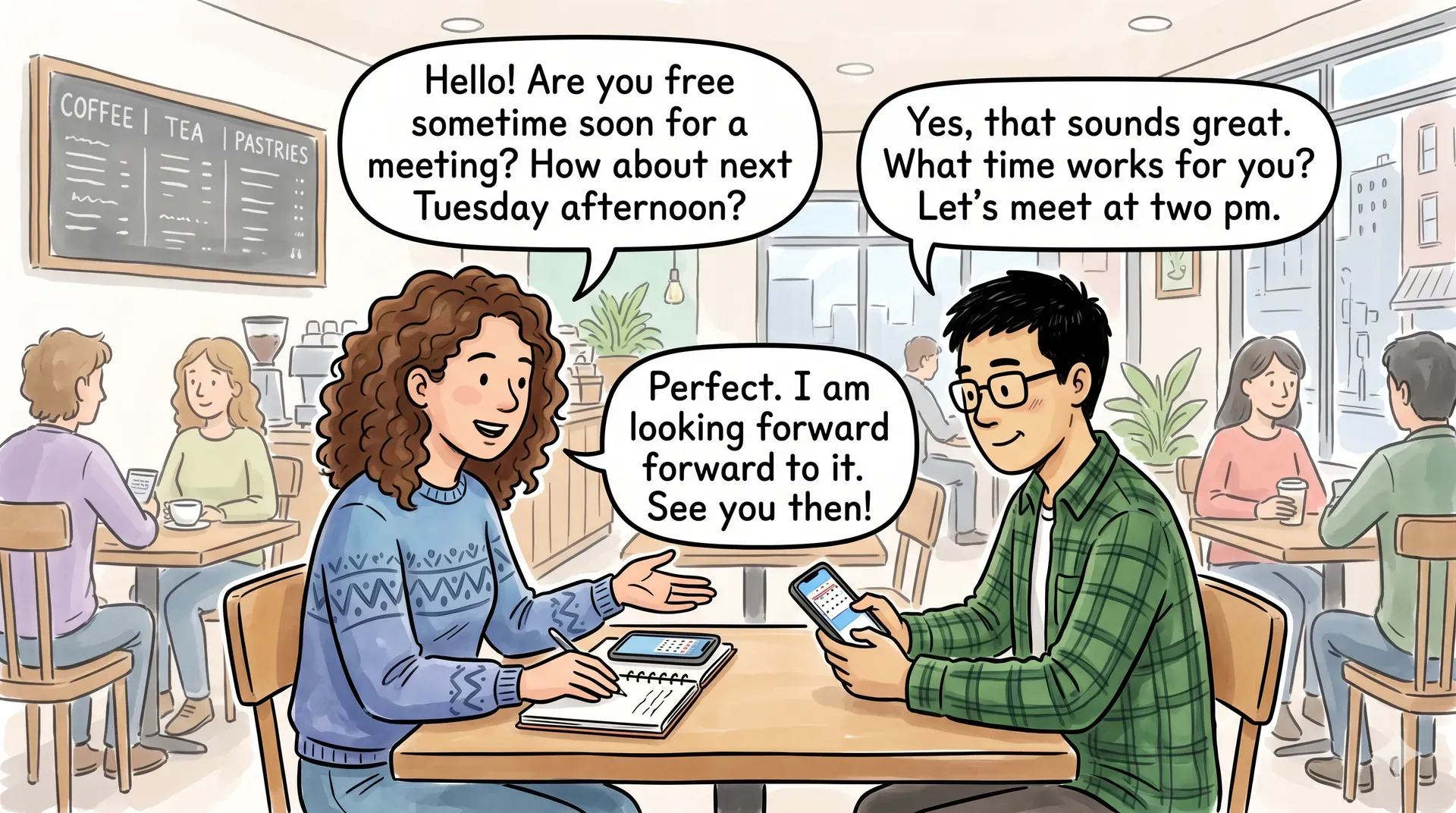
在工作或社交场合安排见面时,礼貌且高效的方式是直接给出明确的时间选项,而不仅仅问一句“Are you free?”。这样既能表达对他人时间的尊重,也更容易快速敲定见面时间。
提议时间(Proposing a Time)
你可以根据具体场景,提出一个或多个备选时间:
“Are you free this Friday afternoon?” — 这周五下午你有空吗?
“How about meeting on Thursday at 2 pm?” — 周四下午两点见怎么样?
“Would Tuesday or Wednesday work better for you?” — 周二还是周三对你更方便?
“I'm free anytime on Monday — what time works for you?” — 我周一全天都有空——你什么时间方便?
“Could we catch up next week, maybe Wednesday or Thursday?” — 我们下周碰个面可以吗?周三或周四怎么样?
“Is there a time that suits you this weekend?” — 这个周末你什么时间方便?
确认时间(Confirming the Time)
对方回复后,可用以下表达确认细节,或表达灵活性:
“Does 3 pm on Friday work for you?” — 周五下午3点对你合适吗?
“Is that time okay with you?” — 那个时间你方便吗?
“Let me check my calendar... Yes, I'm free at that time.” — 我看下我的日历……是的,那个时间我有空
“Just to confirm, we’re meeting at 2 pm on Thursday, right?” — 确认一下,我们周四下午2点见,对吗?
“If you prefer another time, just let me know.” — 如果你更喜欢其他时间,随时告诉我。
接受提议(Accepting the Suggestion)
表达接受、肯定和感谢的方式:
“That works for me!” — 我可以!
“Friday at 3 sounds great.” — 周五3点很好
“I'll put it in my calendar.” — 我记到日历上了
“Looking forward to it!” — 很期待!
不能接受提议(Declining or Negotiating)
如果时间不合适,要委婉说明,并主动协商新时间,显示出合作意愿:
“I'm afraid I'm busy at that time. Could we do it a bit later?” — 那个时间我恐怕有事,能稍晚一点吗?
“I have a meeting on Thursday morning. How about the afternoon?” — 周四上午我有会,下午怎么样?
“That's a bit early for me — could we make it 11 am instead?” — 那时候对我来说太早了——能改成上午11点吗?
“Sorry, I'm tied up on Wednesday. Is Thursday still possible?” — 不好意思,周三我抽不开身。周四还可以吗?
“I won’t be available this weekend, but next week works.” — 这个周末不行,下周可以。
补充说明
- 在正式邮件或工作通讯工具中,如果约的对象比较重要,建议一次性给出多个可选时间,让对方选。例如:“I’m available on Monday after 3 pm, or Tuesday morning. Let me know which works for you.”
- 若对方未及时回复,可礼貌跟进:“Just following up to see if any of the proposed times work for you.”
- 安排线上会议还可加上一句:“If needed, I can send a meeting link.”
对话示范:安排一次见面
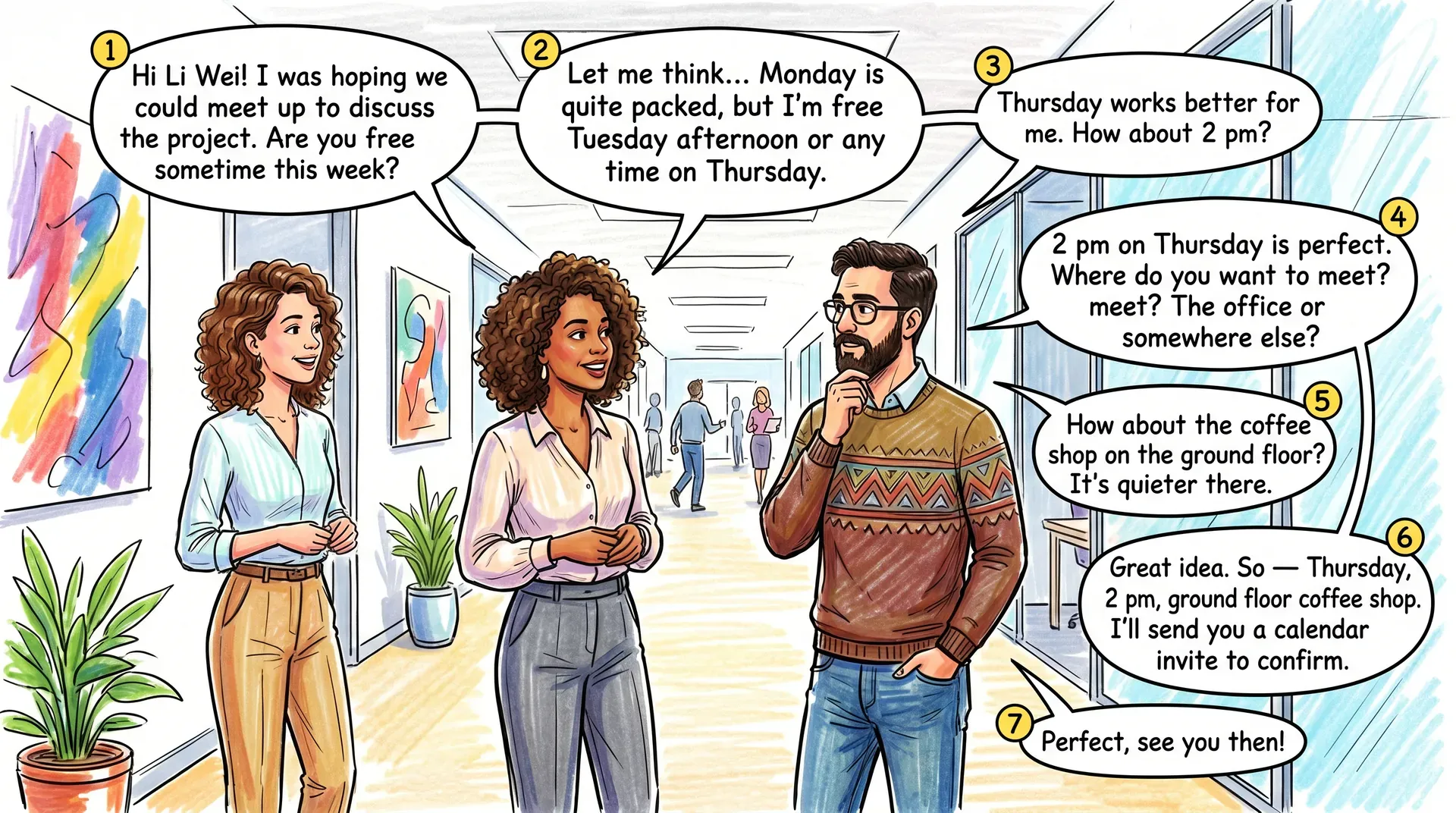
A: Hi Li Wei! I was hoping we could meet up to discuss the project. Are you free sometime this week?
(嗨,李维!我想约你谈谈项目的事。这周你有空吗?)
B: Let me think... Monday is quite packed, but I'm free Tuesday afternoon or any time on Thursday.
(我想想……周一排得很满,但周二下午或者周四任何时间我都有空。)
A: Thursday works better for me. How about 2 pm?
(周四对我更方便。下午两点怎么样?)
B: 2 pm on Thursday is perfect. Where do you want to meet? The office or somewhere else?
(周四下午两点很好。在哪里见?办公室还是其他地方?)
A: How about the coffee shop on the ground floor? It's quieter there.
(一楼的咖啡馆怎么样?那里比较安静。)
B: Great idea. So — Thursday, 2 pm, ground floor coffee shop. I'll send you a calendar invite to confirm.
(好主意。那就——周四,下午两点,一楼咖啡馆。我发一个日历邀请来确认。)
A: Perfect, see you then!
(太好了,到时见!)
表达解析:
“Monday is quite packed”——“packed”在这里是"排满了"的意思,是非常地道的描述繁忙日程的口语说法,比“I'm very busy on Monday”更自然。
“I'll send you a calendar invite”——现代职场常见的做法,给对方发一个日历邀请(Calendar invite),对方接受后双方的日历都会有这个约定记录。
确认与提醒
重要的约定,在临近时间时确认一遍是非常好的职场习惯,既体现出重视,也有助于避免误会。你可以用以下表达:
“Just checking in — we're still on for tomorrow at 3, right?”
(只是确认一下——明天下午三点的约定还是有的,对吧?)
“A quick reminder: we have a meeting tomorrow morning at 10.”
(快速提醒一下:明天上午十点我们有个会议。)
“I just wanted to confirm our lunch tomorrow at noon.”
(我想确认一下我们明天中午的午饭。)
如果想表达更加正式或礼貌,可以说:
“I wanted to reconfirm our call scheduled for tomorrow at 11 am. Please let me know if anything has changed.”
(我想再次确认一下我们约的明天上午11点的电话,如有变动请告知。)
“Please let me know if you’re still available for our meeting on Friday afternoon.”
(请告知周五下午我们的会议是否仍然安排在原时间。)
小贴士
- 确认邮件或消息通常可以在前一天或约定当天早上发出,避免对方遗忘。
- 遇到重要的谈判、面试、客户约定等场合,确认尤其重要。
- 除了“reminder(提醒)”、“confirm(确认)”,还可以用“double-check”、“follow up on”等表达。
取消与推迟约定
有时候临时有变,需要礼貌地取消或推迟:
取消约定
“I'm so sorry, but I'm afraid I have to cancel our meeting tomorrow.”
(非常抱歉,我恐怕明天的会面需要取消。)
“Unfortunately, something urgent has come up and I won’t be able to make it.”
(很遗憾,临时有急事,我没法参加了。)
“Something came up at the last minute. I'm really sorry for the short notice.”
(临时有事。非常抱歉这么晚才通知你。)
“I feel terrible about this — could we reschedule?”
(我很抱歉——我们能改个时间吗?)
推迟约定
“I'm running a bit late — I'll be there around 3:15 instead of 3.”
(我稍微晚了一点——我大概3:15到,不是3点。)
“Could we push the meeting back by an hour?”— 会议能推迟一个小时吗?
“I can't make it at 2 pm, but I could do 4 pm — would that work?”
(我2点不行,但4点可以——那样可以吗?)
“If it’s not too much trouble, can we reschedule our appointment for later this week?”
(如果不麻烦的话,我们可以把约定改到本周晚些时候吗?)
“My apologies, but could you let me know your availability for another time?”
(很抱歉,能否请你告诉我其他合适的时间?)
补充说明
- 取消约定时,“I'm sorry for the short notice”(抱歉这么晚才通知)是一个很重要的礼貌用语。越临时的取消,越需要这句话——它表示你意识到这给对方造成了不便,并且真诚道歉。
- 好的做法是同时提出一个替代时间,这样对方知道你仍然重视这个约定,比如:“Would next Tuesday work for you instead?”(下周二可以吗?)
- 对于需要多次变动的情况,可以表达感谢对方的理解和配合,如:“Thank you for your flexibility!” 或 “I appreciate your understanding.”
日期和时间相关信息
| 单词/短语 | 含义 | 示例句 |
|---|---|---|
| schedule | 日程表 | What's on your schedule? (你日程如何?) |
| appointment | 预约(正式) | I have a dentist appointment. (我有牙医预约。) |
| meeting | 会议/见面 | Let's have a project meeting. (安排项目会议吧。) |
| catch up | 叙旧(非正式) | Let's catch up soon. (找机会聊聊吧。) |
| get-together | 聚会 | We're having a get-together Friday. (周五有聚会。) |
| reschedule | 重新安排 | Can we reschedule our call? (电话能改时间吗?) |
| postpone | 推迟 | The meeting is postponed. (会议推迟了。) |
| cancel | 取消 | I need to cancel our lunch. (得取消午饭。) |
| confirm | 确认 | Please confirm the booking. (请确认预订。) |
| remind | 提醒 | Can you remind me tomorrow? (明天提醒我吗?) |
| available | 有空的 | Are you available on Monday? (周一有空吗?) |
练习题
练习一(选择题)
知识点:“Do you have the time?”的正确含义
同事突然问你“Do you have the time?”,这句话的意思是:
A. 你有空来帮我一下吗?
B. 你知道现在几点吗?
C. 你这个项目有时间完成吗?
D. 你今天有什么安排?
练习二(选择题)
知识点:礼貌拒绝约定时间并提出替代方案
朋友约你周五下午三点见面,但你那个时间有事,下面哪个回应最礼貌且有建设性?
A. No, I can't.
B. I'm busy.
C. I'm afraid I'm busy at 3 on Friday. Could we meet at 5 instead?
D. Friday doesn't work.
练习三(选择题)
知识点:英语时间表达法
“It's a quarter to seven.”表示的是几点?
A. 7:15
B. 6:45
C. 7:45
D. 6:15
练习四(情景问答)
知识点:安排一次会面并确认细节
情境: 你需要和一个刚认识的商务联系人 Michael 约时间见面,讨论一个合作机会。你本周一、三下午有空,周二全天有空。请用英语发一条约见消息(可以是短信或邮件开头的方式),包含:① 说明约见目的 ② 给出你的可用时间 ③ 请对方确认哪个时间方便
练习五(情景问答)
知识点:临时取消约定的礼貌表达
情境: 你和朋友约好明天下午两点一起去看电影,但今天下午突然接到通知,明天必须去公司处理紧急事务。请用英语给朋友发一条消息取消约定,包含:① 道歉并说明情况 ② 表达遗憾 ③ 提出改期的意愿