比较与对比
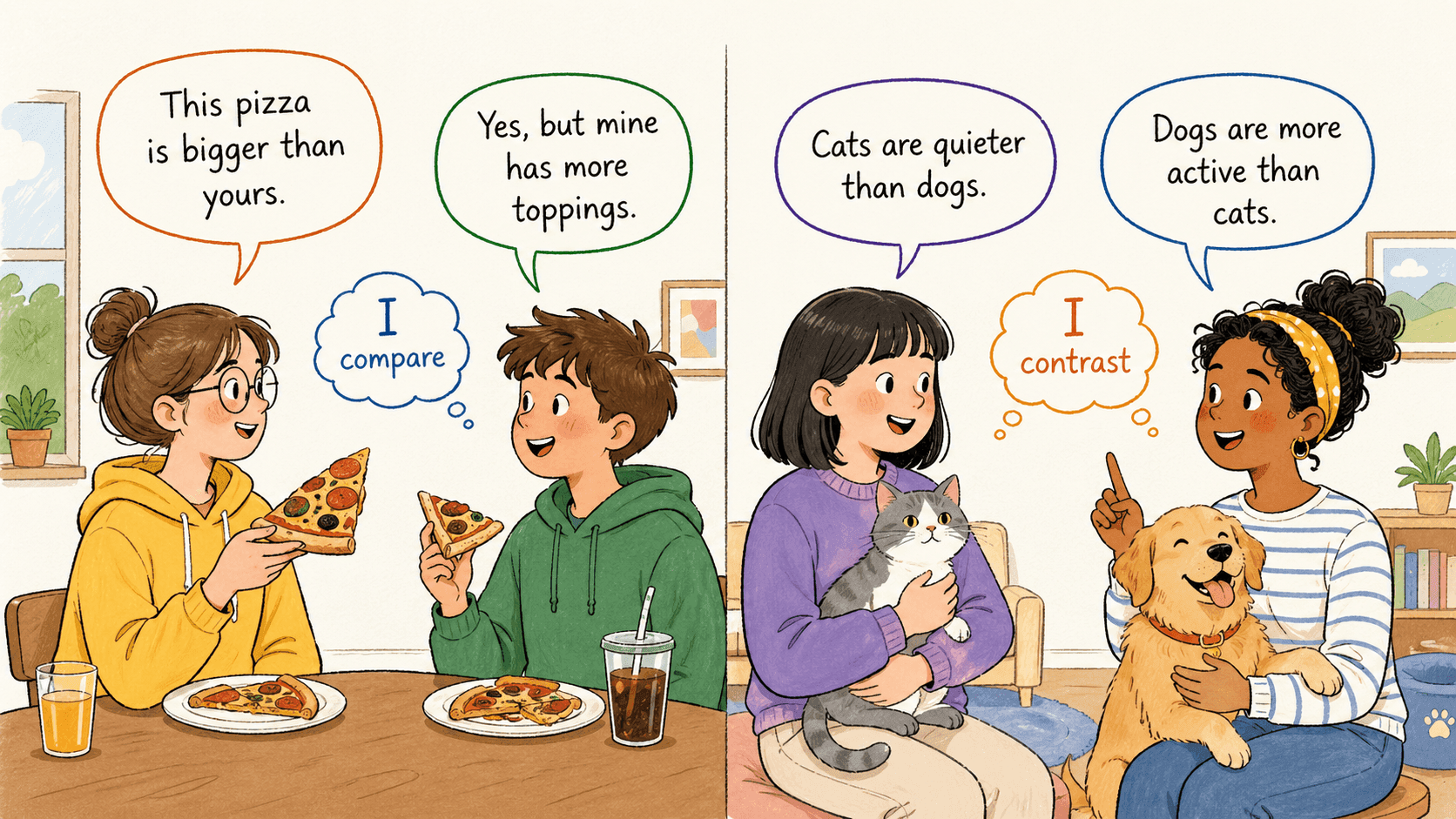
在日常英语交流中,“比较”无处不在。我们经常会拿不同的品牌、产品、城市、生活方式、饮食习惯,甚至人和人之间的性格特点等方方面面做对比。例如,选择手机时,会关注哪一款更好用、更便宜、性能更强大,或者续航时间更长;讨论工作方式时,会比较远程办公和在办公室的优缺点,比如哪个更灵活,沟通效率高低如何,通勤是否方便等;朋友之间评价食物,也常说“这道菜比上次吃的还美味”“这家餐厅比那家环境更安静”。甚至在旅游时,我们也会拿不同的城市、景点做比较,比如“这个地方比上海更适合居住”或者“那座山比这座高”。
准确地表达比较不仅可以让你的观点更清晰、有条理,还能让你在讨论、说明理由甚至辩论时,表达更有说服力。英文中有很多地道而多样的比较表达方式和结构,能够帮助你描述差异、强调优势或中立地陈述不同之处。掌握这些表达法,能够大大丰富你的语言层次,让你的交流更加生动自然,也更容易让对方理解你的立场或感受。
比较级与最高级
在英语中,比较级(Comparative)和最高级(Superlative)是形容词和副词中非常常用的变形。它们帮助我们比较两个事物之间或三个及以上事物之间的差异。掌握这些基本句型能大幅提升表达的准确性与丰富性。
比较级(Comparative)
多数单音节及部分双音节形容词:比较级通常加 -er,并按词尾规则调整拼写
例子:
- “tall → taller”
- “cheap → cheaper”
- “busy → busier”
例句:
“This café is cheaper than the one near the office.”
(这家咖啡馆比办公室附近的那家便宜。)
拼写变化提示:
- 以辅音字母+y结尾的形容词,先变y为i,再加-er:easy → easier, busy → busier
- 以单辅音字母结尾且前面是单元音时,双写最后的辅音字母再加-er:big → bigger, hot → hotter
多音节及部分双音节形容词:前面加 more,如 more careful、more modern
例子:
- “comfortable → more comfortable”
- “expensive → more expensive”
例句:
“The new phone is more expensive but much more durable.”
(新手机更贵,但耐用多了。)
短副词与短形容词相同,如“fast → faster”,“hard → harder”。
最高级(Superlative)
短形容词:词尾加 -est,并在前面加定冠词 the
例子:
- “small → the smallest”
- “tall → the tallest”
长形容词:在前面加 the most
例子:
- “comfortable → the most comfortable”
- “important → the most important”
例句:
“This is the cheapest option on the menu.” 这是菜单上最便宜的选择。
“It's the most convenient route to the airport.” 这是去机场最方便的路线。
拼写变化提示(同上,注意y和辅音字母双写的变化):
- happy → the happiest
- big → the biggest
副词的最高级也类似:
- fast → the fastest
- carefully → the most carefully
不规则比较级和最高级
有一些常用的形容词和副词的比较级和最高级属于不规则变化,没有规律可循,需要单独记忆。
这些词在比较和最高级变化时不能简单地加 -er 或 more,需要特别留意和熟练掌握。例句:
- “This restaurant is better than the one next door.” (这家餐厅比隔壁那家更好。)
- “He is the best player on the team.” (他是队里最好的球员。)
常见错误:
- 双重比较(Double Comparative):“This is more cheaper.”这种说法是错误的——比较级和“more”不能同时用。应该说“This is cheaper.”或“This is less expensive.”
- 最高级冗余:“the most tallest”也不对,正确是“the tallest”。
- 忘记加 than/the:“She is taller than me.”(别忘了than),“He is smartest in the class.”(最高级前要加the:He is the smartest in the class.)
表达差异的程度
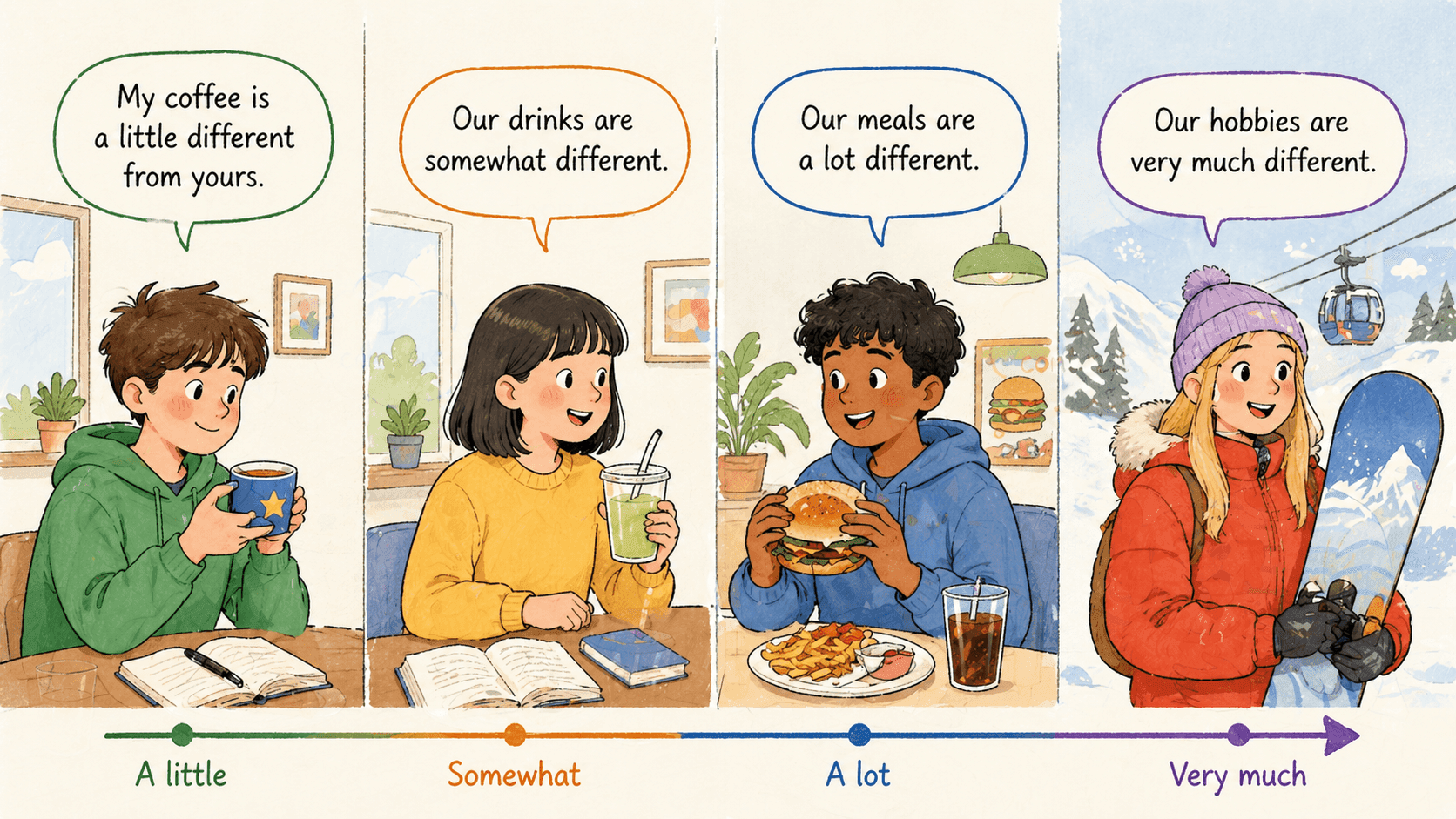
比较的时候,往往并不仅仅是简单的“A 比 B 好”这种表述,如何描述差距的“大小”可以让你的英文更加地道、具体和有说服力。下面是表达差异“程度”的常见方法,还有一些常见的程度副词和倍数表达:
1. “much / far / a lot / way + 比较级” —— 表示差距很大
用法:在比较级前加上这些副词,强调程度之大。
例句:
- “The new version is much faster than the old one.”
(新版本比旧版本快多了。) - “The problem is far more complicated than we expected.”
(这个问题比我们预想的要复杂得多。) - “Their solution is a lot cheaper than ours.”
(他们的方案比我们的便宜多了。) - “The second method is way better.”
(第二种方法好太多了。 way 表示“非常/极其”,很口语)
2. “a bit / slightly / a little + 比较级” —— 表示差距不大
用法:放在比较级前,表示“略微、稍微”之意,表达细微的区别。
例句:
- “The second option is slightly more expensive, but the quality is noticeably better.”
(第二个选项稍微贵一点,但质量明显更好。) - “This chair is a bit more comfortable.”
(这把椅子稍微更舒服一些。) - “My apartment is a little bigger than yours.”
(我的公寓比你的稍微大一些。)
3. 倍数比较:“twice / three times / half as + 形容词/副词 + as...”
用法:在形容词前加上倍数,或用“half as...as”表示一半。
例句:
- “The apartment is twice as large as my current one.”
(这套公寓比我现在住的大一倍。) - “It takes three times as long to get there by bus.”
(坐公共汽车去那里要花三倍的时间。) - “This phone is half as expensive as the old model.”
(这款手机的价格只是旧型号的一半。)
4. 显著/明显差距副词
- significantly, considerably, noticeably, substantially, dramatically
- 放在比较级之前,突出强调对比的变化更大、更明显、更重要。
例句:
- “The new process is significantly more efficient.”
(新流程高效得多。) - “Her English has improved considerably over the past year.”
(她的英语在过去一年进步了很多。)
这些副词能帮助你表达“多了”、“差一点”、“倍数”、“显著不同”等多层次的比较,从而让你的表达更加丰富和有层次感。
对话示范:比较两个选择
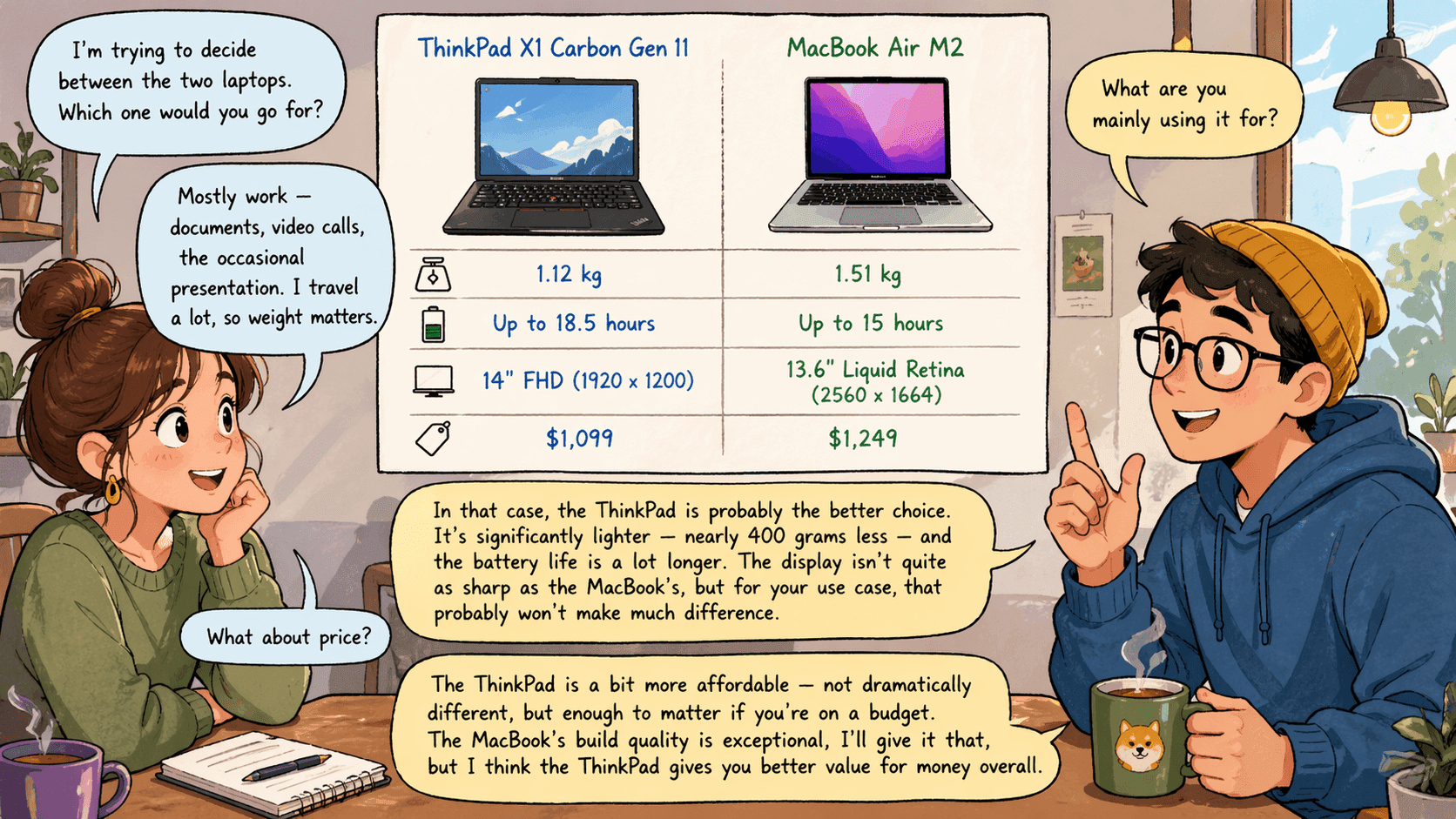
A: I'm trying to decide between the two laptops. Which one would you go for?
(我在考虑这两台笔记本电脑。你会选哪一台?)
B: What are you mainly using it for?
(你主要用来做什么?)
A: Mostly work — documents, video calls, the occasional presentation. I travel a lot, so weight matters.
(主要是工作——文件、视频通话,偶尔做演示。我经常出差,所以重量很重要。)
B: In that case, the ThinkPad is probably the better choice. It's significantly lighter — nearly 400 grams less — and the battery life is a lot longer. The display isn't quite as sharp as the MacBook's, but for your use case, that probably won't make much difference.
(那样的话,ThinkPad 可能是更好的选择。它明显更轻——轻了将近400克——而且续航时间长多了。显示屏不如 MacBook 的那么清晰,但对于你的使用场景来说,这可能不会有太大影响。)
A: What about price?
(价格呢?)
B: The ThinkPad is a bit more affordable — not dramatically different, but enough to matter if you're on a budget. The MacBook's build quality is exceptional, I'll give it that, but I think the ThinkPad gives you better value for money overall.
(ThinkPad 稍微便宜一点——差距不是很大,但如果你有预算限制的话还是有意义的。MacBook 的做工质量确实很出色,这点我承认,但我认为 ThinkPad 整体来说性价比更好。)
表达解析:
“Significantly lighter”——“significantly”表示差距显著,比“much lighter”更正式,也更有说服力。
“It's not quite as sharp as...”——这是“as...as”的否定用法,“not as sharp as”意思是“不如……清晰”,是做对比时非常常用的结构。
“I'll give it that”——口语中用来承认对方某个优点确实存在,“这点我承认”,即使整体上你不同意或倾向不同选择,这个短语展示了客观和公正。
“Better value for money”——“value for money”是衡量“性价比”的固定短语,是购物和评价讨论中极其常用的表达。
对比结构:表达相似与不同
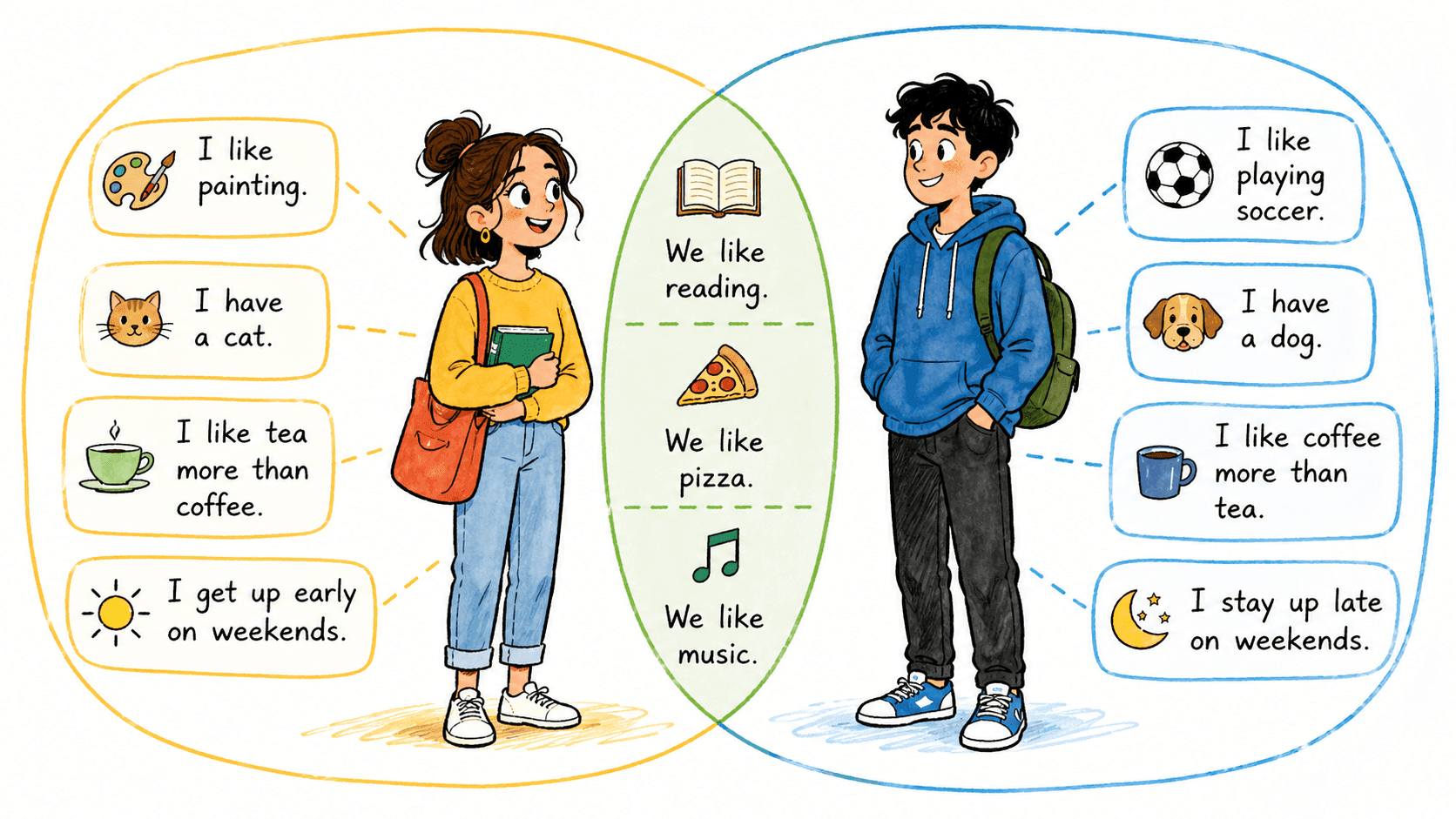
比较是英语表达中非常常见的结构,既可以用于具体事物之间的对比,也可以用于观点、特征、趋势等更抽象的比较。常见表达方式如下:
表达相似
- “Both A and B...” — A 和 B 都……
Both smartphones have long battery life. (两款手机电池寿命都很长。)
- “A is similar to B in that...” — A 和 B 相似之处在于……
This movie is similar to the book in that both focus on friendship. (这部电影和那本书的相似之处在于两者都关注友谊。)
- “Like A, B also...” — 和 A 一样,B 也……
Like her brother, she also enjoys playing tennis. (和她哥哥一样,她也喜欢打网球。)
- “A and B have a lot in common.” — A 和 B 有很多共同点
Cats and dogs have a lot in common as pets. (作为宠物,猫和狗有很多共同点。)
- “Neither A nor B...” — A 和 B 都不……
Neither my sister nor my parents like spicy food. (我妹妹和我的父母都不喜欢辛辣食物。)
- “Just as A does..., so does B.” — 正如 A ……,B 也是如此
Just as reading helps you relax, so does listening to music. (正如阅读有助于你放松,听音乐也是如此。)
- “The same goes for...” — ……也是一样
The rule applies to students. The same goes for teachers. (这项规定适用于学生,教师也是一样。)
表达不同
- “A is quite different from B.” — A 和 B 相当不同
Living in the city is quite different from living in the countryside. (生活在城市与生活在农村是非常不同的。)
- “Unlike A, B...” — 与 A 不同,B……
Unlike the iPhone, Android phones allow for more customization. (与 iPhone 不同,安卓手机允许更多自定义。)
- “While A is [形容词], B is [形容词].” — A 是……,而 B 是……
While English is simpler in terms of grammar, Chinese is more complex in writing. (在语法方面,英语更简单,而汉语在书写方面更复杂。)
- “A tends to be more [形容词], whereas B is generally [形容词].”
Coffee tends to be more popular in the West, whereas tea is generally favored in the East. (咖啡在西方更受欢迎,而茶则通常在东方受到青睐。)
- “The key difference between A and B is...” — A 和 B 之间的关键区别是……
The key difference between these two brands is their customer service. (这两个品牌之间的关键区别在于它们的客户服务。)
- “In contrast, ...” — 相比之下……
Cars pollute the environment; in contrast, bicycles are environmentally friendly. (汽车会污染环境;相比之下,自行车则非常环保。)
- “On the other hand, ...” — 另一方面……
Buying a car is convenient. On the other hand, it can be expensive to maintain. (买车很方便;另一方面,养车可能很贵。)
用比较表达观点和推荐
比较不仅可以用来客观比较,还可以用来表达主观观点和推荐。以下是一些常用表达:
-
“In my opinion, online learning platforms are far superior to traditional classrooms when it comes to flexibility.”
(在我看来,在灵活性方面,在线学习平台远胜于传统教室。) -
“On balance, I think A is the better option.”
(综合来看,我认为 A 是更好的选择。) -
“It really depends on what matters most to you.”
(这真的取决于你最看重什么。) -
“If I had to choose, I'd go with online learning — mainly because of its flexibility and convenience.”
(如果必须选择,我会选在线学习,主要因为其灵活性和便利性。) -
“They're both good in different ways, but A suits your needs better.”
(两者各有优点,但 A 更适合你的需求。) -
“For me personally, online learning stands out because it allows me to study at my own pace and fits my busy schedule.”
(对我个人而言,在线学习更突出,因为它让我可以按照自己的节奏学习,并且适合我忙碌的时间安排。)
比较文化与生活方式
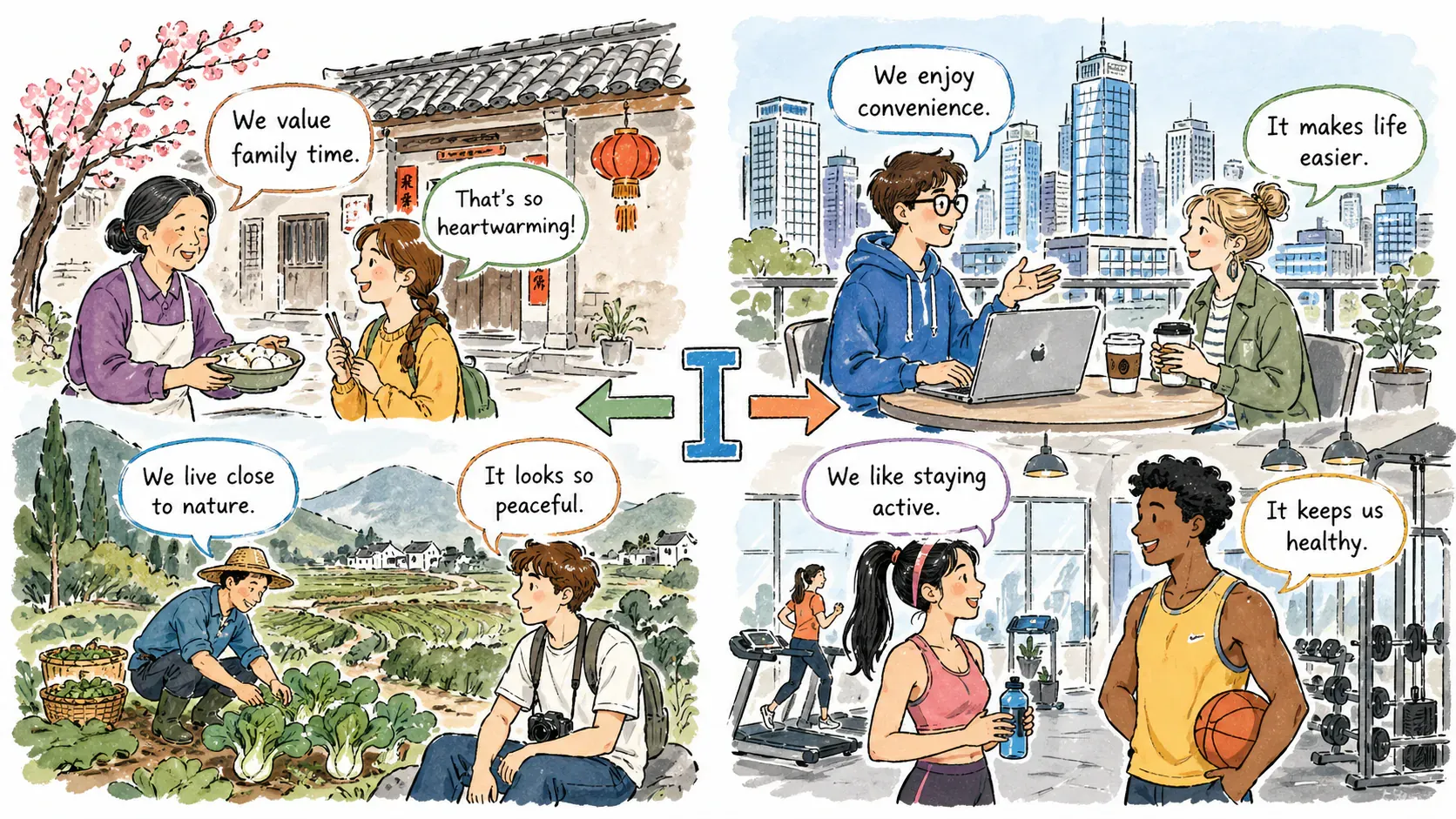
比较还常用于更大的话题,比如文化、生活方式、社会现象、年代差异等。常见表达结构包括:
-
“Life in the city tends to be more fast-paced compared to the countryside.”
(和农村相比,城市生活往往节奏更快。) -
“In contrast to Western-style direct communication, many Asian cultures value indirect expression.”
(与西方式的直接沟通相比,很多亚洲文化更看重间接表达方式。) -
“Compared to a decade ago, people's attitudes towards work-life balance have shifted considerably.”
(与十年前相比,人们对工作与生活平衡的态度发生了显著变化。) -
“Unlike in the past, now more young people prefer freelancing to traditional office jobs.”
(与过去不同,如今更多年轻人偏好自由职业而非传统的办公室工作。)
语言要点:
- 在讨论文化差异时,英语中常常使用“tend to”、“in general”、“typically”等表达,以避免绝对化陈述。
- 比如,“Chinese people value...” 可替换为 “People in China tend to value...”,显得更礼貌、更准确。
- “tend to” 表示“倾向于”,比较委婉,留有余地,避免过度概括。
补充例句
-
“Both cities have their unique charm, but Beijing is much older than Shanghai.”
(两座城市各有其独特魅力,但北京比上海要古老得多。) -
“Unlike high school, university requires more independent learning.”
(与高中不同,大学需要更多的自主学习。) -
“Neither solution is perfect, but the first one is more practical.”
(两个方案都不完美,但第一个更切实际。) -
“The key similarity between these sports is teamwork.”
(这些运动之间的主要相似点是团队合作。)
这些结构和例句可以帮助你在实际对话和写作中更灵活地比较、分析各种事物,表达自己的看法和偏好。
练习题
练习一(选择题)
知识点:比较级的正确形式
“这部电影比原著书有意思多了。”请选出正确的英语表达:
A. The movie is more interesting much than the book.
B. The movie is much more interesting than the book.
C. The movie is more interesting than much the book.
D. The movie is much interesting more than the book.
练习二(选择题)
知识点:“not as...as”的用法
你想表达“这家餐厅没有之前那家贵”,最地道的说法是?
A. This restaurant is less expensive than the previous one.
B. This restaurant is not as expensive as the previous one.
C. This restaurant is cheaper than the previous one.
D. A、B、C 都正确,且含义相同
练习三(选择题)
知识点:“unlike”与“similar to”的区别
你想说“和上海不同,成都节奏更慢”,正确的说法是?
A. Similar to Shanghai, Chengdu has a slower pace of life.
B. Unlike Shanghai, Chengdu has a much more relaxed pace of life.
C. Like Shanghai, Chengdu tends to be more laid-back.
D. Both Shanghai and Chengdu have a relaxed pace of life.
练习四(情景问答)
知识点:做出有依据的比较推荐
情境: 你的朋友正在考虑是住在市区(city center)还是郊区(suburbs),向你征求意见。请用英语给出你的观点(5-7句话),对两个选项做比较,并给出你的推荐和理由。
练习五(情景问答)
知识点:比较两种学习方式或工作方式
情境: 请比较“在线学习”和“线下课堂学习”这两种方式,各自的优劣是什么?你个人更倾向哪种方式?请用英语表达(6-8句话)。