名词性从句
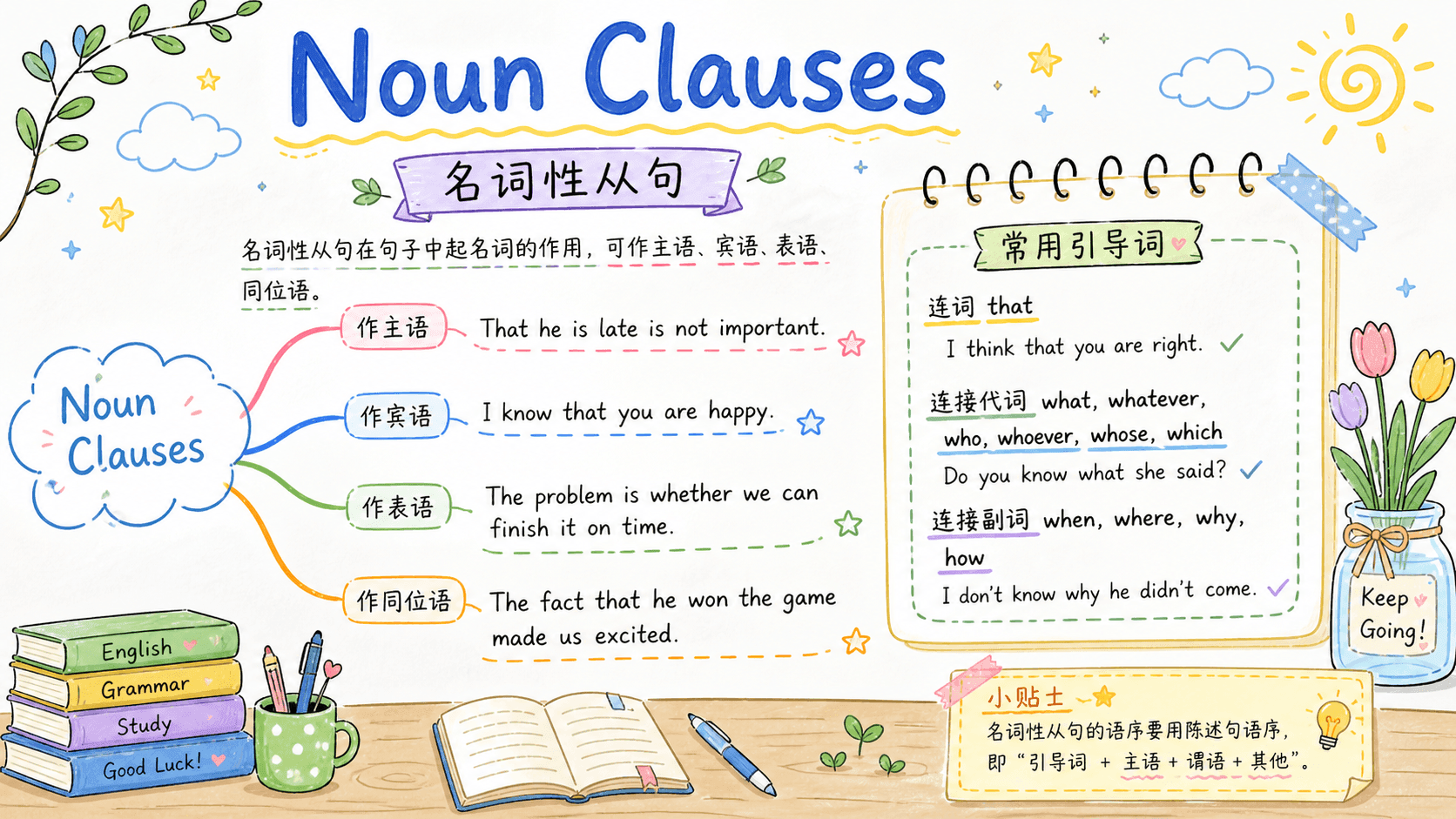
所谓“从句”,就是在一个主句中嵌入另一个带有主谓结构的句子,让它在整个句子中充当某种成分。英语中有多种从句类型,其中“名词性从句”是一类极为常见且重要的结构。名词性从句的本质,是用一个句子来代替名词,承担句子中本该由名词出现的位置。这样的从句可以作主语、宾语、表语等成分。例如:
- 作主语:What you said is true.(你说的话是真的。整个 what you said 作为句子的主语)
- 作宾语:I don't know when she will arrive.(我不知道她什么时候到。when she will arrive 作为 know 的宾语)
- 作表语:The problem is that we don't have enough time.(问题是我们没有足够的时间。that we don't have enough time 作为表语说明 the problem)
名词性从句不仅能表达复杂想法,还让句子结构更丰富灵活。理解这种结构的关键在于体会“这个从句在句子里承担了原本属于名词的作用”,而不是单纯去背诵格式或引导词。掌握并灵活运用名词性从句,可以大幅提升表达抽象概念、意见、假设等复杂内容的能力,无论是在写作还是日常交流中都非常重要。
宾语从句
宾语从句在句子中充当宾语——它代替了一个普通名词宾语的位置。也就是说,原本用于承接动作的宾语,不再是单独的一个名词,而是一个由主谓结构组成的句子,描述一件完整的事情、一个想法或某种情况。宾语从句的出现让句子可以表达更复杂的内容,也是英语写作和表达中极为常用的结构。
That 引导的宾语从句
最常见的宾语从句由 that 引导,that 在口语和非正式写作中常常可以省略,但在正式写作中保留that可使语句更清晰。that 引导的宾语从句常常承接“认知类”动词,如 think, believe, know, say 等。
I believe (that) hard work always pays off in the end.
我相信努力终究会有回报。(that 可省略,但从句结构不变;believe 后接整个“努力会有回报”这件事作宾语)
She said (that) she would come to the meeting.
她说她会来参加会议。(said 后接她说的内容作宾语)
We know (that) the Earth moves around the Sun.
我们知道地球绕着太阳转。
常见的引导宾语从句的主句动词有:think / believe / know / say / hope / expect / feel / find / discover / agree / understand / suggest / remember / promise 等。这些动词表达“认知、感受、陈述、表达观点”等含义。例如:
-
I hope (that) you can come to my party. (我希望你能来参加我的聚会。)
-
Scientists have discovered (that) water exists on Mars. (科学家们已经发现火星上存在水。)
-
He promised (that) he would finish his work on time. (他承诺会按时完成工作。)
疑问词引导的宾语从句
宾语从句也可以由特殊疑问词(what / where / when / how / why / who 等)或“是否”类词(whether / if)引导。当主句内容涉及未知、疑问或需要解释的情况时,这些疑问词会引导一个完整的从句作为宾语。注意,这时从句表达的是“事情本身”,不是一个真正的问句。
I don't know where she went after the meeting.
我不知道她会议结束后去哪里了。(where 引导宾语从句,从句用陈述语序:she went,不是 where did she go)
Can you tell me how this machine works?
你能告诉我这台机器怎么工作吗?(how 引导宾语从句,陈述语序:this machine works)
Please explain why you were late.
请解释一下你为何迟到了。
还可以用 whether / if 引导“是否”类的宾语从句,表达不确定或二选一的情况。两者可在多数情况下互换,但正式写作及搭配 to do 时常用 whether。
- I wonder whether/if he will come tomorrow.(我想知道他明天是否会来。)
- She hasn't decided whether to go abroad next year.(她还没决定明年是否出国。)
语序注意:疑问词引导的宾语从句一定要用陈述语序(主语 + 谓语),不能用原来的疑问语序。错误例句:“I know where is she.”,正确用法是 “I know where she is.”。
- I can't remember what he said at the meeting. (我记不清他在会议上说了什么。)
- Do you know when the movie starts? (你知道电影什么时候开始吗?)
- Tell me who broke the window. (告诉我谁打破了窗户。)
时态一致规则
在英语宾语从句中,有一个非常重要的时态一致规则:如果主句是过去时态,从句的时态在大多数情况下要“顺次往过去推一格”。也就是说:主句发生在过去,从句里的动作或事实通常也应该用相应的过去时态来表达。这不仅适用于简单句型,各类从句也遵循这一规律。
具体时态的“推移”方案:
常见时态转换举例
- 一般现在时(is/are/do/does)→ 一般过去时(was/were/did)
- 现在进行时(is/are doing)→ 过去进行时(was/were doing)
- 现在完成时(has/have done)→ 过去完成时(had done)
- 一般将来时(will do)→ 过去将来时(would do)
- can → could
- may → might
例句与讲解
-
He said he was tired.(不是 He said he is tired.)
他说他累了。(主句 said 是过去时,从句 is → was)
-
She told me she would call back later.(不是 she will call back)
她告诉我她会稍后回电。(主句 told 是过去时,will → would)
-
I didn't realize that the store had already closed.(不是 has closed)
我没意识到商店已经关门了。(主句过去时,has done → had done)
-
They thought they could solve the problem quickly.(不是 can solve)
他们认为他们能很快解决这个问题。(thought 是过去时,can → could)
-
We knew she was waiting for us in the library.(不是 is waiting)
我们知道她在图书馆等我们。(knew 是过去时,is waiting → was waiting)
-
He explained that he had finished his homework.(不是 has finished)
他解释说他已经完成了作业。(explained 是过去时,has finished → had finished)
-
She wondered if her friends would remember her birthday.(不是 will remember)
她想知道她的朋友是否会记得她的生日。(wondered 是过去时,will → would)
时态一致的例外
需要注意的是,表达“永恒真理”或“客观事实”时,无论主句是什么时态,从句都可以继续用一般现在时。这类内容并不会随时间推移发生变化。例如:
-
The teacher said that the sun rises in the east.
老师说太阳从东方升起。(这是自然规律,不受主句时态影响,后面仍用一般现在时 rises。)
-
Grandma told us that water boils at 100 degrees Celsius.
奶奶告诉我们水在100摄氏度沸腾。(客观事实,使用一般现在时 boild。)
小贴士:如果宾语从句表达的时态已经很明确(如 by... yesterday, when I was young 等),要根据实际含义选择正确的时态,不必机械性地“往过去推”。理解时态一致原则的核心在于时态逻辑和表达的内容相互配合。
口诀: 主句过去,从句多“降格”;真理事实,一般现在(不降格)。
主语从句
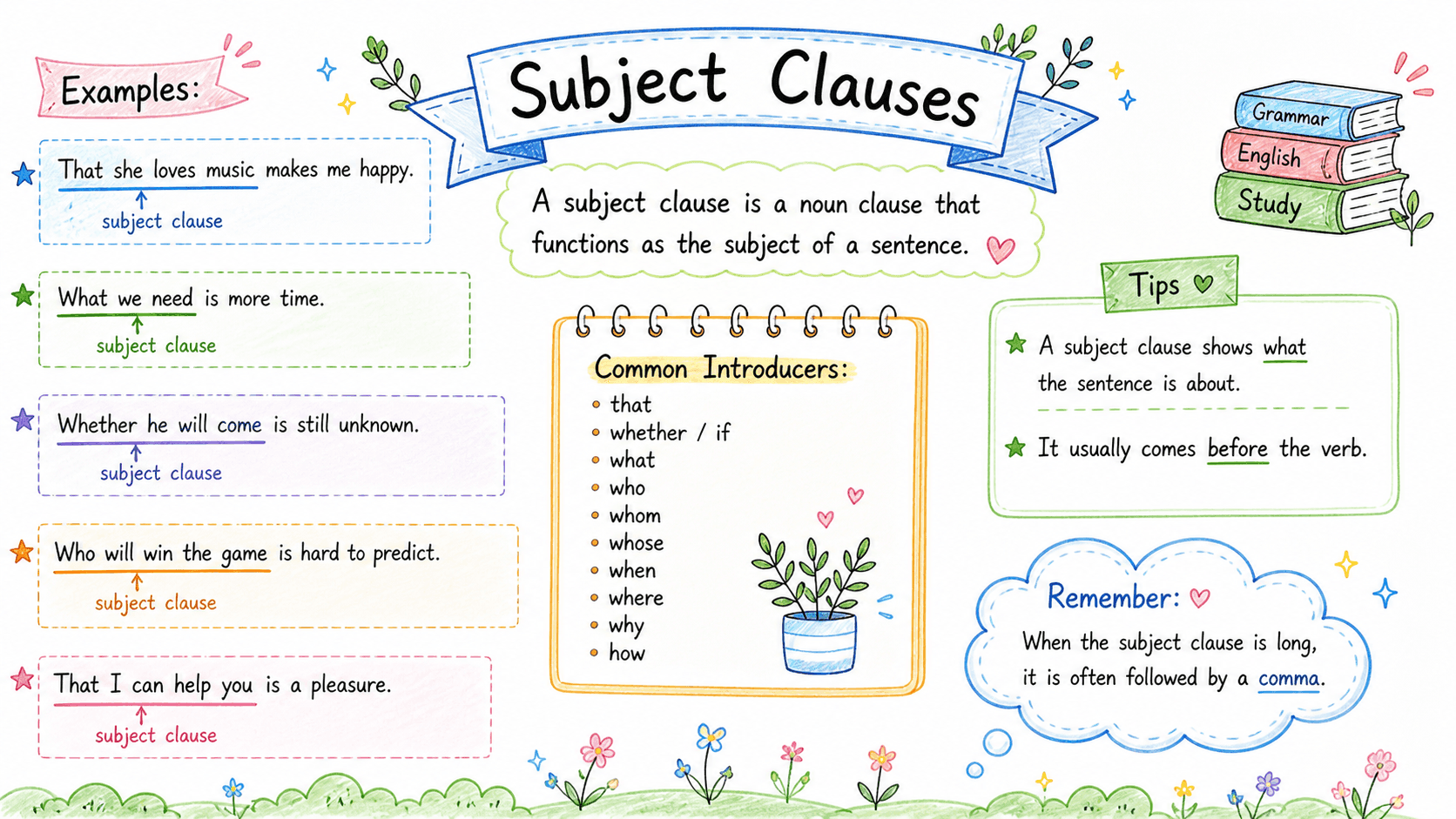
当整个从句在句子中充当主语时,这种从句被称为主语从句。在英语中,如果一个句子的主语部分很长或者结构较为复杂,通常不会直接放在句首,而是用 it 作形式主语,把从句后置。这种用法能让句子结构更清晰、表达更自然。
常见主语从句的引导词
主语从句一般由 that, whether/if, what, when, where, who, why, how 等引导。例如:
- That you passed the exam makes me very happy.
你通过了考试让我很高兴。(that 引导主语从句,直接放句首,但比较书面)
但口语和书面语中,更多情况下会用形式主语 “it” 开头,让句子更自然。
以 It 开头的主语从句(更常用,表达客观情感、判断等):
It is important that you read the contract carefully before signing.
在签字前仔细阅读合同是很重要的。(It 是形式主语,that 引导的从句才是真正的主语)
It's surprising that nobody noticed the mistake earlier.
没有人更早发现这个错误,这很令人惊讶。(It's + 形容词 + that 从句,是主语从句最常见的句型之一)
It is possible that the meeting will be cancelled.
会议有可能被取消了。(It is possible... that... 结构表达可能性)
扩展用法:
除了 “It + be + adj. + that...” 结构之外,还可以用 “It + be + noun + that...” 或 “It + be + past participle + that...” 等,使表达更加丰富:
-
It is a pity that you can't join us tomorrow. 很遗憾你明天不能加入我们。
-
It is widely believed that regular exercise is beneficial to health. 人们普遍认为规律锻炼有益健康。
直接用从句作主语(语气更强调,结构较正式):
What he said completely changed my perspective.
他说的话彻底改变了我的观点。(What he said 是主语从句,由 what 引导,充当主语)
Whether she comes or not doesn't matter to me anymore.
她来不来对我来说已经不重要了。(Whether 引导主语从句,表示“是否”这件事)
That the earth goes around the sun is a scientific fact.
地球围绕太阳转是科学事实。(that 引导主语从句,陈述客观事实)
How you plan matters a lot in this project. 你如何计划在这个项目中很重要。(how 引导的主语从句)
注意:
- 用直接主语从句时,句子会显得更正式或者突出强调;
- 日常表达、尤其是口语和较长从句时,使用 it 作形式主语更常见,而且句子更容易理解。
表语从句
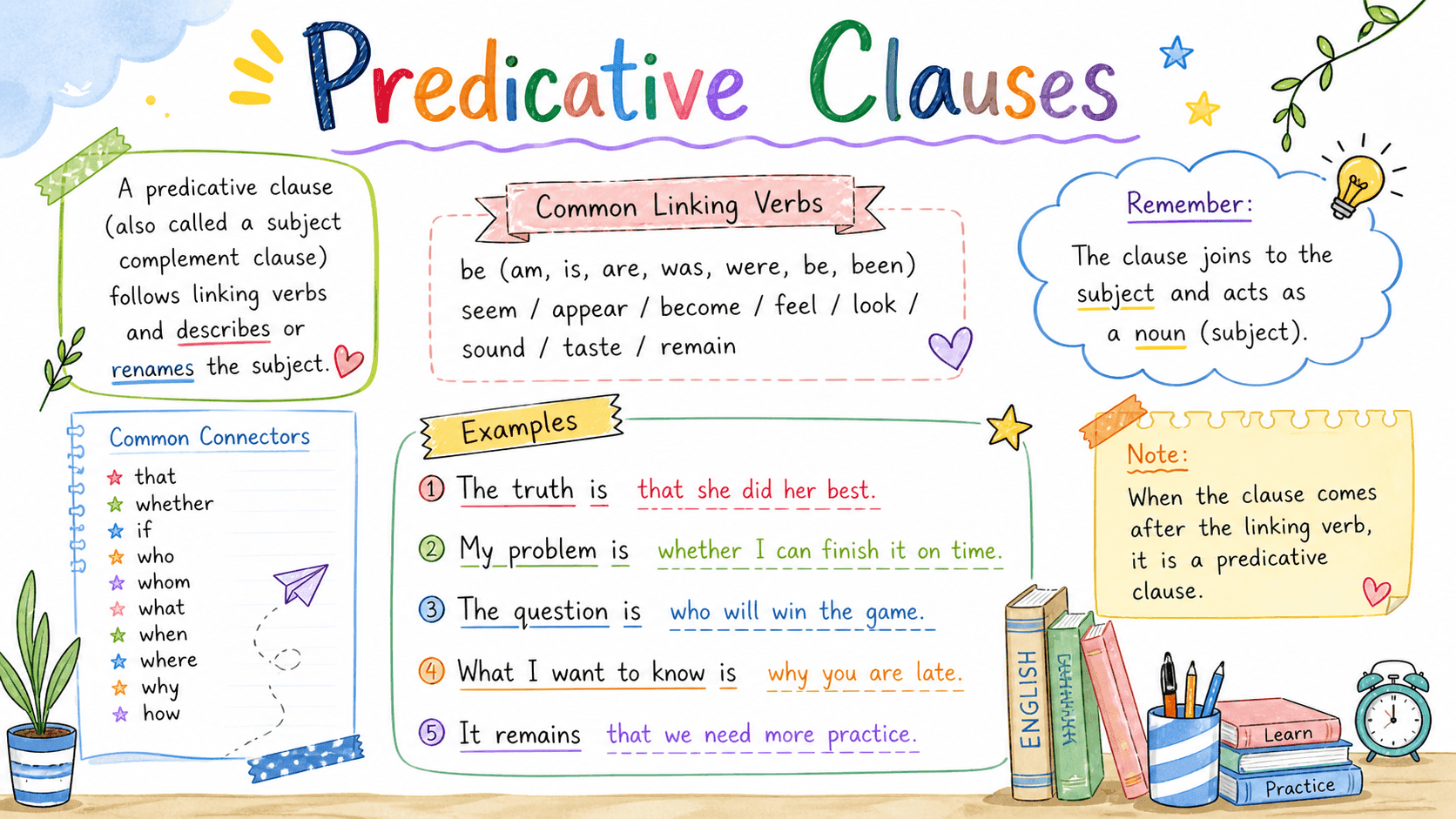
表语从句是在系动词(be / seem / appear / remain / become 等)之后出现的从句,在句中充当表语,作用是对主语进行解释、说明或具体化。常常由 that, whether/if, what, who, which, when, where, why, how 等引导。
常见结构举例
The problem is that we don't have enough time to finish.
问题是我们没有足够的时间完成。(be 后接 that 从句,说明“问题是什么”)
My concern is whether the budget will be approved in time.
我的顾虑是预算能不能及时获批。(be 后接 whether 从句,说明“顾虑的内容”)
The question is who will take the responsibility.
问题是谁来承担这个责任。(be 后接 wh-从句,说明“问题的内容”)
The truth is that nobody really knows what will happen next.
实情是,没有人真正知道接下来会发生什么。(表语从句嵌套了一个宾语从句 what will happen next)
-
The fact is that we have no other choice. 事实是我们没有其他选择。
-
That is why I called you. 那就是我给你打电话的原因。(why 引导的表语从句,也是常见结构)
-
The point is how we solve the problem. 关键在于我们如何解决问题。
三类名词性从句的记忆方法与易混点:
- 宾语从句通常放在动词后——“告诉我一件事”。
例:I know that he is right.(我知道一件事) - 主语从句在句首或由 it 形式主语引导——“一件事是什么”。
例:That she passed the exam surprised us./It surprised us that she passed the exam.
(她通过了考试让我们感到惊讶。/ 让我们感到惊讶的是她通过了考试。) - 表语从句接在系动词后——“这是什么”。
例:The reason is that she was sick. (原因是她生病了。)
共同点:
- 都包含完整的主谓结构;
- 都用陈述语序(即主语 + 谓语),而非疑问语序;
- 在写作和口语表达中都是高级表达能力的重要标志。
情境对话
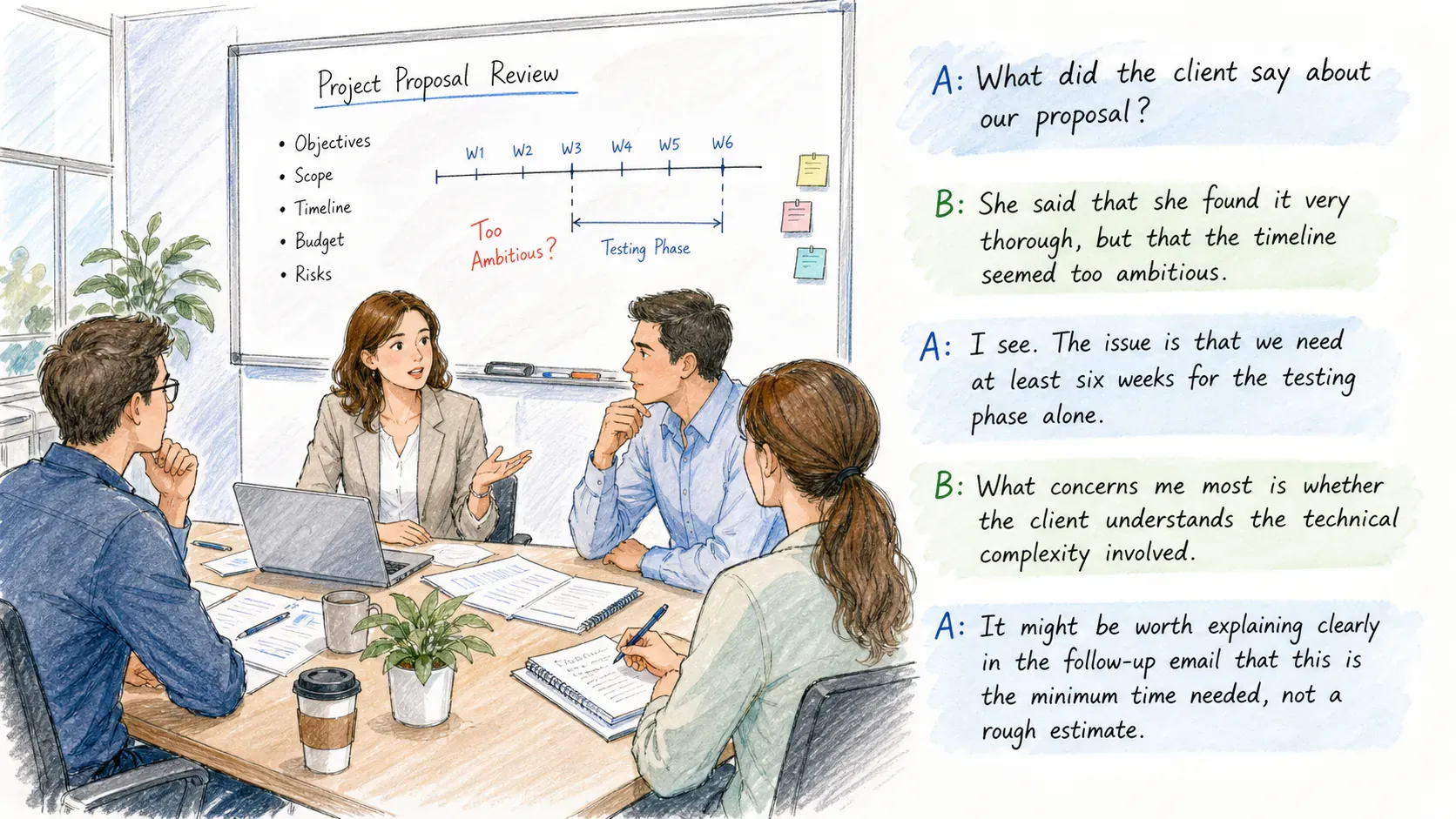
场景:商务会议后的讨论
A:What did the client say about our proposal?
客户对我们的方案有什么说法?
B:She said that she found it very thorough, but that the timeline seemed too ambitious.
她说她觉得方案很详尽,但时间线看起来太激进了。(宾语从句,said + that;时态一致:found / seemed 与 said 保持一致)
A:I see. The issue is that we need at least six weeks for the testing phase alone.
明白了。问题是,仅测试阶段就需要至少六周。(表语从句:the issue is + that 从句)
B:What concerns me most is whether the client understands the technical complexity involved.
最让我担心的是客户是否理解其中的技术复杂度。(What concerns me most 是主语从句;whether 从句是宾语从句嵌套)
A:It might be worth explaining clearly in the follow-up email that this is the minimum time needed, not a rough estimate.
在后续邮件中清楚地解释这是所需的最短时间而非粗略估算,可能是值得的。(It is worth + that 主语从句)
练习题
练习一(选择题)
知识点:宾语从句的陈述语序规则
以下哪个宾语从句的语序是正确的?
A. I don't know where is the nearest pharmacy.
B. She asked me what time did the meeting start.
C. Can you tell me how long has he been waiting?
D. I wonder whether she has already made a decision.
练习二(选择题)
知识点:宾语从句的时态一致
“He told us that he _____ to attend the conference.”
A. is unable
B. was unable
C. will be unable
D. has been unable
练习三(选择题)
知识点:形式主语 It 的用法
以下哪个句子中,It 作为形式主语的用法是正确的?
A. It surprised that no one knew the answer.
B. It is well known that exercise improves mental health.
C. It seems that is raining outside.
D. It was suggested he should to leave early.
练习四(情景问答)
知识点:三种名词性从句的综合运用
请根据以下三个语境,分别写出含有宾语从句、主语从句、表语从句的句子,并在括号内标注从句类型。
语境一:你的好朋友问你“接下来要做什么”,你回答“我不知道下一步该怎么做”。
语境二:你想表达“令人遗憾的是,很多年轻人不重视睡眠质量”。
语境三:你想表达“团队失败的真正原因,在于内部沟通不畅”。
练习五(情景问答)
知识点:时态一致规则与例外
请判断以下两组句子,哪些使用了时态一致,哪些是例外情况(表达客观事实),并解释为什么。
第一组:“She told me that the meeting was postponed to Friday.”
第二组:“The science teacher explained that water is made up of hydrogen and oxygen.”