条件、让步与原因结果状语从句
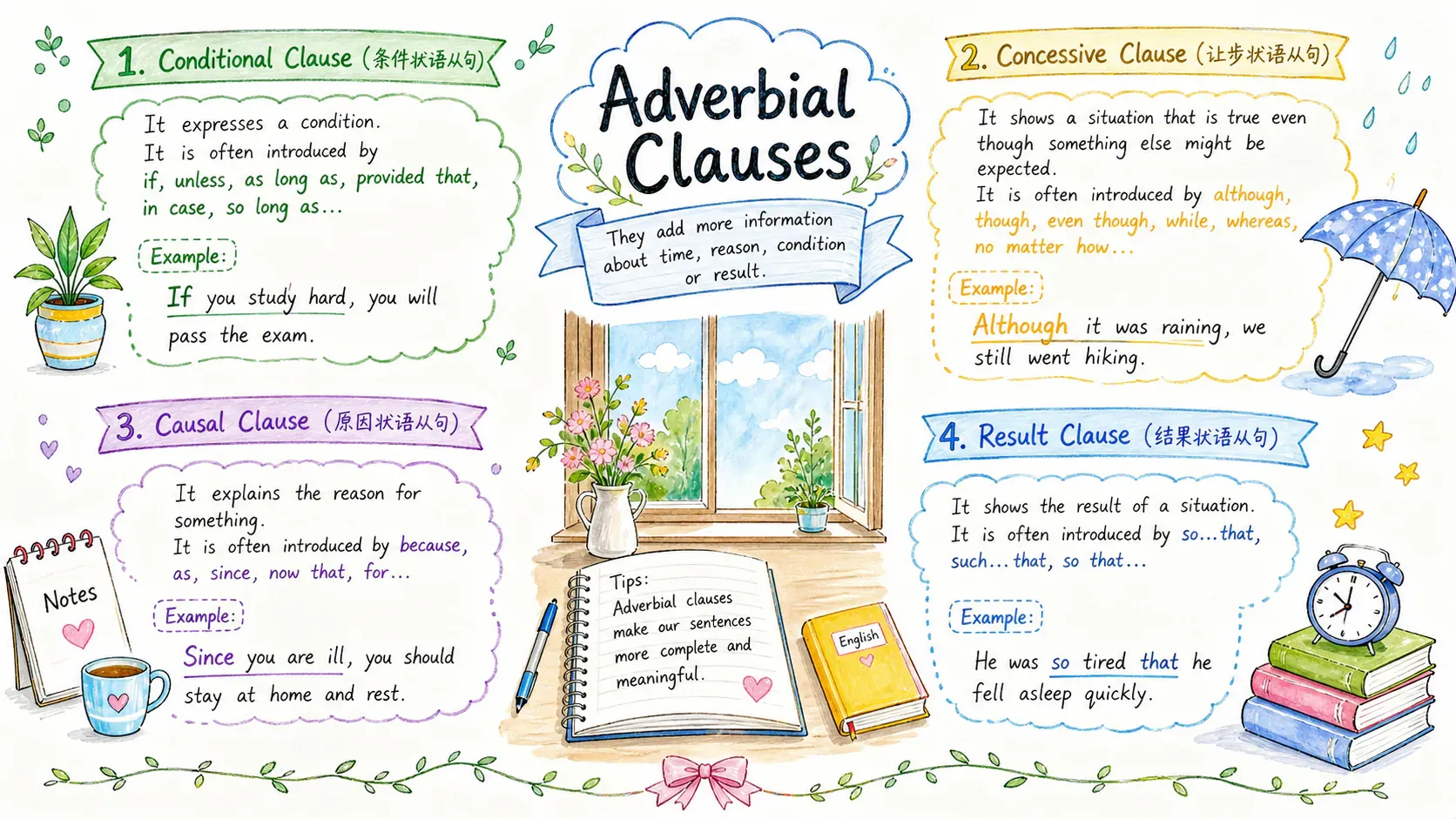
除了时间状语从句之外,英语中还广泛使用多种其他类型的状语从句。常见的有让步状语从句(如“虽然……但还是……”)、原因状语从句(说明“因为……”的理由)、结果状语从句(表达“所以……”产生的后果)以及目的状语从句(表示“以便……”的目标)。这些状语从句不仅能帮助我们在一个复合句中清晰地表达让步、原因、结果、目的等复杂的逻辑关系,还能让句子结构更具条理、内容更富层次。
例如,合理地组织这些状语从句,可以让我们在表达观点、讲述经历或阐释原因时,做到思路严密、前后呼应。善用这些句型,不仅可以提升书面表达的逻辑性和丰富性,也有助于在口语交流中表达更加连贯、有说服力的思想,从而让英语表达更加精准和有深度。
让步从句:“虽然……但……”
让步从句主要表达“尽管……也/仍然……”的逻辑关系,即先承认一个障碍、困难或出乎意料的事实,随后说明主句的结果并未受其影响。这一结构在议论文、说明文、日常交流与演讲等多种语境下非常常用,是英语表达中连接复杂思维、展现语气转折的重要工具。
Although / Though / Even though(虽然,尽管)
这三者均可用来引出让步从句,含义相近,但语气强弱、适用语体略有不同:
- Although:最常见、最正式,书面和口语皆可使用;
- Though:语气稍口语化,常用于口语对话,有时可放在句末;
- Even though:强调让步的“力度”,表达“即便如此”、“尽管如此”的意味更强烈,适合突出主句发生的不易或强烈对比。
Although the journey was long, everyone arrived in good spirits.
虽然旅途漫长,但大家到达时精神都很好。(although 承认旅途漫长,但结果仍然积极)
Even though she was nervous, she delivered a confident speech.
尽管她很紧张,她仍然发表了一篇自信的演讲。(even though 强调让步力度更强,“尽管如此”)
Though it was late, they kept working on the project.
虽然时间很晚,他们还是继续在做项目。(though 语气口语化)
重要规则:although/though 和 but 不能同时用于同一句子
✗ Although it was raining, but we went out.
✓ Although it was raining, we went out. 虽然在下雨,我们还是出去了。
✓ It was raining, but we went out. 在下雨,但我们还是出去了。
注意:Although/though 已经体现了“让步转折”,句中就不能再用 but,否则结构重复,表达不地道。but 只能和普通主句配合,如 It was raining, but we went out.
有时 though 也可灵活用在主句末做补充说明(副词),如:
- The movie was boring. I watched it till the end, though. (电影很无聊,但我还是看到最后。)
Despite / In spite of(尽管)
Despite 和 in spite of 也表达让步关系,但后面只能接名词、代词或动名词(-ing),不能带完整的主谓从句,因此与 although/though 结构上有重要差别。
Despite the heavy rain, the outdoor concert went ahead as planned.
尽管大雨倾盆,户外音乐会仍按计划进行。(despite + 名词短语)
In spite of feeling exhausted, she managed to finish the marathon.
尽管筋疲力竭,她还是坚持完成了马拉松。(in spite of + 动名词 -ing)
Despite his wealth, he lived a simple life.
尽管他很富有,他却过着简朴的生活。(despite + 名词所有格)
结构归纳:
| 用法 | 结构 | 举例 | 中文释义 |
|---|---|---|---|
| Although / Though | 连词 + 完整从句 | Although it was raining, we went out. Though it was late, they kept working. | 虽然在下雨,我们还是出去了 虽然时间很晚,他们还是继续做。 |
| Despite / In spite of | 介词 + 名词/代词/动名词 | Despite the rain, the match went ahead. In spite of feeling tired, they persevered. | 尽管下雨,比赛还是照常进行。 尽管感到疲惫,大家依然坚持。 |
注意:
- although/though 后面接“主语+谓语”完整从句,不能和 but 连用。
- despite/in spite of 后接名词、代词或动名词,不能接完整句子。
如果要让 despite/in spite of 后面跟“主语+谓语”,需使用名词性结构,如“Despite the fact that...”
Despite the fact that he was young, he did an excellent job.
(尽管他年纪小,他仍做得非常出色。)
常见误区 & 归纳小结
- 虽然 although/though/Even though 强调“转折让步”,但只能单独使用,不和 but 连用。
- Despite 后不加 of;in spite of 中的 of 不可省略,且后接内容必须符合名词性要求。
综合练习 请把中文翻译成英文:
- 尽管天气不好,比赛还是照常举行。
- 虽然他没有经验,但他学得很快。
- 尽管感到疲惫,大家依然坚持到了最后。
原因从句:“因为……”
英语中表示原因的连接词主要有三个:because / since / as,它们各自有不同的语气和适用场景,选用时应结合表达重点与语境。
Because(因为):直接、强调性最强
Because 用来突出某个明确的、关键的原因,常用来回答“为什么”的问题,强调“正是因为这个原因”或在语境中消除歧义,也适合用于口语和书面语中,需要直截了当说明理由时。
She didn't come to work because she was unwell. 她没来上班,因为她不舒服。(because 直接说明缺席的原因)
小提示:“because”从句可以放在前面或后面,但一般更习惯放在主句之后(即 “主句 because 原因从句”)。
-
I left early because I had an appointment.
我提前离开,因为我有个约会。 -
The flight was delayed because of the weather.
航班因天气原因延误了。(注意:此处 because of 后接名词性短语。)
Since / As(由于,鉴于,既然):语气委婉、原因常为已知
Since 和 as 也有“因为”的意思,但它们更适用于说话双方都知道的、或相对不太重要的原因。语气上没有 because 那么直接与强调,常见于解释背景、补充说明、或开篇引语。
Since everyone has arrived, we can start the meeting.
既然大家都到了,我们可以开始会议了。(since 表示“既然这个情况显而易见”,引出结果)
As you know, the project deadline has been moved forward.
正如你所知,项目截止日期已经提前了。(as you know 是固定表达,as 引导的原因是双方共知的信息)
补充说明:“since” 和 “as” 多出现在说明、解释、或事先已知的情形。它们常放在句首,让原因成为“背景信息”,而不是最突出的重点。
-
Since it’s raining, let's stay indoors.
既然下雨了,我们就在室内吧。(强调双方预知的客观情况) -
As he hadn’t finished his homework, he couldn’t go out.
因为他没做完作业,所以不能出去。(as 引导原因,语气较弱)
结构对比与常见错误
Because of 后面加名词/名词短语;Because 后面引导从句。
I was late because of the traffic.
我迟到了,因为遇到了交通堵塞。(because of 后接名词短语)
I was late because there was heavy traffic.
我迟到了,因为(那里)交通很拥堵。(because 后接完整从句)
As 也可以单独作“随着”讲法;但本内容聚焦因果关系。
归纳小结:
- 必须突出、“唯一且必要的因果”→选择 because。
- 轻描淡写、原因已广为人知→选 since/as,更自然。
结果从句:So...that / Such...that
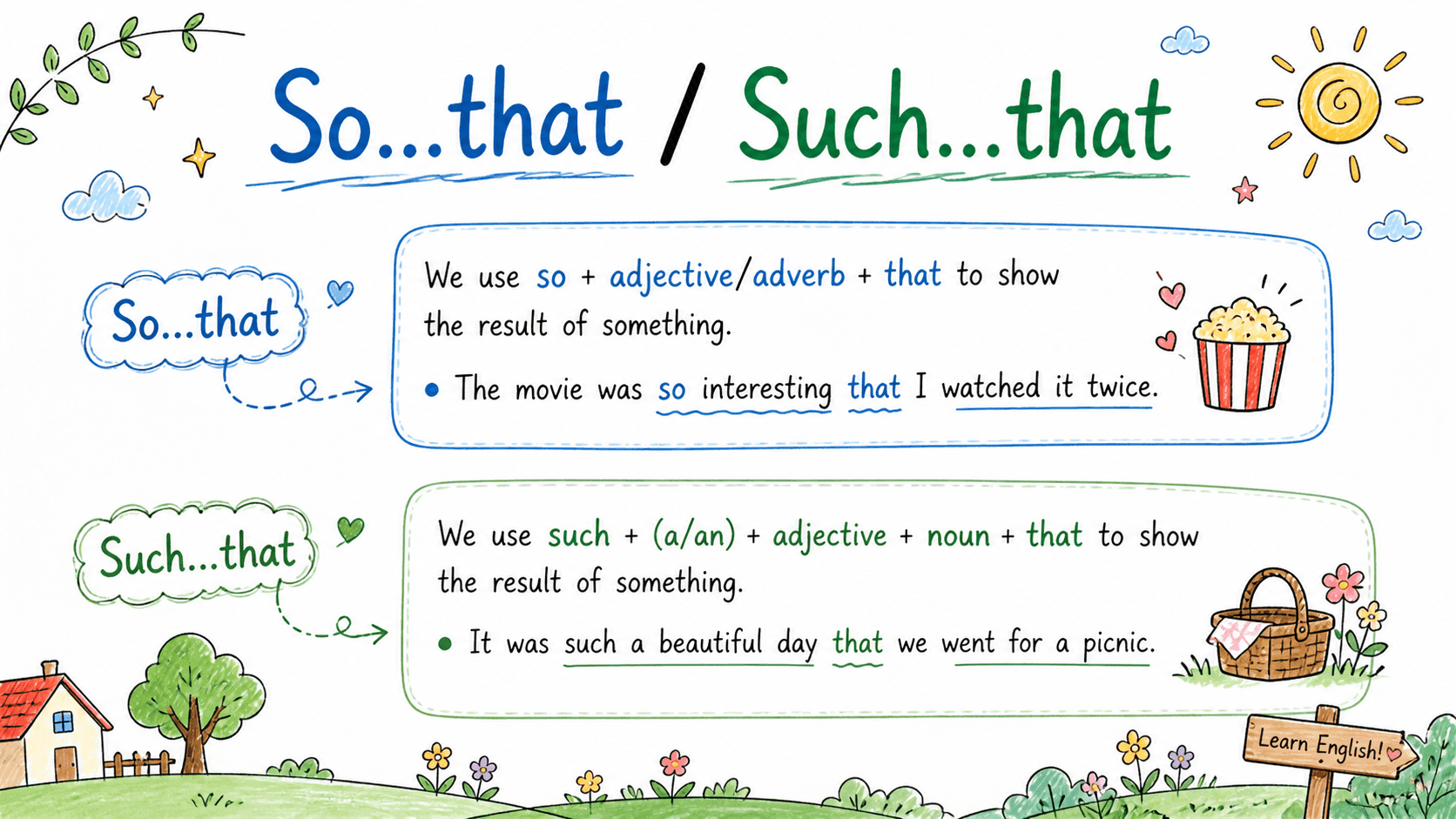
这两个结构用来表达“……到……的程度,以致……”——强调某种程度或数量,导致了某个结果,这在书面和口语中都很常见,尤其用于描述因果紧密关联的情境。例如在学术表达、考试作文、故事叙述、日常交流等都可应用,能让描述更生动具体。
So...that 结构详解
So + 形容词/副词 + that
表示前面的程度非常突出、以致后面的结果成立。so 修饰形容词(如 difficult, tired)或副词(如 quickly, late)。
The exam was so difficult that more than half the class failed.
考试难到一半以上的同学都不及格。(so + 形容词 difficult + that 表示难到某个结果程度)
She spoke so quickly that I couldn't follow what she was saying.
她说得太快,我完全跟不上她说的话。(so + 副词 quickly + that 引导结果)
He was so tired that he fell asleep immediately.
他太累了,以至于立刻睡着了。(so + 形容词 tired + that)
The room was so noisy that we couldn't hear each other.
房间太吵了,我们根本听不见彼此说话。
补充说明: 有时 so...that 中的 “that” 可省略,特别是在口语中:
- She was so angry (that) she left the meeting. (她非常生气,以至于离开了会议。)
Such...that 结构详解
Such + a/an + 形容词 + 名词 + that 或 Such + 形容词(可选)+ 名词(多数名词时不用a/an)+ that
Such 用来修饰“名词”,既可接可数名词(单数用 a/an),也可接不可数或复数名词。重点突出名词的“特质或状况”。
It was such a compelling presentation that the investors immediately agreed to fund the project.
这是一次如此有说服力的报告,以至于投资人立刻同意资助这个项目。(such + a + 形容词 + 名词 + that)
They are such talented students that all the teachers praise them.
他们真是如此有才华的学生,所有老师都夸奖他们。(such + 形容词 + 名词 + that)
It was such bad weather that we had to stay home.
天气太糟糕了,我们只好待在家里。(such + 形容词 + 不可数名词 + that)
用法要点:
- So 修饰形容词或副词;
- Such 修饰名词/名词短语(通常带形容词)。
常见错误&易混点
- 错误:He is so a good student that...
正确:He is such a good student that... - 错误:It is such cold that...
正确:It is so cold that...
目的从句:So that / In order to
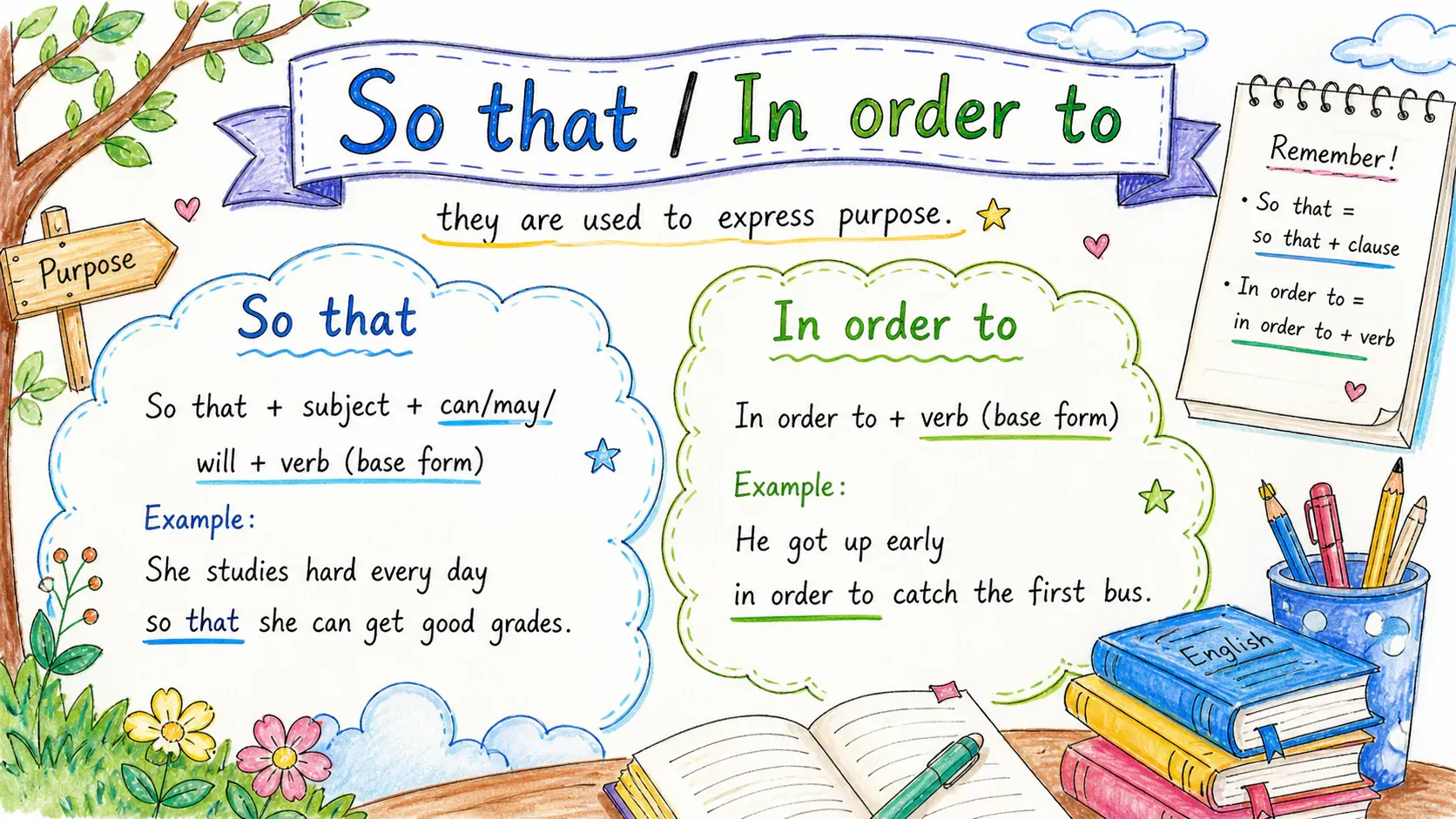
So that(以便,为了)
用于引导目的状语从句,说明做某事的目的,后面通常跟 can / could / will / would 等情态动词,使目的表达更加具体清晰。so that 可放在句中或句末,语气较为正式,书面和口语均可用,尤其常见于计划、建议等场景。
She rehearsed every day so that she could perform with confidence.
她每天排练,以便能自信地演出。(so that 引导目的,her goal 是能自信演出)
He arrived an hour early so that he could get a good seat.
他提前一小时到达,为了能占到一个好位子。(so that 引导具体的目的)
We left home early so that we wouldn’t miss the train.
我们很早就出发了,这样就不会错过火车了。
小结:
- So that 从句通常有“can, could, will, would”等(表达能力、希望、计划、目标)。
- so that 不能省略,否则句意可能模糊。
In order to(为了,以便)
in order to 后接动词原形,表示行为的目的,强调为达成某个目标而采取的具体行动。它比 so that 结构更简洁,适合书面或正式场合。
She rehearsed every day in order to perform with confidence.
她每天排练,为了能自信地演出。(in order to + 动词原形,比 so that 更简洁)
He got up early in order to finish his homework. 他早起为了完成作业。
补充说明:
- 常见的替代表达还有 “to do sth.”,但 in order to 更正式、强调目的。
- 非正式口语更习惯直接用 to + 动词原形:I took a taxi to catch the train.
对比与归纳
- So that + 主语 + 情态动词(can/could/will/would)+ 动词,重点在“目标”或“结果”;
- In order to + 动词原形,结构更简洁,突出“目的”动作,主语与主句一致。
小结:
- “So…that”/“Such…that”:强调某种程度/数量导致某种结果;
- “So that/In order to”:表达行为采取的目的。
- 注意区分结构和习惯用法,合理选用更地道!
情境对话
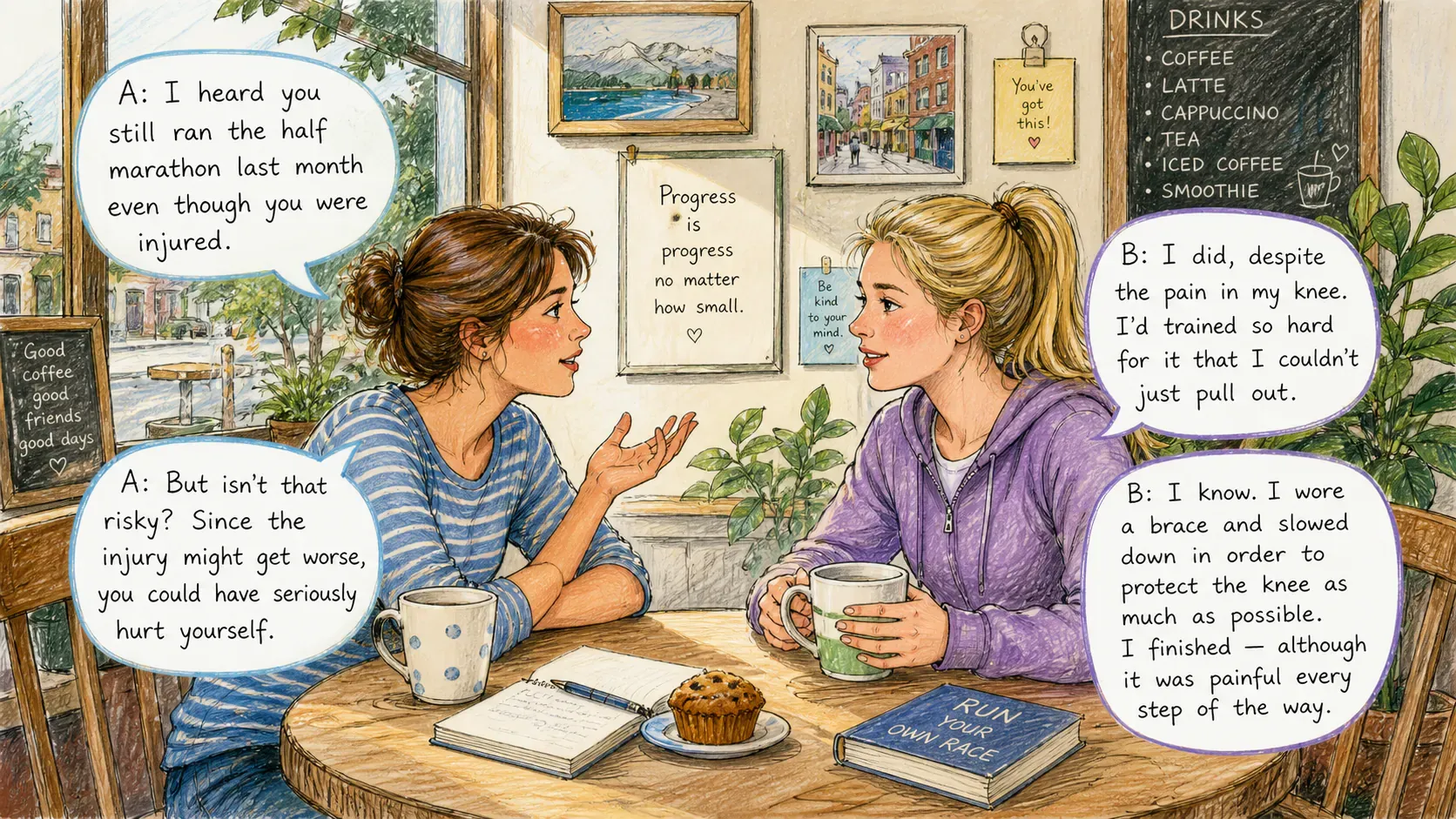
场景:朋友讨论一次困难的经历
A:I heard you still ran the half marathon last month even though you were injured.
我听说你上个月即使受伤了还是跑完了半程马拉松。(even though 强调让步力度)
B:I did, despite the pain in my knee. I'd trained so hard for it that I couldn't just pull out.
是的,尽管膝盖疼。我为此训练得那么刻苦,以至于我没办法就这么退出。(despite + 名词;so hard that 结果从句)
A:But isn't that risky? Since the injury might get worse, you could have seriously hurt yourself.
但这不是很冒险吗?既然伤情可能加重,你有可能严重伤到自己。(since 用于已知的担忧原因)
B:I know. I wore a brace and slowed down in order to protect the knee as much as possible. I finished — although it was painful every step of the way.
我知道,我戴着护膝,放慢了速度,为了尽可能保护膝盖。我完成了——虽然每一步都很痛。(in order to 目的从句;although 让步)
练习题
练习一(选择题)
知识点:Although 和 But 不能同时使用
以下哪个句子是正确的?
A. Although she was tired, but she kept working.
B. Even though the price is high, but people still buy it.
C. Despite being busy, she still found time to call.
D. Though it was cold, but the children played outside.
练习二(选择题)
知识点:Although/Despite 后接内容的区别
“___ the bad weather, the event was a huge success.”
A. Although
B. Despite
C. Even though
D. Because of
练习三(选择题)
知识点:So...that vs Such...that 的区别
“The movie was _____ emotional _____ many people in the audience were in tears by the end.”
A. so ... that
B. such ... that
C. so ... as
D. such a ... that
练习四(情景问答)
知识点:Because / Since / As 的语气差异
以下三个原因句,请判断各用 because / since / as 哪个最合适,并解释理由。
情境一:你在邮件开头解释为什么你提出某个建议,对方可能不知道背景情况。
情境二:开会时主持人说“既然大家已经看过材料了,我们直接进入讨论”。
情境三:朋友问你为什么没参加上次的聚餐,你回答是因为有临时会议。
练习五(情景问答)
知识点:让步、原因、结果/目的从句的综合使用
请以“坚持学英语”为主题,在以下三个句子框架中分别填入让步、原因或目的从句,使句子完整且逻辑自然。
句子一(让步):“_____, many people still give up after a few months.”
句子二(原因):“The key is to find materials you enjoy _____.”(用 because 或 since)
句子三(目的):“You should set small weekly goals _____.”(用 so that 或 in order to)