get / take / give / have 搭配

在英语中,get、take、give、have 是四个最常见也是最灵活的动词。它们不仅出现在各种生活场景、考试、书面语和口语中,每个词还能够和大量名词、形容词或短语灵活组合,产生出层出不穷的新意思。例如:get a job(找到工作)、take notes(记笔记)、give advice(给建议)、have fun(玩得开心)。同一个名词和不同动词搭配,意思可能会发生巨大变化,比如 have a shower(洗澡)和 take a shower,两者在英美用法上就有细微区别。
很多英语学习者容易受到中文直译的影响,看到“得到”就用 get,“拿、带”用 take,“有”用 have,“给”用 give。但实际上,这些动词的用法和它们在特定搭配中的意义往往和字面意思有较大差异。它们有各自偏好的搭配领域——有些表达只能用其中一个动词,不能随意互换,否则表达就会显得不自然或产生歧义。例如,“get married”只能用 get,“take a break”常常优于 have a break,而“give someone a hand”(帮忙)中不能随意替换为 get/ have。
准确掌握 get、take、give、have 的各种常用搭配,不仅能让表达更地道,还能帮助更好地理解英语的语感与逻辑。这些动词在表示“获得、经历、给予、拥有、变化、动作完成、进行活动”等不同语义时,常常有固定或高频的短语结构。理解每个词的常见搭配和常用场景,是迈向英语熟练表达的重要一步。
get:获得、变化与到达

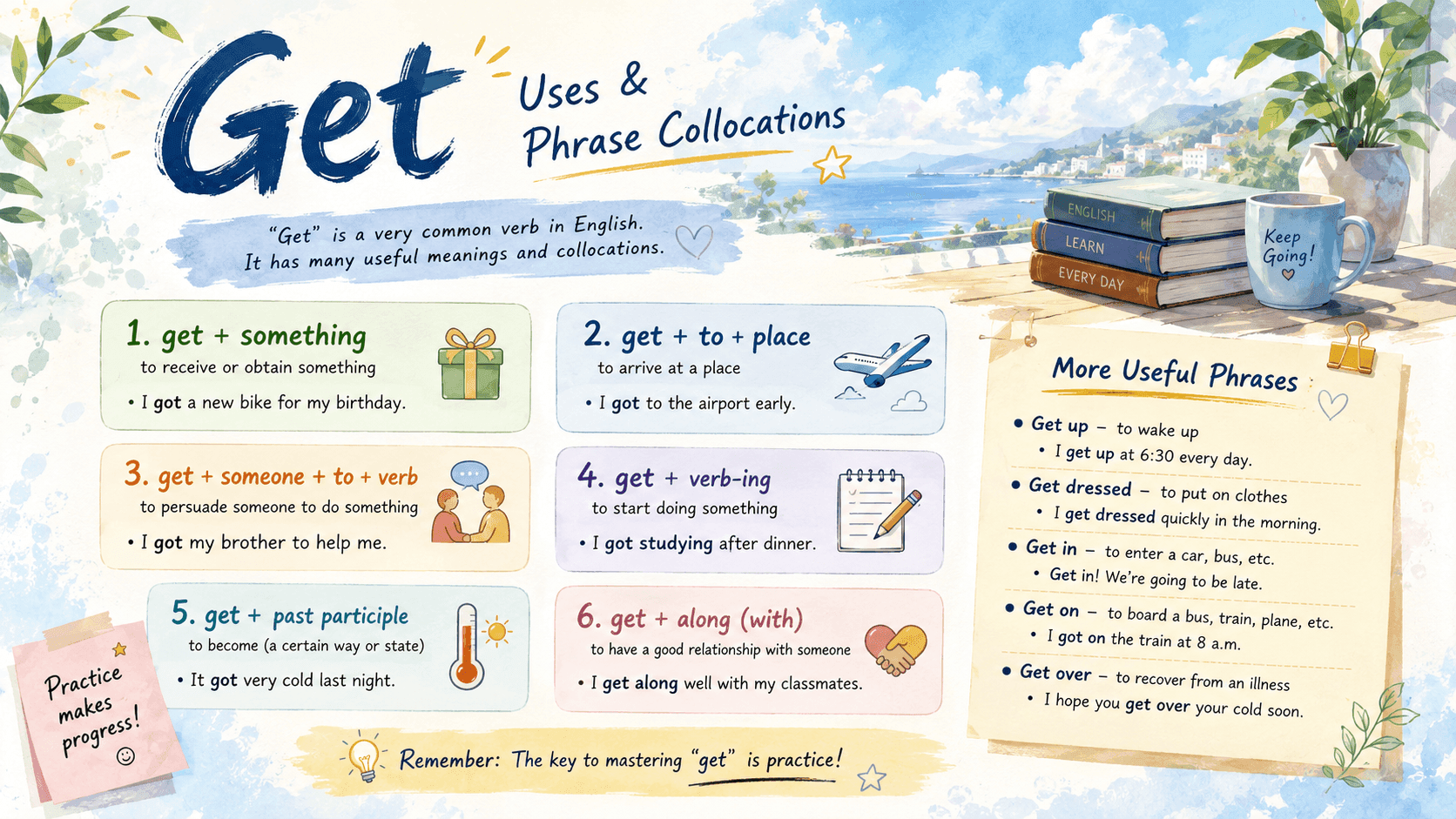
get 是英语中最常用、最灵活的动词之一,其语义核心主要有三个维度:获得/得到(acquiring something)、变成某种状态(becoming a state)、到达(reaching somewhere)。这三个核心用法渗透在日常口语、书面语和各类搭配中。掌握好这三大语义主线,你会发现看似陌生的 get 短语也能猜出大致意义。
除了 get 的基本本意,日常英语还有许多习惯用法并非逐词直译,而是更靠近语感和固定搭配。下文汇总了 get 最常见、最实用的常用搭配,并举例说明。
get 的核心搭配及例句
获得/取得类(get + 名词):
- get a job(找到工作)— She finally got a job at a tech company. (她终于在一家科技公司找到了工作。)
- get permission(获得许可)— You need to get permission before using the photo. (你需要在使用这张照片前获得许可。)
- get a chance(得到机会)— I never got a chance to explain myself. (我从来没有机会解释我自己。)
- get a result(得到结果)— We're still waiting to get the test results. (我们还在等考试结果出来。)
- get information(获取信息)— Where can I get more information about the course? (我可以在哪里获得关于这个课程的更多信息?)
- get an email / message / call(收到邮件/短信/电话)— Did you get my email yesterday? (你昨天收到我的邮件了吗?)
- get a ticket(拿到票/开罚单)— I got a ticket for speeding last week. (我上周因为超速被开了一张罚单。)
- get help(获得帮助)— Can you get help from your classmates? (你可以从你的同学那里获得帮助吗?)
变化/状态类(get + 形容词/过去分词):
- get angry(变得愤怒)— Don't get angry — let's talk calmly.(别生气——我们冷静地谈谈。)
- get married(结婚)— They got married last spring.(他们去年春天结婚了。)
- get tired(感到疲倦)— I get tired easily in hot weather.(天气热时我很容易感到疲倦。)
- get better / worse(变好/变坏)— His health is getting better every day.(他的健康每天都在好转。)
- get dressed(穿上衣服)— I get dressed quickly every morning.(我每天早上很快就穿好衣服。)
- get lost(迷路;困惑)— We got lost on the way to the museum.(去博物馆的路上我们迷路了。)
- get upset(变得不高兴)— Try not to get upset about small things.(尽量不要为小事生气。)
- get confused(变得困惑)— I always get confused by these instructions.(我总是被这些说明弄糊涂。)
- get drunk(喝醉)— He got drunk at the party last night.(他昨晚在聚会上喝醉了。)
- get bored(感到无聊)— It's easy to get bored during long meetings.(长时间开会很容易感到无聊。)
达到/到达类(get to...):
- get to work/school/home(到达工作/学校/家)— What time do you usually get to work?(你通常几点到公司?)
- get there/anywhere/somewhere(到达某地/任何地方/某个地方)— How long does it take to get there?(到那里需要多长时间?)
- get back(回来,返回)— I'll get back home by 7 p.m.(我会在晚上7点前回到家。)
- get downstairs/upstairs(下楼/上楼)— Can you get upstairs quietly?(你可以安静地上楼吗?)
动作完成类(短语动词及习惯搭配):
- get on with(与……相处;继续做)— She gets on well with her colleagues.(她和同事们相处得很好。)
- get rid of(摆脱;处理掉)— I need to get rid of all this old furniture.(我需要把这些旧家具都处理掉。)
- get in touch(取得联系)— Let's get in touch after the conference.(会议结束后我们保持联系。)
- get along(进展;相处)— How are you getting along with the new project?(你这个新项目进展得怎么样?)
- get over(克服;恢复)— It took him a week to get over the flu.(他花了一周时间才从流感中恢复过来。)
- get through(通过;熬过)— She got through the exam without any problems.(她顺利通过了考试。)
- get by(勉强过活)— It's hard to get by on such a low salary.(靠这么低的工资很难维持生活。)
- get together(聚会)— Let's get together for dinner this weekend.(我们这个周末一起吃个饭吧。)
- get out (of)(离开;摆脱)— Get out of the car, please.(请下车。)
- get off(下车;离开)— We got off the bus at the next stop.(我们在下一站下了公交车。)
常见 get 搭配易混陷阱与用法讲解
- get married 只能用 get,不能用 take/have/be married 来表达“结婚”的过程。
- get lost 不仅指迷路,也可指“别烦我”,如 Get lost!(走开!)
- get in touch with sb. (与某人取得联系),日常就用“get”表达,比“contact”更口语。
- get back to sb.(回复某人),常见于工作或客服场景: I'll get back to you as soon as possible.
英语中 get + 形容词 表示“状态变化”,如 get cold / hot / dark / late。
场景对话

A:Did you get a chance to speak with the manager yesterday?
你昨天有机会和经理谈了吗?
B:Yes, I finally got in touch with her. But I got a bit nervous and couldn't get my point across clearly.
是的,我终于联系上她了。但我有点紧张,没能把我的意思说清楚。
A:Don't get upset if things don't go as planned. You'll get over it soon.
如果事情没按计划进行别太难过,你很快就会释怀的。
B:Thank you for your concern.
谢谢你的关心。
take:拿取、花费、乘坐与体验
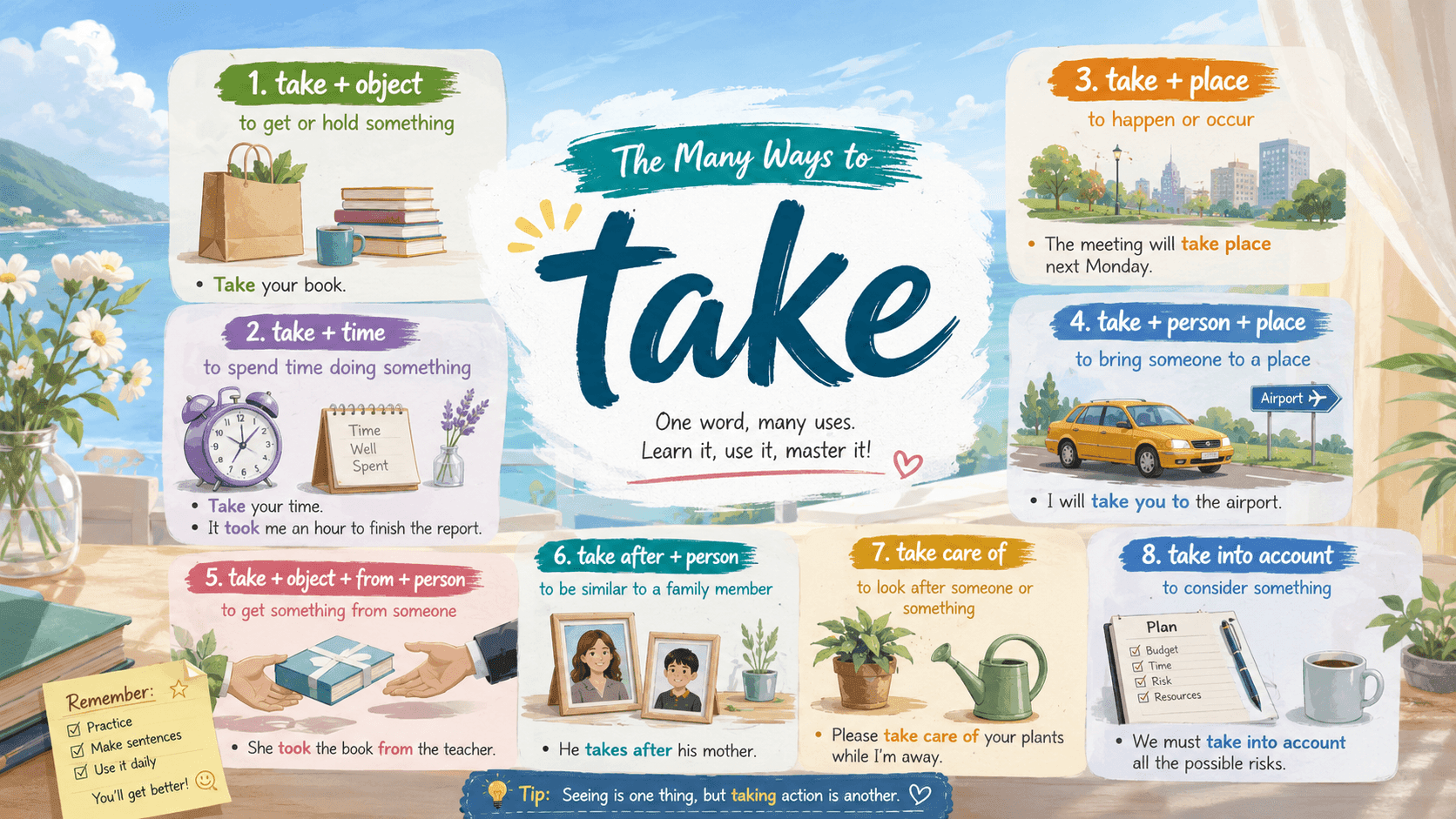
take 是英语中非常高频且多用途的动词,其核心语义为:拿起/带走/接受/获得。由此延展出“花费(时间/金钱)”、“乘坐交通工具”、“体验/进行某活动”、“承担责任”和其他多样化用法。我们来详细梳理常见搭配及易混点。
take 的搭配及例句
体验/进行类:
- take a break(休息一下)— Let's take a short break before continuing. (我们继续之前先休息一下。)
- take a photo(拍照)— May I take a photo here? (我可以在这里拍张照吗?)
- take a look(看一看)— Can you take a look at my draft? (你能看看我的草稿吗?)
- take a walk(散步)— I usually take a walk after dinner. (我通常晚饭后散步。)
- take a shower/bath(洗澡)— I'll take a shower after the gym. (健身后我要洗个澡。)
- take an exam/test(参加考试)— She took three exams this week. (她这周参加了三场考试。)
- take a seat(就座)— Please take a seat. (请坐。)
- take a nap(小睡一会儿)— I need to take a nap this afternoon. (我今天下午需要小睡一会儿。)
责任/行动类:
- take notes(记笔记)— Always take notes during important meetings. (重要会议期间一定要记笔记。)
- take medicine(吃药)— Remember to take your medicine after meals. (记得饭后吃药。)
- take responsibility (for)(承担责任)— A good leader takes responsibility for the team's failures. (好领导会为团队失误担责。)
- take action(采取行动)— We need to take action immediately. (我们需要立刻采取行动。)
- take a risk/chance(冒险)— Sometimes you have to take a risk to succeed. (有时你必须冒险才会成功。)
- take turns(轮流)— Let's take turns presenting our ideas. (我们轮流展示想法。)
时间/机会/事件类:
- take time(花时间/需要时间)— Good habits take time to develop. (好习惯的养成需要时间。)
- take years/days/weeks(花费数年/天/周)— It took me years to learn English well. (我学好英语花了好多年。)
- take advantage of(利用;占便宜)— Take advantage of every learning opportunity. (利用每一次学习机会。)
- take place(发生/举行)— The concert takes place next Saturday. (音乐会下周六举行。)
- take care of(照顾/处理)— She takes care of her younger siblings after school. (她放学后照顾弟妹。)
- take the opportunity(抓住机会)— You should take the opportunity to travel abroad. (你应该抓住出国旅行的机会。)
交通/获取类:
- take a bus/train/plane/taxi(乘坐交通工具)— I usually take the bus to work. (我上班通常坐公交。)
- take the subway(坐地铁)— How long does it take to take the subway there? (坐地铁到那儿需要多长时间?)
- take a route(走某条路线)— Which road should we take? (我们应该走哪条路?)
易混表达与特别注意:
- “take a photo”不是“make a photo”;英语表达某人“拍照”只能用“take”。
- “take a shower”不能说成“do a shower”或“make a shower”;表达“洗澡”固定搭配是“take a shower/bath”。
- “take place”(发生/举行)本身是动作发生的表达,不可直译为“带到某地”。
- “take care”的意思根据上下文可以为“照顾”,比如“take care of your parents”,也可做告别语“Take care!”(保重!)。
- 表达“需要多久时间”,常用 句型:How long does it take to...? 例如:How long does it take to drive there?
有些 take 的短语或者固定搭配,不宜直译,建议整体记忆。注意掌握常考口语表达,例如“take a break”、“take a chance”、“take part in”(参加)、“take responsibility”以及与交通、时间相关的各种搭配。
拓展:常见 take 相关的地道表达
- take part in(参加)— She will take part in the competition. (她将参加比赛。)
- take one’s word for it(相信某人的话)— I'll take your word for it. (我相信你的话。)
- take something seriously(认真对待)— You should take your health seriously. (你应该认真对待你的健康。)
- take it easy(放轻松)— Take it easy; don’t panic! (放轻松,别慌!)
通过多读多用常见搭配,能让“take”这类变形多端的动词,为你的英语交流增添地道和流畅度。
give:给予与提供
give 的核心语义是给予/提供某物(to provide something to someone),但在许多搭配中,give 常常与抽象名词连用,表达“给予某种行为、体验或影响”。它不仅限于“实物”,更多是指“动作”或“服务”的传递。与 take 相比,give 强调“主动给出”,而且常常用于正式、半正式或口语场景。
give 的核心搭配与用法拓展
给予/提供类:
- give advice(给建议)— Can you give me some advice on this? (你能在这事上给我点建议吗?)
- give permission(给予许可)— The teacher gave permission for the students to leave early. (老师允许学生提前离开。)
- give a speech(发表演讲)— He gave an inspiring speech at the graduation ceremony. (他在毕业典礼上发表了激励人心的演讲。)
- give a presentation(做演示)— I have to give a presentation to the board tomorrow. (我明天要在董事会上做演示。)
- give information(提供信息)— Please give us more information about the position. (请向我们提供更多关于这个职位的信息。)
- give instructions(给予指示)— The supervisor gave clear instructions. (主管给了明确的指示。)
互动/沟通类:
- give someone a call(给某人打电话)— I'll give you a call when I arrive. (我到了会给你打电话。)
- give someone a hand(帮某人一把)— Could you give me a hand with these boxes? (你能帮我搬下这些箱子吗?)
- give feedback(提供反馈)— The teacher gave detailed feedback on every essay. (老师对每篇作文都做了详细点评。)
- give an example(举例)— Can you give an example to explain that? (你能举个例子解释一下吗?)
- give birth to(生育;产生)— She gave birth to twins last month. (她上个月生了一对双胞胎。)
- give a warning(发出警告)— The doctor gave a warning about unhealthy eating. (医生对于不健康饮食发出了警告。)
反应/情感类:
- give up(放弃)— Never give up on your dreams. (永远不要放弃你的梦想。)
- give in(屈服;让步)— He finally gave in to the pressure. (他最终屈服于压力。)
- give away(赠送;泄露)— Don't give away the ending of the movie! (别把电影的结局说出来!)
- give someone trouble(给某人添麻烦)— I hope this isn't giving you too much trouble. (希望这没有太让你为难。)
- give one’s opinion(发表意见)— Please give your opinion at the meeting. (请在会议上发表你的看法。)
- give a smile/laugh(展现微笑/笑一下)— She gave a warm smile. (她露出了温暖的微笑。)
补充说明:
- give 在短语动词中非常常用,比如 give up(放弃)、give in(屈服)、give away(赠送或泄露)、give off(散发〔气味、热量等〕),这些表达在口语和写作中都很地道。
- 与 give 连用的搭配往往比直接的“give sth”更为固定、地道,如 “give a hug”(拥抱)、“give a promise”(做出承诺)、“give a glance”(看一眼)等,建议整体记忆。
have:拥有、体验与进行

have 的核心语义是拥有,但在日常表达和各种搭配中,have 不仅指“拥有某物”(如 have a car),更加广泛地表示经历/体验某件事或者进行某种活动、甚至状态感受。与 take 相似,但 have 更强调主观上的体验、状态或互动。掌握好 have 的常见搭配能够让你的表达更加自然、地道,不再只是生硬地用“have sth”,而是说出英语母语者常用的句子。
have 的核心搭配与用法
体验/进行类:
这些搭配强调经历或参与某项活动,语气温和且非常口语化,常用于日常会话和正式场合。
- have a meeting(开会)— We have a meeting every Monday morning. (我们每周一早上开会。)
- have a conversation(进行对话)— I had a long conversation with my mentor. (我和我的导师进行了长谈。)
- have fun(玩得开心)— Did you have fun at the festival? (你在节日上玩得开心吗?)
- have a meal(吃一顿饭)— Let's have a meal together to celebrate. (我们一起吃顿饭庆祝吧。)
- have a rest(休息一下)— You should have a rest — you look exhausted. (你该歇会了,看起来很累。)
- have a look(看一看/瞧一眼)— Have a look at this — it's really interesting. (看看这个,真的很有趣。)
- have a chat(随便聊聊)— Let's have a chat after work. (下班后聊聊吧。)
- have a drink(喝一杯)— Would you like to have a drink with me tonight? (今晚一起喝一杯?)
状态/感受类:
have 与“感受/状态”搭配时,更多描述身体、心理上的状态或某种抽象体验。
- have a headache(头疼)— I've had a headache all morning. (我一早上都头疼。)
- have difficulty(遇到困难)— Many students have difficulty with pronunciation. (许多学生发音上有困难。)
- have experience(有经验)— She has a lot of experience in project management. (她在项目管理方面很有经验。)
- have an effect on(对……有影响)— Diet has a significant effect on your energy levels. (饮食对精力有重大影响。)
- have a chance(有机会)— Did you have a chance to read my email? (你有机会看我邮件了吗?)
- have a cold(感冒)— He has a bad cold. (他得了重感冒。)
互动/关系类:
have 还常用于人与人之间的交流、冲突、关系等场景。
- have a word with(和某人谈话/私下谈谈)— I need to have a word with you after class. (我课后想和你谈谈。)
- have an argument(发生争论)— They had an argument over money. (他们为钱吵了一架。)
- have a problem with(对……有问题/不满)— Do you have a problem with the arrangement? (你对这个安排有意见吗?)
- have a relationship(谈恋爱/有关系)— Are you having a relationship with anyone? (你在谈恋爱吗?)
补充说明:
- have 的这些搭配往往是固定搭配,不能随意用别的动词替换,如“have fun(玩得开心)”不是“play fun”。
- 在美式和英式英语中,“have”与“take”在某些搭配上可以互换,比如“have a shower/take a shower”,但在更多场合“have”更日常自然。
- 这些搭配不仅适合日常用语,也常常出现在写作和正式场合,提高表达丰富度。
四个高频动词常见短语速查
练习题
第一题(选择题)
知识点:get 的搭配用法——"变化/状态"类
下列哪个句子中的 get 搭配是正确且地道的?
A. She got bore after the first hour of the lecture.
B. He gets along good with everyone in the office.
C. I finally got rid of all the old magazines in my room.
D. They got in touch of each other after many years.
第二题(选择题)
知识点:take 与 have 的搭配区分
以下哪两个句子都使用了正确的搭配?
A. “I need to take a rest.” / “Let's have a shower before dinner.”
B. “She took a look at the report.” / “We had a long conversation about it.”
C. “He takes a headache.” / “They had a good time at the party.”
D. “Please take a moment to rest.” / “I have a shower every morning.”
第三题(选择题)
知识点:give 的搭配——“提供/给予”类
下列哪个搭配是错误的?
A. give someone a hand
B. give birth to a baby
C. give an advice
D. give someone advice
第四题(情景问答)
知识点:四个动词搭配的综合运用
用下面给出的搭配,将以下中文情景翻译成英文。必须至少使用三个不同的动词(get/take/give/have):
情景:“在会议上,经理休息了一下,然后给大家提供了一些反馈。她建议团队利用这次机会、承担更多责任。会议进行得很顺利,大家都玩得很开心。”
第五题(情景问答)
知识点:have 与 take 的语义差异
在某些搭配中,have 和 take 似乎可以互换,比如“have a shower”和“take a shower”,“have a look”和“take a look”。请解释这两组搭配在哪个英语变体中使用哪个词,并思考:在哪些情况下两个动词绝对不能互换?