描述我的家
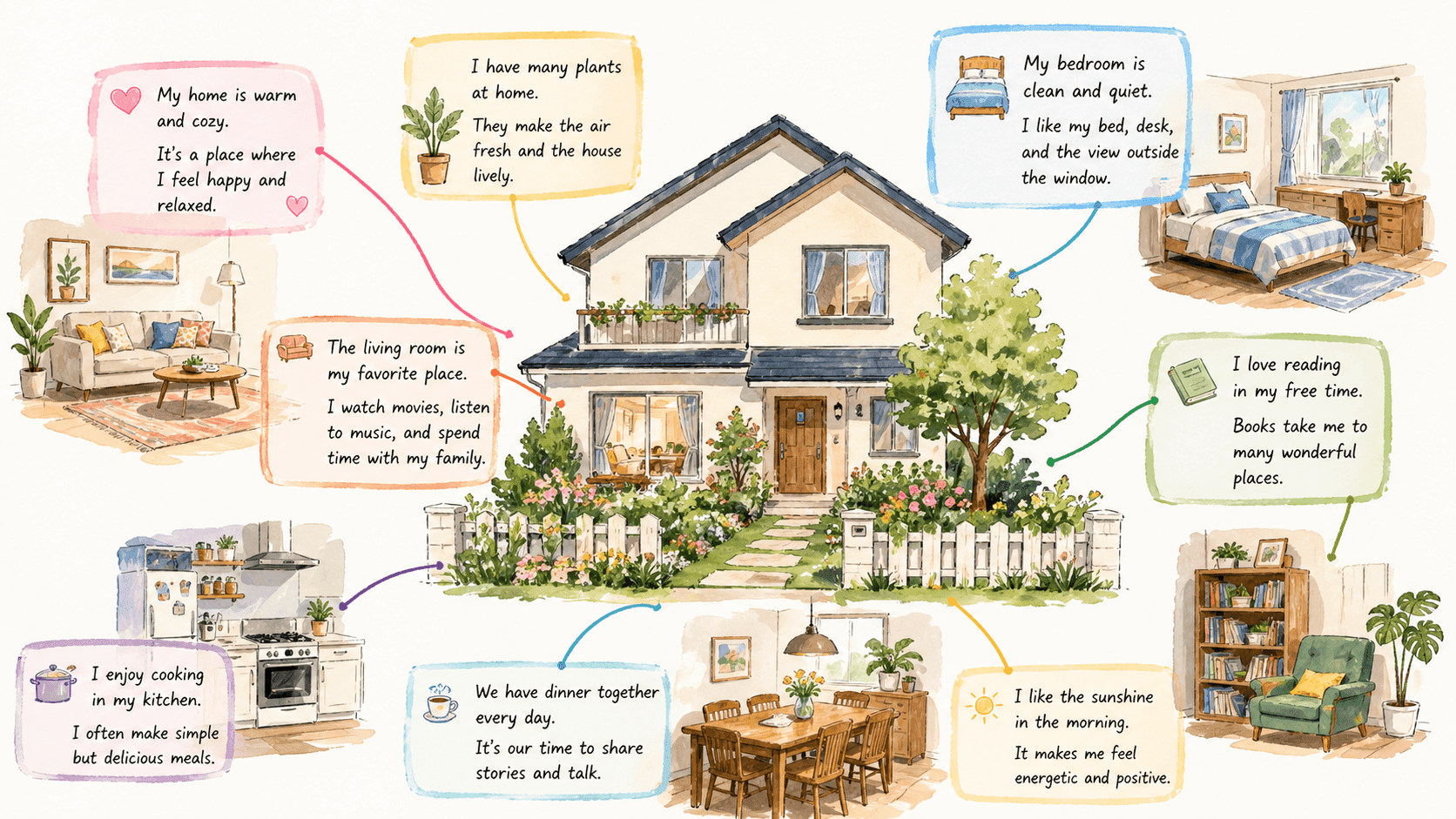
在开口介绍自己家的时候,很多同学首先会犯难:“我不知道怎么说那些家具的英文名字”,或者“说完 I live in an apartment 之后就卡住了,不知道后面该讲什么”。其实,想要用英语清晰又自然地描述自己的家,远远不止背下所有家具单词这么简单。更关键的是把握描述顺序和内容结构——先介绍房子的类型和所在楼层,然后说明房子的内部结构、各个房间布局,最后补充你对这个家的感受或者特别喜欢的地方。这样一套有逻辑的表达顺序,不但让对方更容易理解你的描述,也符合中英文介绍家庭时的共同思路,只不过核心表达方式变成了英语。
在实际交流中,有些同学可能会担心自己词汇量有限,无法细致描述每一件家具,其实完全没必要追求面面俱到。即使只用基础词汇,也能让叙述生动有温度。你可以通过以下几个方面来组织表达:
- 简要介绍户型,例如:“I live in a two-bedroom apartment on the tenth floor.”
- 描述房间之间的位置关系或整体布局。
- 分享你最喜欢的空间,比如:“My favorite place at home is the balcony, where I enjoy my morning coffee.”
- 最后用一句简单的话表达对家的感受或独特之处。
采用这样的表达顺序,即使词汇量有限,也能使描述清晰、自然、具有个人特色。
家的类型与楼层
在用英语描述“我家是什么样的?”时,首要的一步就是明确你的住所类型以及所在楼层,这不仅有助于别人立刻形成空间感,也展现你的表达条理。其实,这一逻辑和我们中文自我介绍时的惯常顺序很一致——先大致定位,再慢慢细化。不同的住房类型有各自专属于它的英文词汇,掌握这些能让交流更精准、更自然。
常见的住宅类型主要包括:
| 英文名称 | 中文解释 | 说明 |
|---|---|---|
| Apartment | 公寓 | 城市常见,多户型楼房,一套住宅可租或买,对应中文“公寓”或“楼房”。 |
| Flat | 公寓(英式) | 英式英语,含义同 apartment,常见于英联邦国家。 |
| House | 独立屋/别墅 | 独栋住宅,可带花园车库,不仅指豪华别墅,普通独立住宅也可称 house。 |
| Studio | 单间公寓 | 面积小,起居睡眠在同一开放空间,适合一人居住。 |
| Condo | 共管公寓 | 个人产权,通常有健身房等公共设施,美加常见。 |
| Townhouse | 联排别墅 | 多层住宅,与邻居共墙,兼有私人空间和社区氛围,常见于郊区。 |
除此之外,还有别墅中的“bungalow”(一层平房)、“villa”(豪华别墅)、“duplex”(双拼)、“cottage”(小屋)等词汇,遇到特殊户型时也可灵活使用。
说清房子的类型后,接下来要表达楼层。常用句型是 “on the Nth floor”。要特别注意:1楼的表达在英式和美式英语里完全不同——英国人说 ground floor(地面层)和 first floor,美国人则直接叫 first floor 和 second floor,经常因此容易产生误解。比如 someone living “on the first floor”,到底是在一楼还是二楼,就要结合语境分辨,或者补充更多细节以防混淆。
平时简单介绍可以这样说:
I live in a two-bedroom apartment on the 8th floor of a residential building.
我住在一栋住宅楼的8层,是一套两室的公寓。
该句遵循了 “I live in a + 户型描述 + apartment/house + on the + 楼层 + floor” 的结构。其中 “two-bedroom” 是复合形容词,中间用连字符修饰 apartment,清晰表达“两室”的意思。
更多表达示例:
-
I live in a three-bedroom house with a small garden.
我住在一栋带有小花园的三居室独立屋。 -
Our family moved to a penthouse on the twentieth floor last year.
我们一家去年搬到了二十楼的顶层公寓。 -
She lives in a cozy studio on the ground floor.
她住在一楼的一个温馨单间公寓里。 -
My grandparents own a little cottage near the woods.
我祖父母在树林附近有一间小木屋。
这些句式可以根据你家实际情况和场景自由组合。描述住所类型和楼层清楚后,交流会简单很多。
房间结构的描述
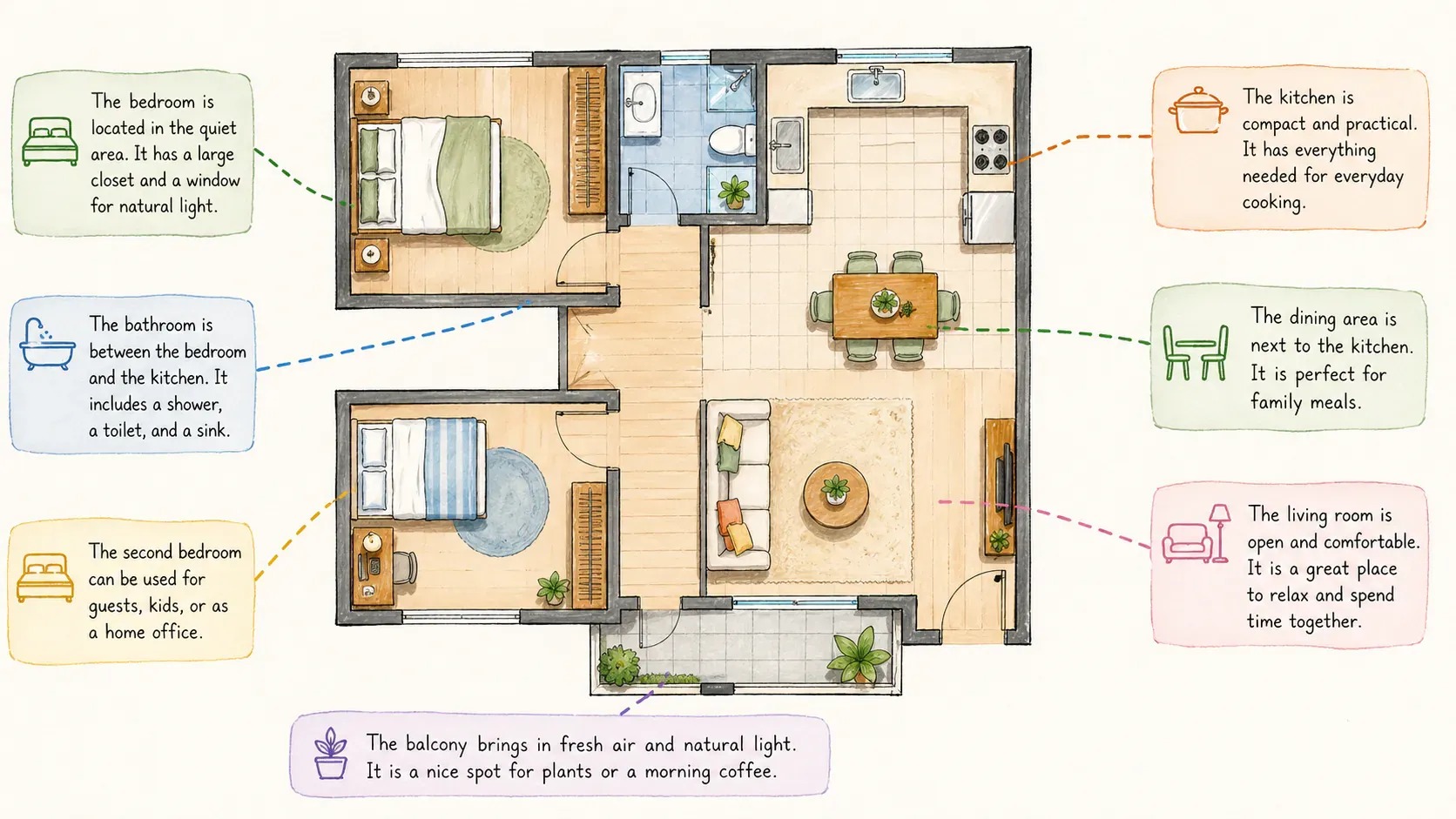
完成住所整体类型介绍后,自然要描述内部空间和房间结构,让别人对你家的“布局蓝图”有更鲜明的印象。英语里描述房间名称不难,但和中文逐个对照时,有些词比较容易混淆,需格外注意其本地用法。
用法说明举例:
- The study is right next to the living room.(书房紧挨客厅)
- The dining area is opposite the kitchen.(餐厅在厨房对面)
- The master bathroom is adjacent to the bedroom.(主卫和卧室紧邻)
- The study is right next to the living room.(书房紧挨客厅)
- The dining area is opposite the kitchen.(餐厅在厨房对面)
- The master bathroom is adjacent to the bedroom.(主卫和卧室紧邻)
要描述房间在几层楼上,可以用 “The + 房间 + is on the + 楼层 + floor”:
The master bedroom is on the second floor, and the kitchen is right next to the living room.
主卧在二楼,厨房就在客厅旁边。
口语中可自然替换表达 “right next to”(紧挨着),比单说 next to 更具生活气息。描述房间布局时还常用如下表达:
-
opposite(对面):The bathroom is opposite the guest bedroom. - 浴室在客卧的对面。
-
adjacent to(紧邻):The study is adjacent to the dining room. - 书房紧邻餐厅。
-
connected to(与……相连):The open kitchen is connected to the living area. - 开放式厨房与客厅相连。
-
at the end of the hallway(在走廊尽头):My room is at the end of the hallway. - 我的房间在走廊的尽头。
-
in the corner of(在……角落里):There’s a reading nook in the corner of the living room. - 客厅的角落里有一个阅读区。
你可以根据自己家的实际情况将上述句型灵活应用,既能提升表达的丰富度,也能让“云参观”你家的朋友有更清晰具体的空间想象。
家具与摆设
每个房间都承载着不同的功能,也配备着各自独有的家具。掌握核心家具词汇,是用英文清楚描述“我家”的第一步。下面根据常见家庭分区,进一步扩展和细化常用家具名词,让表达更加丰富:
中文的“衣柜”在英语里常见两种说法:wardrobe 用于欧式、大型或独立衣柜,closet 则是美式,通常指内嵌式的储藏空间或更衣衣帽间。公寓描述场景下更常用 wardrobe,但如果家中有 walk-in closet(步入式衣帽间),要用 closet。
有时还能细致到“小件”表达,例如 living room cushions(沙发靠垫)、bedroom lamp(卧室台灯)、kitchen stool(厨房高脚凳)、bathroom shelf(浴室置物架)等。这些生活化细节能让你的英文描述更加“有生活气息”。
描述家具位置的常用英文表达
家具的陈设位置是家庭布局的一大亮点。用结构化句型加上常用介词短语,表达就很清晰:
-
next to(紧挨着),例:The armchair is next to the bookshelf.
(扶手椅紧挨着书架。) -
in front of(在…前面),例:The coffee table is in front of the sofa.
(茶几在沙发前面。) -
behind(在……后面),例:The bed is behind the door.
(床在门的后面。) -
between ... and ...(在……和……之间),例:The desk is between the wardrobe and the window.
(书桌在衣柜和窗户之间。) -
in the corner of(在……角落里),例:There’s a floor lamp in the corner of the living room.
(客厅角落里有一盏落地灯。)
也可以描述“靠着某面墙”——against the wall(靠墙),如 The TV stand is against the wall by the window.
There's a large bookshelf next to the window, and a small coffee table in front of the sofa.
窗户旁边有一个大书架,沙发前面有一张小茶几。
你会发现,描述房间里的家具摆放,英文中常用“There is/are + 物品 + 位置”这种经典结构。例如:
- There's a desk in the corner of the study.(书房角落有一张书桌。)
- There are two armchairs in front of the window.(窗户前面有两把单人椅。)
- There is a rug under the coffee table.(茶几下铺着一块地毯。)
单数用 there is,复数用 there are,这是描述“某处有某物”最自然的英文表达方式。只要熟练掌握上面的家具词汇和位置表达方式,你就可以用英语自如介绍每个房间的布置细节了。建议根据自家实际,试着组合上述家具与介词短语描述一次你的房间,既能锻炼口语,也方便日后向外国朋友介绍自己的家。
描述位置关系的对话
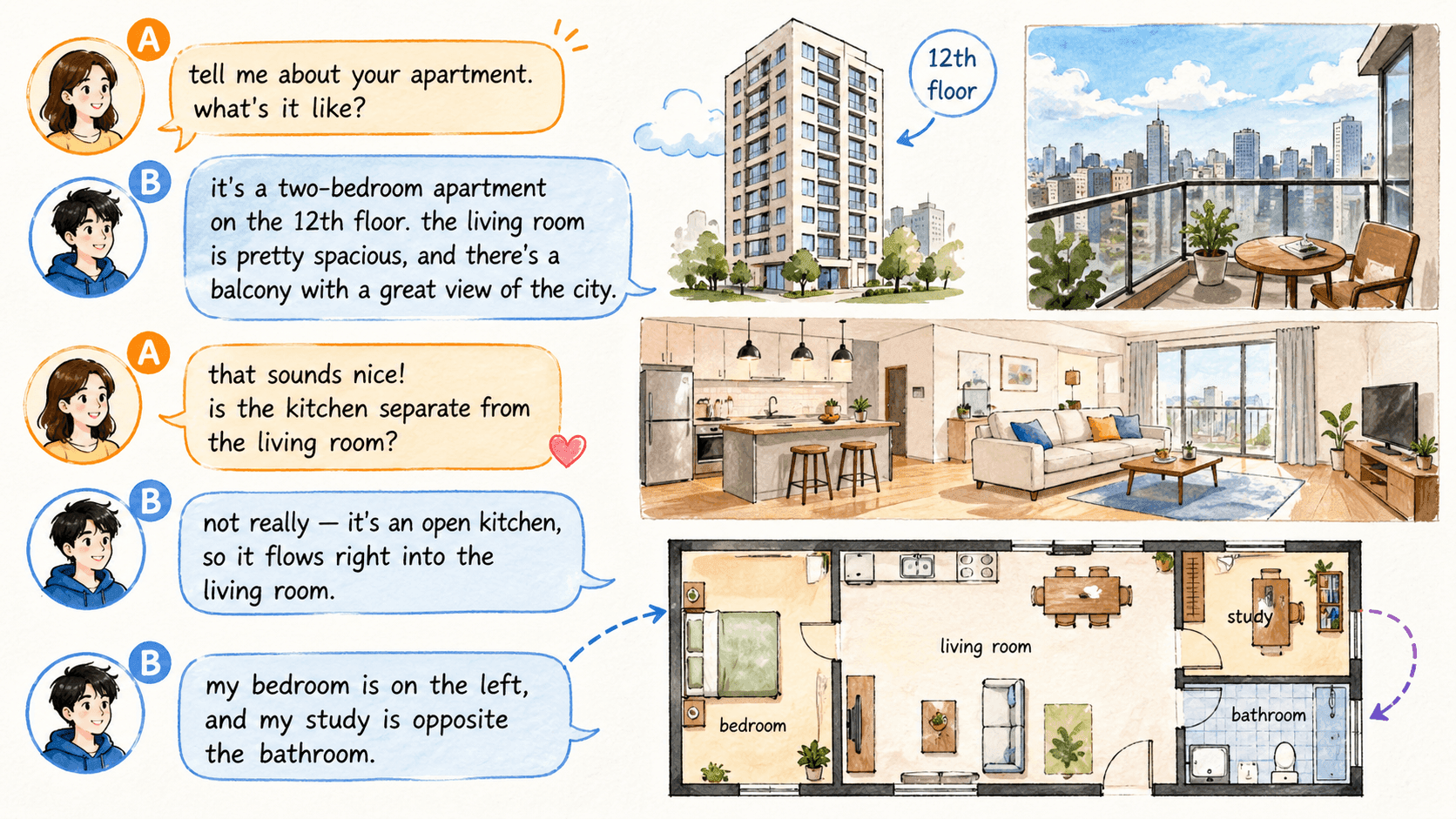
把上面学到的表达整合起来,看一段完整的描述对话:
A:Tell me about your apartment. What's it like?
告诉我你的公寓是什么样的?
B:It's a two-bedroom apartment on the 12th floor. The living room is pretty spacious, and there's a balcony with a great view of the city.
是一套两居室,在12层。客厅挺宽敞的,阳台上还能看到城市全景。
A:That sounds nice! Is the kitchen separate from the living room?
听起来很好!厨房和客厅是分开的吗?
B:Not really — it's an open kitchen, so it flows right into the living room. My bedroom is on the left, and my study is opposite the bathroom.
其实不是——是开放式厨房,和客厅连在一起。我的卧室在左边,书房在卫生间对面。
对话里有几个值得注意的表达:“flows right into” 描述两个空间自然相连,非常生动;“Not really” 是“不完全是”的自然回应,比直接说“No”更礼貌;“opposite the bathroom” 中 opposite 后面直接跟名词,不需要加 of。
表达大小与采光
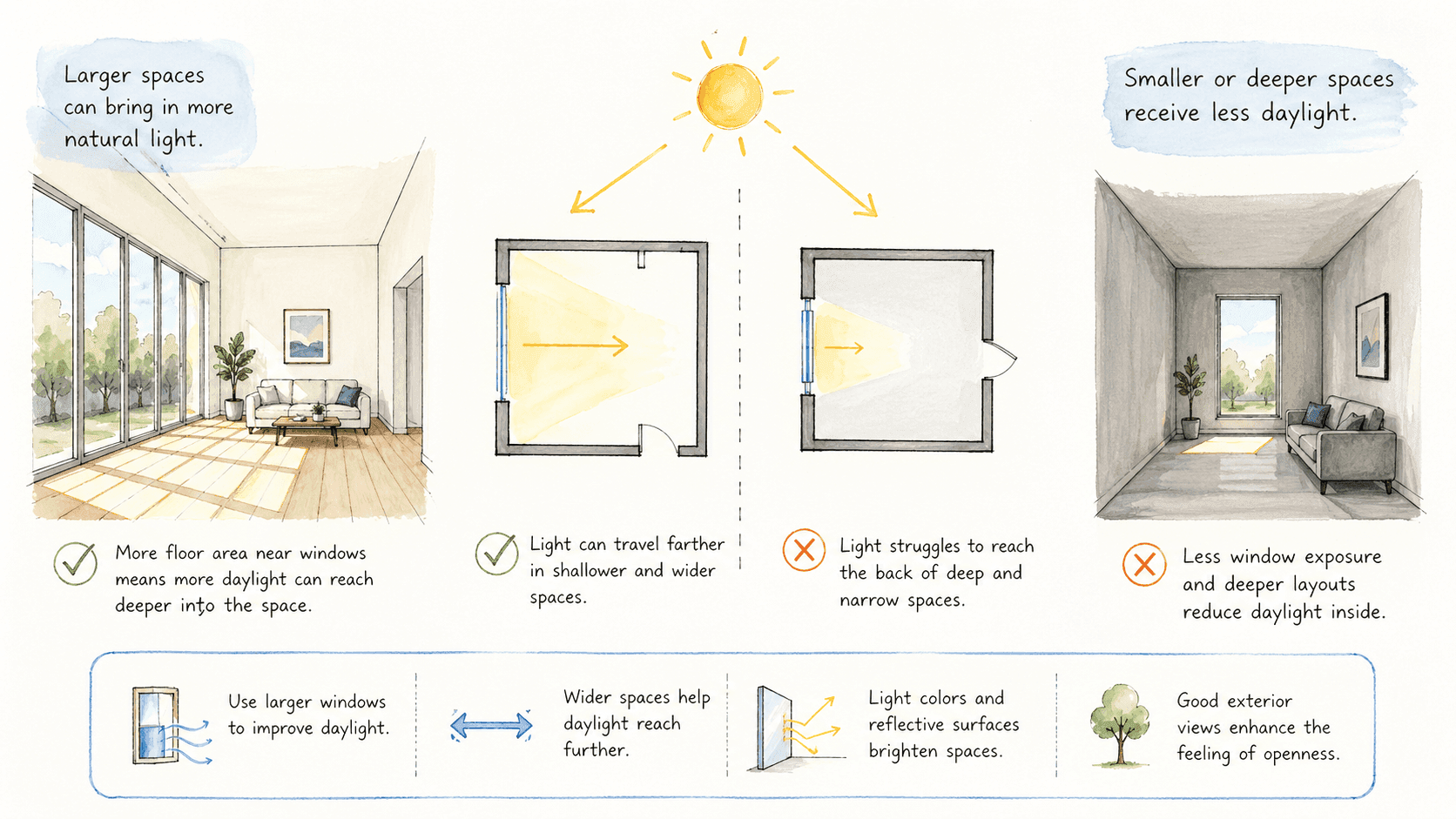
在描述家的时候,空间是否宽敞、明亮,可以说是中国人最关心的两个大因素。其实在英文中,关于“大小”和“采光”,也有很多地道、实用的表达,我们可以系统地学习一下。
描述空间大小
常见的形容空间大小的英文形容词及其用法有:
你还可以用 tiny(很小的)、huge(巨大的)、average-sized(中等大小的)等词进一步精确表达。
比如,“It's a small apartment, but the living room is surprisingly spacious.”(公寓虽小,但客厅出乎意料地宽敞。)
描述采光与朝向
良好的采光是很多人最看重的住房优点。英文中:
- natural light(自然光、自然采光),例如 The room gets plenty of natural light(房间采光很好)。
- bright(明亮的):The study is bright and airy(书房很明亮、通风)。
- light-filled(充满阳光的):It's a light-filled living room(客厅充满阳光)。
- sunny(阳光充足的):The balcony is very sunny in the afternoon(下午阳台阳光很好)。
- well-lit(光线充足的):The dining area is well-lit(餐区采光很足)。
关于朝向,常见表达包括:
- south-facing/north-facing(朝南/朝北的):The master bedroom is south-facing, so it stays warm in winter(主卧朝南,冬天很暖和)。
- 用 face 做动词直接表达,诸如 The windows face east, so the room is bright in the morning(窗户朝东,早上房间很亮)。
你可以根据不同的时段、空间直接扩展:
The living room faces west, so it gets the afternoon sun.
客厅朝西,下午有阳光。
The living room is quite spacious and gets a lot of natural light. My bedroom is a bit smaller, but it's cozy and faces south, so it's always warm in winter.
客厅相当宽敞,采光也很好。我的卧室小一点,但很温馨,朝南,所以冬天总是暖和的。
你还可以这样补充说明采光好自然氛围好的表达:
- “gets a lot of natural light”(采光好)是英语母语者最自然的说法,“gets a lot of sun”则更强调“晒太阳”,也很常用;
- 还可以说 “The apartment is filled with sunlight.”(公寓阳光充足),“The hallway is a bit dark as it doesn’t get much natural light.”(过道比较暗,因为采光不好)。
掌握这些表达后,可以灵活描述自家的空间和采光情况,让介绍更生动、地道。
表达居住感受与喜好
除了描述房屋的硬件条件,最后还可以补充介绍自己的居住体验和情感感受。这不仅让你的描述显得更有人情味,也能让交流更有共鸣,比如表达你喜欢这个家的哪些方面,或者有哪些不满意但能接受的小缺点。
有效地表达居住感受还能帮助对话顺利继续——对方有可能会根据你的分享,交流自己的类似经历或观点,使对话更加自然深入。所以,适当分享自己的真实感受是让整个房屋描述变得生动、立体的重要一环。
“The only downside is...”(唯一的缺点是……)和“It's a bit + 形容词 + but...”(有点……但是……)是表达委婉不满的经典结构,既诚实又不显得在抱怨,是非常有用的日常表达框架。
下面是一段自然表达居住感受的完整例子:
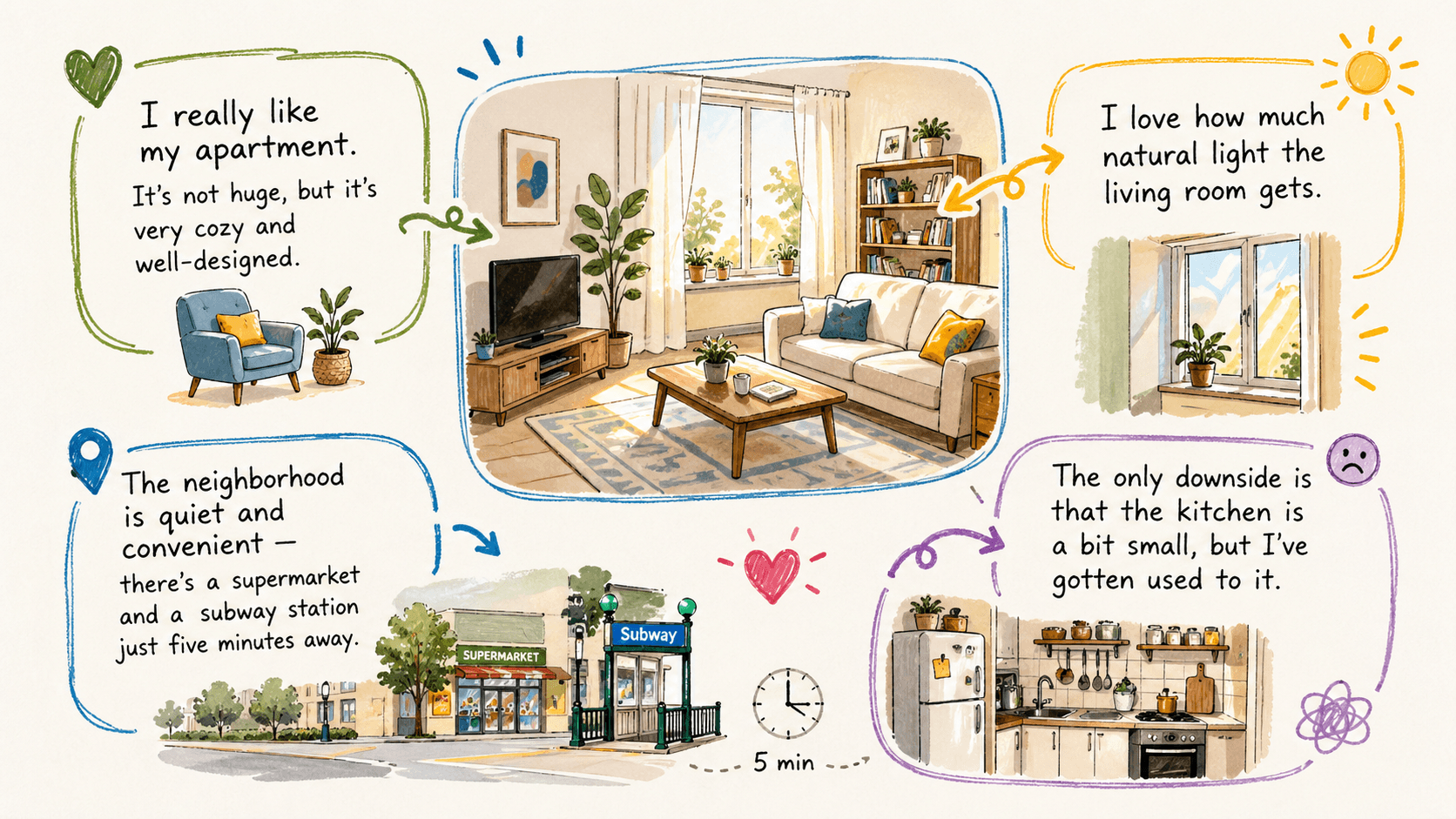
I really like my apartment. It's not huge, but it's very cozy and well-designed. I love how much natural light the living room gets. The neighborhood is quiet and convenient — there's a supermarket and a subway station just five minutes away. The only downside is that the kitchen is a bit small, but I've gotten used to it.
我很喜欢我的公寓。不是很大,但很温馨,设计也很合理。我特别喜欢客厅的采光。小区很安静,也很方便——步行五分钟就有超市和地铁站。唯一的缺点是厨房有点小,不过我已经习惯了。
注意 “I've gotten used to it”(我已经习惯了)——这是现在完成时的用法,表示过去开始、持续到现在的状态,和中文“已经习惯了”的含义完全吻合。“I'm used to it”也可以,但前者更强调“经过一段时间之后才适应”的过程感。
常见错误对比
学习描述“家”时,有几个错误是中国学习者特别容易犯的。理解这些典型错误,并掌握正确表达方式,有助于提升口语和写作的地道性。
错误1:把楼层说错
❌ I live on 8 floor.
✅ I live on the 8th floor.
解析:楼层前面必须加定冠词 the,楼层数必须用序数词(1st, 2nd, 3rd, 4th...)。例如:“I live on the 5th floor.” 而不是 “on 5 floor”。此外,on 是固定搭配,用 in 或 at 都不对。
补充:问别人住几楼时,正确问法是:
- Which floor do you live on? (你住在第几层?)
- Are you on the third floor or the fourth?(你是在三楼还是四楼?)
错误2:方位介词误用
❌ The bookshelf is in the window.
✅ The bookshelf is next to / by the window.
解析:“in the window” 英语里常指“摆在橱窗里展示的东西”,而不是指在窗户旁边。表示某物紧挨着窗户,英语习惯用 “next to” 或 “by”。
比如:The sofa is next to the window. (沙发在窗户旁边。)
补充:相关介词差异举例:
- in front of the window(在窗户前面)
- behind the door(在门后面)
- on the balcony(在阳台上)
错误3:There is/are 的数量一致
❌ There is two bedrooms in my apartment.
✅ There are two bedrooms in my apartment.
解析:当主语是复数(如 two bedrooms),需用 there are。如果主语是单数或不可数名词(如 a kitchen, some furniture),用 there is。
补充:
- There is a study in my apartment.(有一个书房。)
- There are three chairs on the balcony.(阳台上有三把椅子。)
错误4:混淆 some 和 any 的用法
❌ There isn’t some chairs in the living room.
✅ There aren’t any chairs in the living room.
解析:否定句和疑问句通常用 any,而肯定句用 some。
- There are some books on the table.(桌上有一些书。)
- Are there any pictures on the wall?(墙上有画吗?)
- There isn’t any milk in the fridge.(冰箱里没有牛奶。)
错误5:用错英语房型词汇
❌ My home has many rooms: a big hall, two sleeping rooms, and a cook room.
✅ My home has many rooms: a large living room, two bedrooms, and a kitchen.
解析:
- living room(客厅/起居室)
- bedroom(卧室)
- kitchen(厨房)
- dining room(餐厅)
避免直译“sleeping room”(应为 bedroom)、“cook room”(应为 kitchen)。
温馨提示:今后描述居住环境时,可以养成“定冠词 + 序数词 + floor”(on the 9th floor)、“next to/ by the window” 等表达习惯,并特别注意 there is/are、any/some 这类基础句型,也可以留意房屋常见的空间用词规范表达。
练习题
练习一(选择题)
下列哪个句子对“客厅朝南”的描述最正确?
A. The living room is in south direction. B. The living room faces south. C. The living room is at south. D. The living room looks at south.
练习二(选择题)
你的朋友问你住几楼,你应该怎么回答?
A. I live in 12th floor. B. I live at floor 12. C. I live on the 12th floor. D. I'm living in the floor 12.
练习三(选择题)
“There is two bedrooms in my apartment.”这句话有什么问题?
A. apartment 用错了 B. there is 应改为 there are C. bedroom 应该用单数 D. 句子完全正确
练习四(情景问答)
情景:你的外国同事第一次来拜访,他问:“What's your place like?”(你家是什么样的?)请用至少三句话描述你的住所,包含:住宅类型 + 楼层 + 一个你最喜欢的地方。
练习五(情景问答)
情景:你在描述自己家时想说“客厅不大,但很温馨,采光也好”,请用一句完整的英文表达。