逻辑连接
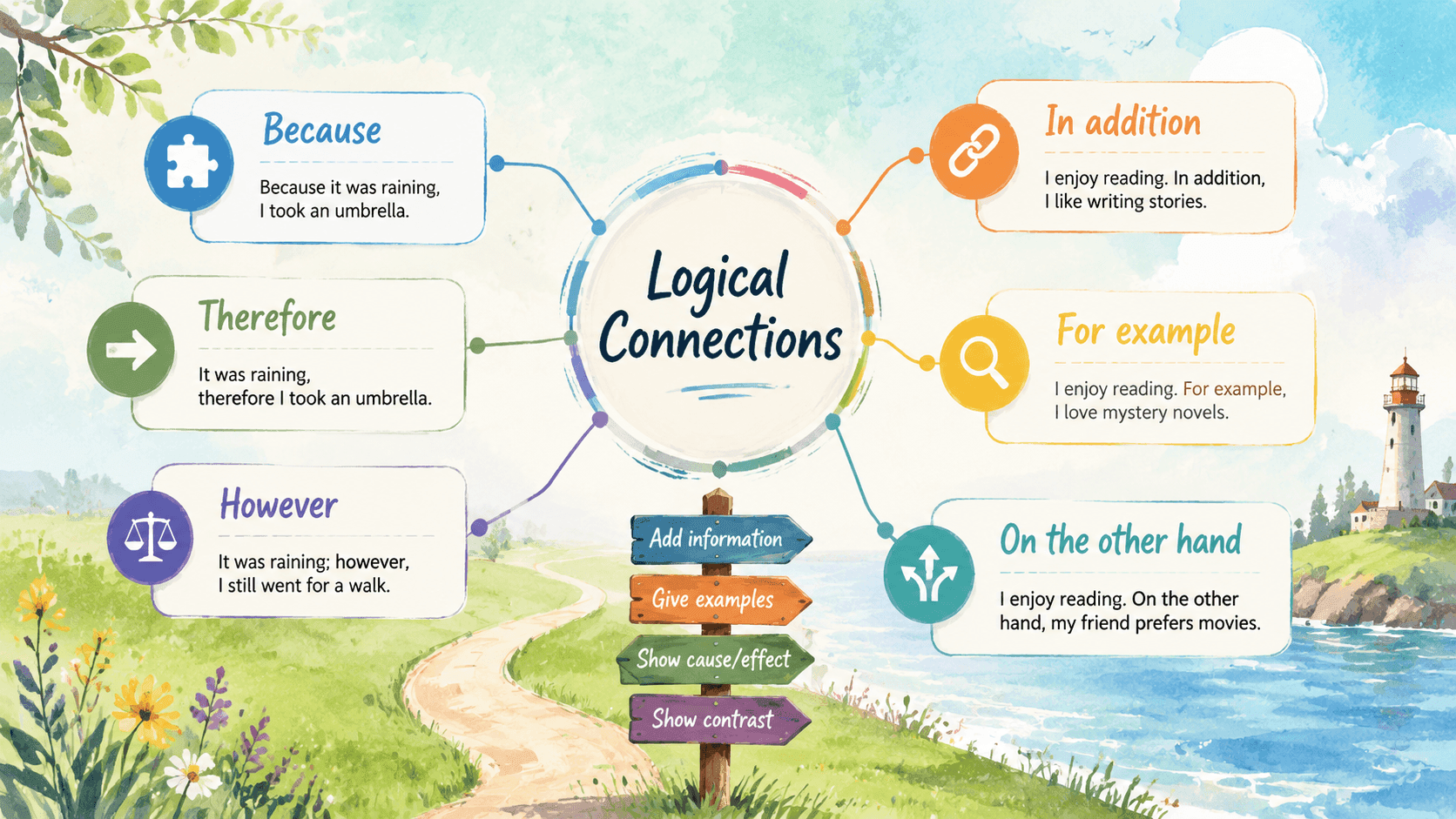
如果说词汇是砖块,那么逻辑连接词就是水泥。没有连接词,再高级的单词和句子也只是零散的表达;有了逻辑连接词,语言才能条理清晰、信息连贯,使交流更加顺畅。不论是日常对话、学术写作、还是正式演讲,逻辑连接词都在帮助我们明确地表达原因、结果、转折、递进、对比、条件等各种复杂的思想关系,使听众或读者能够轻松跟上我们的思路。
很多中国英语学习者在实际表达中,常常只用 and / but / so 这几种基础的连接词,一旦遇到更复杂的逻辑,往往就会词穷,无法准确展开自己的观点。其实,英语里针对因果、转折、顺序、举例、条件、让步、并列等不同逻辑关系,都有精准、丰富的连接词和表达方式。例如,描述原因时不仅可以用 because,还能用 since、as、due to、because of 等词;表达转折不仅有 but,还有 however、nevertheless、although、despite 等等。掌握这些表达方式,能让句子和段落的层次更加分明,让观点的逻辑展开更加自然有力。
逻辑连接词不仅仅是词汇层面的丰富,更体现了思维结构的严谨和表达习惯的提升。熟练运用多样的连接词,能够让你的英语表达更加地道、有说服力,也能帮助你更好地理解母语者的文章和演讲,感受英语思维的流动和逻辑的力量。
因果关系
引导原因的词
because(从属连词,引导原因从句)是最基础的因果词,几乎所有英语学习者都知道,但真正把它用对的人并不多——因为它的近义词 since / as / due to / owing to / because of 各有语法差异。
because 引导完整的原因从句(because + 主语 + 动词),因为语气最强,通常回答“为什么”的问题。since 和 as 也引导原因从句,但语气较弱,通常用于“原因是双方已知的、不是核心信息”的场合。

A:Why did you cancel the trip?
你为什么取消了旅行?
B:I cancelled it because I wasn't feeling well. Since the weather was also bad, it seemed like the right decision.
我取消了,因为我身体不舒服。由于天气也不好,这个决定似乎是正确的。
-
第一处用 because,是对“为什么取消”这个直接问题的正面回答,语气最强;
-
第二处用 since,引出“天气也不好”这个补充说明,语气相对轻松。
due to 和 because of 是介词短语,后面只能跟名词或名词短语,不能跟完整从句(不能跟“主语 + 动词”):“due to bad weather”✓ / “due to the weather was bad”✗。owing to 与 due to 用法相同,但更正式。
引导结果的词
结果类连接词放在“因”之后,引出“果”:so(连词,引导结果从句)、therefore(副词,“因此”,多用于书面)、thus(副词,“从而”,更正式)、as a result(固定短语)、consequently(副词,“结果”,正式)。
The team worked overtime for two weeks. 团队加班了两个星期。
As a result, they finished the project ahead of schedule. 结果,他们提前完成了项目。
转折与对比
转折词是写作中最能体现逻辑深度的一类词。初级用 but,进阶用 however、although、despite、whereas——差别不仅在于正式程度,更在于语法结构和句子层次。
but / however / although 的结构差异
but 是并列连词,连接两个平等的独立分句,放在句子中间,前面加逗号:“She was tired, but she kept working.”
however 是连接副词,不能和并列连词一样用。它有两种正确用法:
- 放在句首,后面加逗号(“However, the results were disappointing.”);
- 放在句中,前后都加逗号(“The results, however, were disappointing.”)。
however 不能直接放在逗号后面连接两个句子(不能像 but 那样用)。
although / though 是从属连词,引导让步从句。让步从句可以放在主句前也可以放在主句后:“Although it was raining, we went hiking.”= “We went hiking, although it was raining.”——两种顺序都对,但把让步从句放在前面,对比感更强。
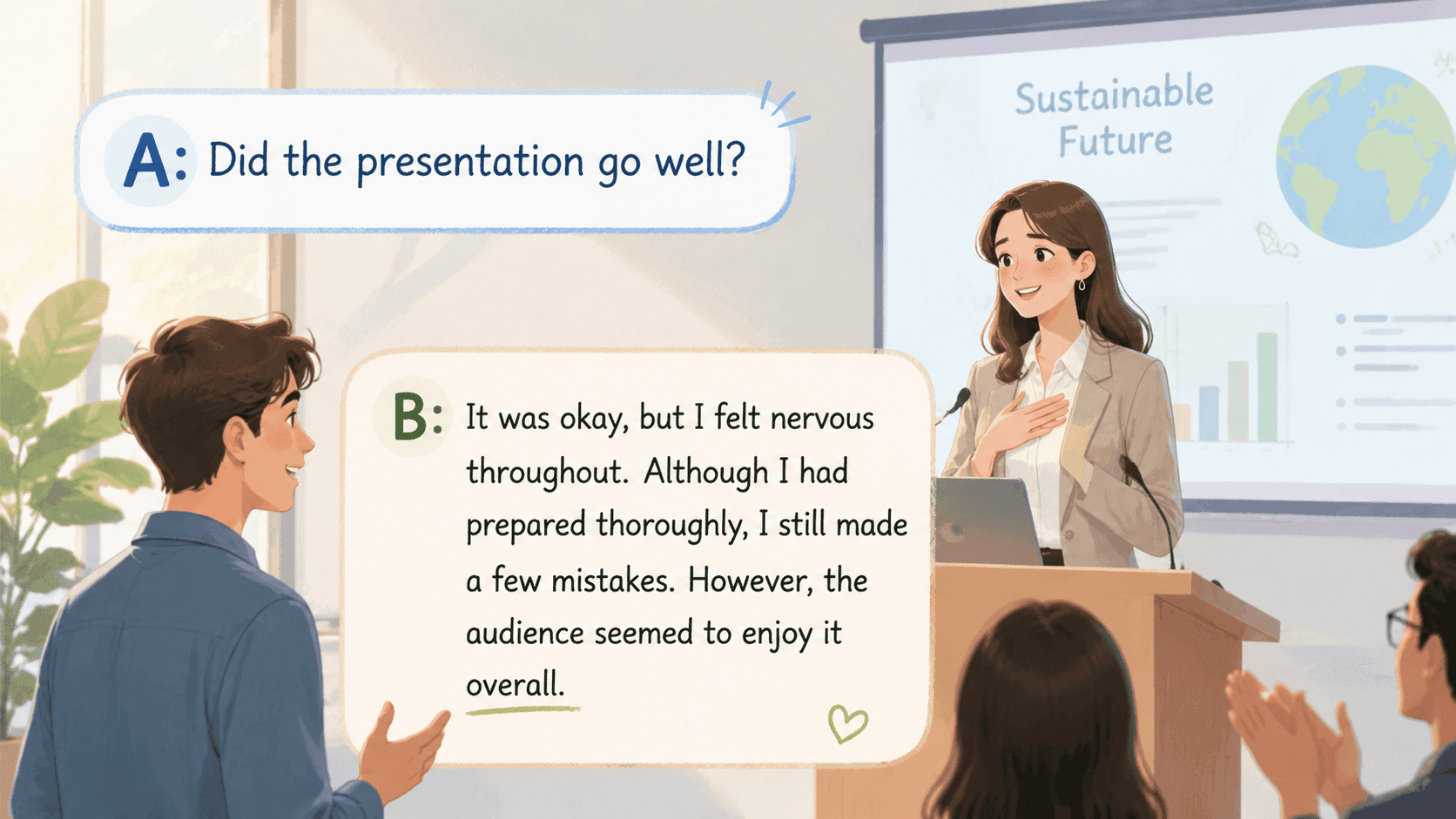
A:Did the presentation go well?
演讲进展顺利吗?
B:It was okay, but I felt nervous throughout. Although I had prepared thoroughly, I still made a few mistakes. However, the audience seemed to enjoy it overall.
还行吧,但我全程都很紧张。尽管我做了充分的准备,还是犯了几个错误。不过,观众整体上似乎很喜欢。
“but I felt nervous”——but 连接两个平等分句;“Although I had prepared”——although 引导让步从句放在主句前;“However, the audience”——however 放句首,后面加逗号,引入新的转折信息。三个转折词在同一段话里各司其职。
despite / in spite of 与 even though
despite 和 in spite of 是介词(短语),后面跟名词或动名词(-ing),不能跟完整从句:“despite the rain”✓ / “despite the fact that it rained”✓(通过 the fact that 将从句转化为名词短语)/ “despite it rained”✗。
even though 比 although 语气更强,强调让步的程度更出乎意料:“Even though she had almost no experience, she got the job.”(尽管她几乎没有经验,她还是得到了这份工作——出乎意料的程度很高。)
Despite the difficult conditions, the team completed the project on time. 尽管条件艰难,团队还是按时完成了项目。
In spite of the heavy traffic, she arrived at the meeting on time. 尽管交通拥堵,她还是准时到达了会议。
Even though the budget was cut in half, the quality of the work was outstanding. 即使预算被削减了一半,工作质量依然出色。
whereas 和 while 用于对比两个事物,强调两者之间的差异而非转折:“She prefers tea, whereas her husband drinks only coffee.”(她偏好喝茶,而她丈夫只喝咖啡。)这两个词描述的是并列的不同,而不是“虽然……但是”的退让关系。
顺序与递进

顺序词
顺序词用于描述动作的先后步骤,是说明文和叙述文中不可缺少的工具词。从表示“第一步”到“最后”,有一套完整的顺序词系统:
First / To begin with / To start with(首先)→ Then / Next / After that(然后/接下来)→ Meanwhile / At the same time(与此同时)→ Finally / Eventually / In the end / Lastly(最后)。
这些顺序表达不仅仅适用于描述流程(如操作指南、实验步骤),还可以用于叙述日常生活、事件进展,甚至在议论文中梳理思路。例如:
-
First, you should collect all the necessary documents before you start.
首先,你应该在开始前收集所有需要的材料。 -
Then, make sure to fill out the application form carefully.
然后,请确保认真填写申请表。 -
Meanwhile, keep an eye on your email for any important updates.
与此同时,注意查收邮件,及时获取重要通知。 -
In the end, submit everything before the deadline.
最后,请在截止日期前提交所有材料。
常见顺序词归纳如下:
To apply for the position, first send your CV to the HR department. Next, you will be contacted for an initial phone interview. After that, there may be a second round in person. Finally, a decision will be made within two weeks.
申请这个职位,首先把你的简历发给人力资源部门。接下来,他们会联系你进行初步的电话面试。之后,可能会有第二轮面对面的面试。最后,将在两周内做出决定。
有时也可以用 before, previously, earlier, afterwards, later 等表时间顺序,但它们侧重时间上的前后而非步骤的推进,如:
-
Previously, he worked as a journalist.
以前,他曾是一名记者。 -
Later, she became the CEO of the company.
后来,她成为了公司的首席执行官。
递进与补充
递进词表示在前面信息的基础上进一步添加信息,层次递进,说明信息越来越强或越来越重要:
also / in addition / additionally(另外,添加信息,语气相对中性)→ furthermore / moreover(此外,进一步补充,语气较强,有“更重要的是”的感觉)→ What's more / On top of that(而且,口语中用于递进强调)→ above all(最重要的是,放最后,强调最重要的一点)。
这些表达常用于议论文、说明文,让你的论点更有说服力、条理更清晰。具体使用时,可根据语境和语气强度选择合适的递进词。
The new policy will save costs. In addition, it will improve efficiency. Furthermore, it aligns with the company's long-term strategy. Above all, it benefits the employees.
新政策将节省成本。此外,它将提高效率。更重要的是,它与公司的长期战略保持一致。最关键的是,它让员工受益。
写作中,递进词常与表示顺序、对比的结构结合,让段落结构更紧密。例如:“First..., Furthermore..., Above all...”体现递进和重点突出。可根据内容逻辑调整递进词,增强表达的层次感。
举例与总结
举例词
举例词用于引出具体的说明案例,支撑前面的观点。常见的举例表达有:
for example 和 for instance:都表示“举个例子”,可以用在句首或句中,后面多跟完整的句子,常用于书面语和口语。例如:
-
For example, recycling can reduce environmental pollution.
例如,回收可以减少环境污染。 -
Many sports are popular in China. For instance, basketball and table tennis have millions of fans.
许多运动在中国很受欢迎。例如,篮球和乒乓球有数以百万计的粉丝。
在句中时,可以置于主语或谓语前后:
-
Some fruits, for example, oranges, are rich in vitamin C.
一些水果,比如橙子,富含维生素C。 -
Students should read more, for instance, newspapers and magazines.
学生应该多读书,例如报纸和杂志。
such as 和 like:用来列举某类事物中的例子,通常放在名词之后,后面不能跟完整的句子,只能列举名词或短语。such as 较为正式,like 稍口语。
-
I love tropical fruits such as mangoes and pineapples.
我喜欢热带水果,比如芒果和菠萝。 -
Some animals, like elephants and tigers, are endangered.
有些动物,比如大象和老虎,正处于濒危状态。
including:强调“包括……在内”,表明所列举是整体中的部分,用于突出部分例子,放在所列内容前面,也后接名词或短语。
- The course covers many topics, including grammar, writing, and speaking.
该课程涵盖了许多主题,包括语法、写作和口语。
小提示:for example/for instance 可以放句首或者句中,但 such as/like/including 不能单独成句,也不能跟完整句子。
Many common foods are high in nutrients. For example, leafy vegetables such as spinach and kale are rich in iron and vitamins.
很多常见食物富含营养。举个例子,菠菜和羽衣甘蓝这类叶菜富含铁和维生素。
-
Some jobs, such as doctors, require long-term training.
一些职业,例如医生,需要长期培训。 -
There are many ways to save energy, like turning off lights when leaving a room.
有很多节能方法,比如离开房间时随手关灯。
总结词
总结词是出现在段落或文章尾部,用于回顾、概括前面核心内容或观点的表达。常见有:
in conclusion / to conclude:表示“最后,总结全文”,通常用于文章或演讲结尾,总结主要结论。不能用于文章开头或中间,否则显得生硬。
- In conclusion, regular exercise is essential for good health.
总之,规律锻炼对健康至关重要。
to sum up / in summary / in short:表示“简而言之”,多用于简单回顾主要内容,风格较为口语。
- To sum up, this product is reliable and affordable.
总而言之,这个产品可靠且价格实惠。 - In summary, we should take action now.
总之,我们现在应该采取行动。
overall / in general:表示“总体而言”,给出宏观评价,大多用在最后一段或总述句。
- Overall, the response from customers has been positive.
总的来说,客户的反馈一直是积极的。
in other words:不是纯粹的总结词,而是用来换一种方式解释或重述刚刚说过的意思,使听众或读者更好地理解。一般放在句中。
- He is frugal. In other words, he doesn’t like to waste money. 他很节俭。换句话说,他不浪费钱。
- In other words, I'm not sure if I can help you.
换句话说,我不确定是否能帮你。
注意: in conclusion 通常只在全文结尾出现,是一种“我要结束了,请注意结论”的信号。不能滥用于文章起始或中间,否则逻辑不当。另外,in other words 并不新提要点,只是换一个角度、方式解释刚才的信息。
-
The project was a complete success. In short, everyone was satisfied with the result.
项目非常成功,简言之,大家都很满意这个结果。 -
In general, teenagers spend a lot of time on their phones.
总体上,青少年花很多时间玩手机。
条件与让步
条件词
条件句用于表示某一条件成立时,结果会发生。英语中最基础的条件连词是 if。
if:连接主句和条件句,直接表达“如果”。
- If it rains tomorrow, we will cancel the picnic. 如果明天下雨,我们就取消野餐。
- If you have any problems, please let me know. 如果你有什么问题,请告诉我。
unless:意思是“除非……否则……”,相当于 if...not 的意思。
- Unless you work harder, you won't pass the test.
除非你更努力,否则你不会通过考试。 (= If you don't work harder, you won't pass the test.)
as long as 和 provided (that):正式表达“只要……”,表示某条件满足,就可以得到某结果,语气比 if 强强调限制条件。
- You can join the tour as long as you register in advance.
只要你提前注册,就可以参加这次旅行。 - You may borrow this book provided that you return it on time. 你可以借这本书,只要你能按时归还。
even if:表示强让步,“即使……”,用来强调这个条件成立与否都不会影响结果。
- Even if you miss one class, you can watch the recording later. 即使你错过一堂课,你也可以稍后观看录像。

A:What if I can't make it to the meeting in person?
如果我没法亲自参加会议怎么办?
B:No problem. You can join online, provided that you have a stable internet connection. Even if you lose connection halfway, we'll send you the recording.
没问题。只要你有稳定的网络连接,就可以在线参加。就算中途断网,我们也会把录像发给你。
小结
- if = 如果
- unless = if...not = 除非
- as long as / provided (that) = 只要
- even if = 即使
这些条件和让步连词经常出现在考试句型、日常表达和正式写作里,区分并灵活运用能提升句子复杂度和逻辑性。
练习题
第一题(选择题)
知识点:because 与 because of 的语法差别(连词 vs 介词短语)
选出语法正确的句子:
A. The event was cancelled because of it was raining heavily.
B. Because the traffic was terrible, we arrived two hours late.
C. She was promoted because of she worked so hard.
D. Due to he was sick, he couldn't attend the conference.
第二题(选择题)
知识点:however / although / despite 的语法结构区别
下列哪个句子中连接词的用法是正确的?
A. Although she was exhausted, but she finished the marathon.
B. Despite of the cold weather, he still went for his morning run.
C. The plan seemed reasonable; however, several team members had concerns.
D. However she tried, she couldn't solve the problem.
第三题(选择题)
知识点:顺序词与递进词的选择
为下列段落选择最合适的连接词,使逻辑清晰流畅:
“To improve your vocabulary, _____ try to read in English every day. _____, keep a vocabulary notebook to record new words. _____, the most important thing is to use the words you learn in real conversation.”
A. First / In addition / Moreover
B. However / Then / Above all
C. First / Then / Above all
D. First / Furthermore / Therefore
第四题(情景问答)
知识点:whereas / while 表对比,以及 in other words 的用法
用一段三到四句话的段落,描述城市生活与乡村生活的对比,要求:使用 whereas 或 while 表达对比,并在段末用 in other words 换一种方式总结你表达的核心观点。
第五题(情景问答)
知识点:综合运用因果、转折、顺序和条件连接词
阅读下面这段逻辑混乱的文字,用合适的连接词(任选其中5个:because / although / however / therefore / first / furthermore / unless / as a result / in other words / such as)对其进行重写,使段落结构清晰、逻辑连贯:
“Many people don't exercise. They are busy. They get sick. They have health problems. They should change their habits. It is hard. They need support.”