STAR 结构讲故事
讲故事,是人类沟通和传递经验的独特方式。从远古篝火旁人类相互交流,到现代社交、职场合作、公共演讲,讲故事始终是拉近彼此距离、激发共鸣、传播思维与价值观的关键手段。无论是在团队协作中总结经验、在会议上激励同伴,还是在日常生活中与朋友分享一段趣事,有逻辑、有情感、有画面感的讲述都比单纯列举事实更具说服力和感染力。
尤其是在英语表达中,善用故事结构能帮助你清晰地展示思考过程、突出自己的角色和贡献,并让听众真正“看到”你描述的场景。这不仅适用于面试或演讲,只要你希望让观点被理解、让经历被记住,都可以通过讲故事的方式来实现。
一个好的故事,会自然而然引导听众进入情境,在叙述中体会冲突、感受变化、记住启发。它不是机械地罗列事实,而是有节奏、有重点、有温度地还原过程和细节。这种能力,是任何语言沟通高手共同拥有的核心素养之一。
STAR 框架
在结构化讲故事的众多方法中,STAR 框架是最被广泛应用、最容易上手的一种。它不仅适用于面试题“Tell me about a time...”的回答,其实任何需要表达个人经历、体现思考和解决问题能力的场合都可以用它来组织叙述。不管是项目复盘、团队分享,还是日常沟通,STAR 都能帮你有条理、有重点地让听众“走进你的故事”。
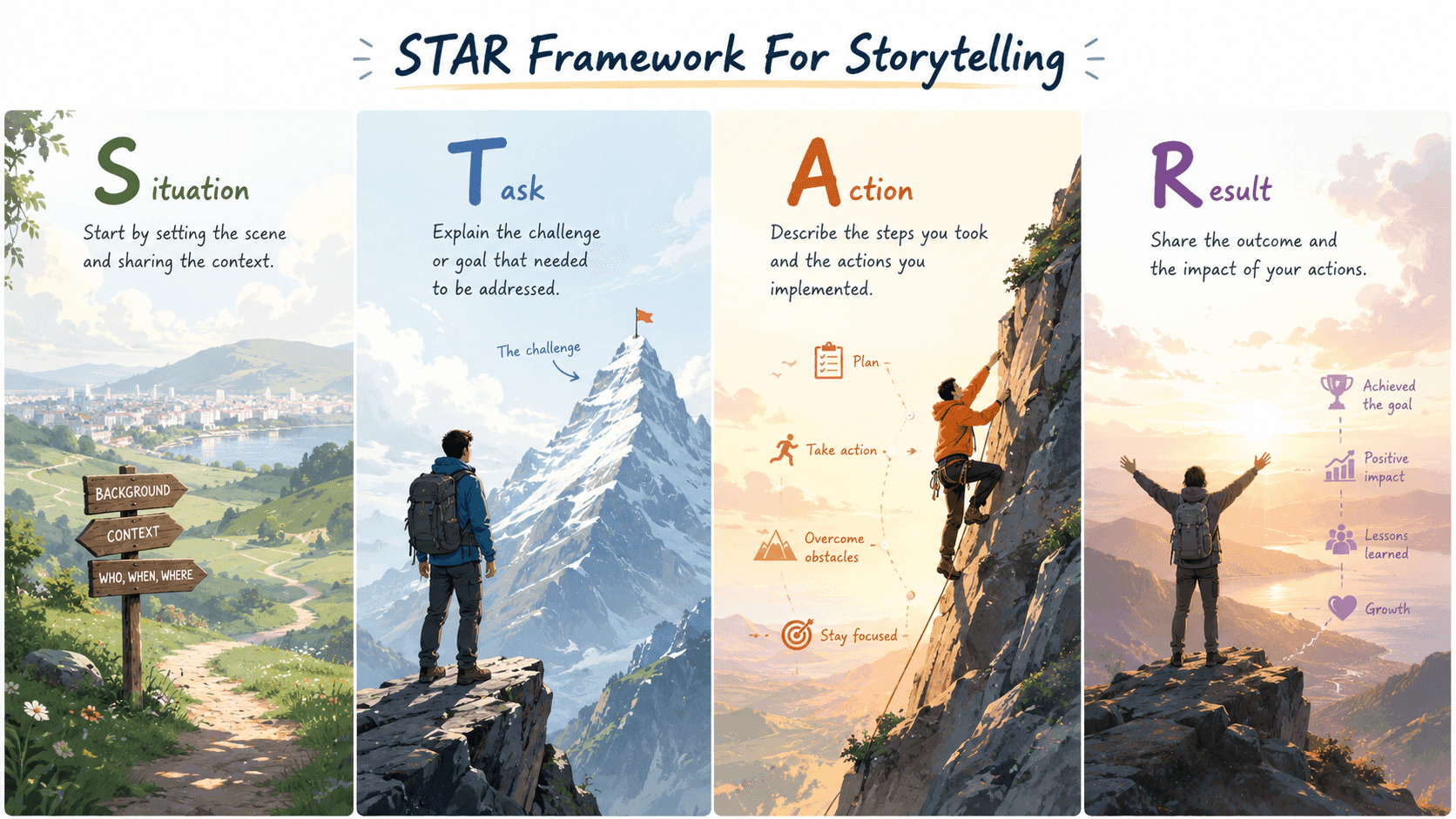
STAR 代表四个步骤:Situation(背景)、Task(任务)、Action(行动)、Result(结果)。这四步构成了一个完整故事的基本骨架,每一步都有不可替代的作用。如果遗漏其中任何一步,故事就会缺乏逻辑和完整性,让人难以感同身受。
Situation(情境/背景,约 15%)
首先,简要交代事情发生的背景,包括时间、地点、相关人物或团队,以及事件的起因。例如:当时是什么环境,发生在什么时候,谁参与了进来?可以自问:“当时是什么环境/条件?有哪些人或团队参与其中?”
Task(任务,约 15%)
接着,要说明你具体面临什么挑战或目标。大家对你的期待是什么?你肩负了哪些任务与责任?可以思考:“你的责任或目标是什么?当时最大的难题是什么?”
Action(行动,约 50%)
这是故事的核心内容。详细描述你采取了哪些措施、做出了哪些决策,以及你个人在整个过程中的具体贡献。注意写清楚每一步的操作和想法,让听众看到你如何解决问题。可自问:“你采取了哪些具体步骤?遇到阻力时你是如何应对的?”
Result(结果,约 20%)
最后,说明事情的结果以及你的收获。结局如何?团队或你个人取得了怎样的成果?有没有带来什么转变或启发?可以问自己:“最后发生了什么?你或团队有哪些具体的收获?”
注意比例:A(行动)应该占故事长度的一半左右。很多人讲故事时花大量篇幅在背景(Situation)和任务(Task)上,导致“行动”只一句带过,这会让故事显得空洞、缺乏说服力。好的 STAR 故事,关键细节和转折点都要体现在 A 部分,用具体的动作、选择、心理活动丰富故事内容。例如,与其简单说“我解决了问题”,不如细致描述“我先怎么发现症结、如何与谁沟通、做了哪些尝试、遇到哪些障碍、又怎么调整方案”等具体过程。
四步中每一步都要简明交代,切忌颠倒、跳跃顺序。比如,不要先抛出结果,再补充前因后果——要像画线一样,自然地从背景过渡到困难,再具体叙述行动,最后给出结果和感悟。这样听众才能顺着你的思路,情感上和你产生共鸣。
还可以“加戏”:在 STAR 四步基础上,适当补充你当时的感受(如焦虑/兴奋)、团队气氛、冲突对话和过程小插曲等,都能让故事更有层次,更具画面感。但结构一定要清晰——让每一步的作用分明,逻辑自然衔接。这样讲出来的故事才真正“好听又好记”。
STAR 故事示例(工作场景)
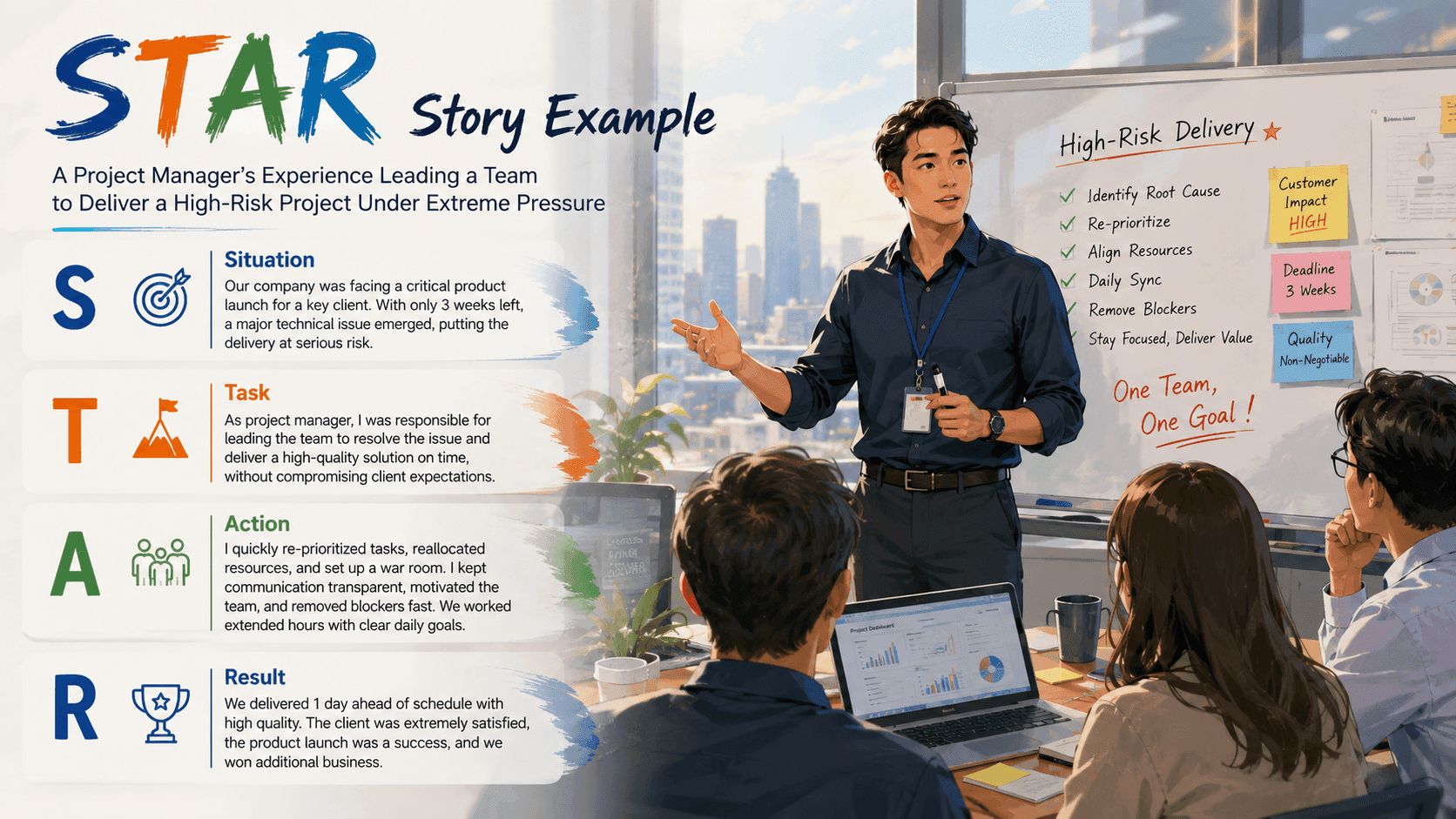
下面是一个完整的 STAR 故事,来自一位项目经理讲述如何在极端压力下带领团队完成高风险交付任务的经历。请留意每个部分如何顺畅衔接,尤其是“行动”部分的细节丰富到能让人沉浸其中。
S — Situation(背景)
It was a Friday afternoon in March, about two years ago. I was managing a software project for a healthcare client, and we had a major release scheduled for the following Monday morning. Everyone was expecting a smooth launch — we had been preparing for weeks, going through multiple test rounds, and the mood in the team was actually pretty upbeat right before things suddenly changed.
那是大约两年前的一个三月份星期五下午。我当时在为一个医疗客户管理一个软件项目,我们计划在接下来的星期一上午进行重要的版本发布。所有人都期待着顺利上线——我们前期反复测试、准备了好几周,团队气氛原本非常积极,直到那一刻发生了急转。
T — Task(任务)
At 4 PM, our lead developer discovered a critical bug in the payment processing module—the kind that could expose patient billing data. We had exactly 64 hours to fix it, retest everything, and still make the Monday launch. Failure wasn't an option: this module handled sensitive information, and any leak would seriously damage both the client's reputation and our company's credibility. I felt a huge weight pressing on my shoulders—but I knew I couldn’t panic. I had to quickly lead the team to find a solution.
下午 4 点,我们的首席开发发现支付处理模块中存在一个关键漏洞——那种可能导致病人账单数据被泄露的问题。留给我们的时间只有 64 小时,必须完成修复、全部重新测试,还要确保赶上周一上午顺利上线。失败根本不是选项:这个模块处理着极其敏感的信息,哪怕一点泄露都会严重损害客户声誉,也会动摇我们公司的公信力。那一刻责任如山压在我肩头,但我明白,绝不能慌乱,必须立刻带领团队找出解决方案。
A — Action(行动)
My first call was to the client. I didn't sugarcoat it — I told them exactly what we found and what we were doing about it. They appreciated the transparency. We agreed to keep them updated every few hours, so they felt included rather than left in the dark.
我的第一个电话是打给客户的。我没有粉饰太平——我直接告诉他们我们发现了什么,以及我们正在做什么。他们很感激这种透明度。我们约定每隔几个小时就更新一次进展,让客户始终“在场”,而不是被蒙在鼓里。
Then I split the team into two groups: one focused entirely on the bug fix, and the other on regression testing — making sure our fix didn't break anything else. I set up a shared document so everyone could see real-time progress and flag blockers immediately. We set up a separate chat channel just for critical updates, and made sure each hour ended with a brief alignment: what's blocking us, who needs support, and what's working.
然后我把团队分成两组:一组全力修复漏洞,另一组专注回归测试,确保修复不会“牵一发而动全身”。我搭建了一个共享文档,每个人随时同步自己的进展和遇到的问题。我们还专门建了一个聊天群,只发最关键的进度提醒,并且每小时都快速对齐一次所有人状态:哪里卡住了,谁需要支援,哪些尝试是有效的。
We worked through the night. At 2 AM, the office was completely silent except for keyboard sounds and the occasional “got it” when someone solved a piece of the puzzle. I stayed on-site the whole time — not because I could write code, but because the team needed to know that leadership wasn't going to disappear when things got hard. I also made sure there was coffee and snacks for everyone. Occasionally, I would walk around, check in quietly with people who looked stuck, and encourage short breaks to keep energy up.
我们通宵工作。凌晨 2 点,整个办公室除了键盘声和偶尔有人破题喊出的“搞定了”,其余一片寂静。我全程都待在现场,并不是为了写代码,而是要让团队看到,无论多难,管理层都不会抽身离开。我还帮大家准备咖啡和小零食。间或会在工位间小范围走动,默默关注每个成员的状态,遇到明显情绪紧绷的就悄声问一句,要不要休息一下,保障体力和专注。
R — Result(结果)
We fixed the bug by Sunday morning, completed all testing by Sunday night, and launched on time Monday morning. The client sent a written commendation to our company leadership. But more than the launch, what I took away was this: transparency in a crisis builds more trust than a perfect track record. People remember how you behave when things go wrong. The team told me afterwards that feeling trusted and supported helped them push through exhaustion and pressure.
我们在周日上午修复了漏洞,周日晚上完成了所有测试,并在周一上午按时发布。客户向我们公司高层特地发来表扬信。但比“成功上线”更有价值的,是我最大的收获——危机时的坦诚和互信,比一张完美履历更能赢得信任。很多同事后来私下和我说,正是这种被信任和被支持的感觉,让他们顶住了压力,坚持了下来。这种时刻,团队凝聚力也迎来了质的提升。
让故事生动的四种技巧

结构只是骨架,细节才是让故事呼吸的血肉。善用细节不仅能让故事更容易被记住,更能让听众沉浸其中、产生情感共鸣。以下四种技巧,是让同一个故事在不同听众耳中产生截然不同效果的“秘诀”。
1. 感官细节
普通版: It was late at night and we were very tired.(那天夜很深,我们都很累。)
生动版:
It was 2 AM, the office was empty except for our team, and the only sound was the hum of the air conditioning and the clicking of keyboards.
凌晨 2 点,办公室里除了我们团队没有别人,唯一的声音是空调的嗡嗡声和键盘的敲击声。
感官细节的力量在于“让听众进入场景”。不仅仅是告诉他们“我们很累”,而是用声音、画面、气味等感官线索,把这一刻“画”出来。当你说“the hum of the air conditioning”,听众的大脑会自动构建那个安静、紧张的深夜场景。这远比“it was very late”有力得多,也更难忘。
对比记忆:试着想想,我们记住的许多难忘时刻,其实都和某个特别的声音、气味或颜色有关。
2. 情绪词汇
普通版: I was surprised and happy when we succeeded.(我们成功时我又惊喜又高兴。)
生动版:
When the final test passed, I felt this wave of relief — like a weight I'd been carrying for three days just dissolved.
当最后一个测试通过时,我感到一阵如释重负——就像我背负了三天的重担突然消散了。
这里的区别在于,“Surprised and happy”是简单地告诉听众“我什么感受”;而“a wave of relief”、“a weight dissolved”则能让听众自然而然地把这种情绪感同身受。情绪词汇的目标是激发共鸣,而不只是陈述事实。你也可以尝试用比喻、类比描述心情,画面感更强。
3. 对话还原
普通版: My manager told me the situation was very serious.(我的经理告诉我情况非常严重。)
生动版:
My manager looked at me and said, “I need you to be honest with me right now — can we fix this?” And I thought, I don't know yet, but I'm going to find out.
我的经理看着我说:“我现在需要你跟我说实话——我们能修复这个问题吗?”我心里想,我现在还不知道,但我会弄清楚的。
还原真实对话是让故事“活起来”最有力的方式之一。哪怕是简单的一句“他说:……”,都会让听众仿佛进入那个场景,感受到现场的气氛和压力。你可以适当加上一些动作、表情描写,比如“他一边叹气一边说……”,更有画面感。
4. 数字具体化
普通版: We didn't have much time.(我们时间不多。)
生动版:
We had exactly 64 hours. I wrote it on the whiteboard in big numbers so everyone could see it every time they looked up.
我们恰好有 64 小时。我把这个数字写在白板上,用大字体,这样每次有人抬起头都能看到它。
“We had exactly 64 hours”远比“we didn't have much time”更有冲击力。具体的数字(不论多还是少)能让听众产生“量化的压迫感”或者“动力感”。你也可以用数字量化成果,比如“缩短了 2 周”、“业绩提升了 30%”,让结果变得真实又令人信服。
这四种技巧可以单独使用,也可以灵活组合。只要抓住【场景画面、细腻情绪、真实对话、具体数字】,你的故事会比“流水账”更容易让人记住、产生共鸣,甚至激发行动力。
STAR 在不同场合的应用
虽然很多人第一次接触 STAR 框架是在求职面试中,其实这个结构化讲故事的工具,在各种正式与非正式的交流场景下同样非常实用。掌握 STAR,你不仅能在“Tell me about a time…”这样的问题下游刃有余,还能让你的团队分享、演讲甚至日常沟通都更加有条理、有感染力。
举例说明:
- 在面试时,面试官更关注你“做了什么(Action)”和“带来了什么实际效果(Result)”,因此讲述时需要把行动步骤和成果量化、细化,比如“提升了 30%”“节省了两周时间”。
- 团队分享时,STAR 有助于系统化地展示你是如何解决问题,以及在过程中学到了什么,这对建立团队信任和传播经验尤其有帮助。
- 演讲开场时,一个生动的 Situation 能吸引听众立刻进入故事情境,拉近距离,让主题更具吸引力。
- 在说服他人时,通过 STAR 讲述真实案例,尤其是能带来积极结果(Result)的故事,会极大提升你的论点说服力,让人信服你的建议。
需要注意的是,面试中的 STAR 和日常讲故事还是有一些细微差别:面试更倾向于数据、量化结果,突出你的个人贡献和影响力;而日常交流、多数公开分享则侧重故事的情感共鸣、价值观传递,不一定需要数字,但要让听众产生认同和共感。善用 STAR,你会发现自己的沟通影响力大大增强,无论在什么场合,都能让自己的故事被更多人记住、认可。
练习题
第一题(选择题)
知识点:STAR 各部分的比例
在 STAR 故事中,哪个部分应该占最大的比例?
A. S(背景),因为背景不清楚的话听众会迷失
B. T(任务),因为要说清楚面临的挑战
C. A(行动),因为这是故事的核心和最有价值的部分
D. R(结果),因为听众最想知道最后结果如何
第二题(选择题)
知识点:感官细节的作用
以下两个句子,哪个更能让听众“进入故事场景”?
A. It was a very difficult and stressful situation.
B. It was 3 AM, the deadline was in six hours, and I could hear my own heartbeat.
第三题(选择题)
知识点:对话还原的效果
在讲故事时,“还原真实对话”(如:“He looked at me and said, 'This is impossible.'”)的主要作用是?
A. 证明你的记忆力很好
B. 让听众感觉自己置身现场,增加故事的真实感和戏剧性
C. 让故事更长,内容更丰富
D. 帮助听众记住故事中的人物名字
第四题(情景问答)
知识点:STAR 结构练习
用 STAR 框架讲述一次你“犯了一个错误,然后从中学到了重要教训”的经历(约 6-10 句话)。不需要真实经历,可以基于常见的学习或工作场景创作。请在每个部分前标注 S/T/A/R。
第五题(情景问答)
知识点:让故事生动的技巧
以下是一个“普通版”故事片段,请用“感官细节”、“情绪词汇”和“对话还原”三种技巧中的至少两种,改写这段话,让它更生动有力。
原版:I was very nervous before my first presentation. My manager said I would do fine. In the end, it went well and I felt relieved.