演示结尾与问答处理

演示进行到最后阶段,很多人会松一口气:内容都讲完了,只剩收尾了,应该最简单。但这个认知恰恰是演示最后一道坎上最常踩到的陷阱。结尾和问答环节是听众对这场演示形成“最终印象”的时刻。心理学中有一个著名的“峰终定律”——人们对一段体验的记忆,主要由两个时刻决定:体验中的高峰,以及体验如何结束。一个平淡、仓促或混乱的结尾,会拉低听众对整场演示的整体评价,哪怕前面讲得再好。
更需要注意的是 Q&A 环节。对于许多职场人来说,Q&A 是整场演示中压力最大的部分。你无法预测听众会问什么,也无法提前准备好每一道题的标准答案。有人可能会问一个让你一时语塞的问题,有人可能会提出带有质疑甚至挑战意味的问题,还有人可能会让你解释一些你当场不知道答案的细节。这种“失控感”让许多人害怕 Q&A,甚至在无意中用不充分的准备把这个本应成为亮点的环节变成了短板。
演示结尾的三重功能
一个好的演示结尾不只是“说完了”,它承担着三重功能:总结核心内容、激励听众采取行动,以及留下好印象。这三件事必须在短短几分钟内全部完成,而且完成的顺序和语气都很重要。
第一重功能:总结核心内容。 听众在听完一场演示后,能记住的内容比我们想象的要少得多。主动帮助他们回顾是演讲者的责任,而不是听众的义务。总结部分应该简洁、直接,只重复最核心的三个要点,不要重新展开论证。
To summarize the three key points from today's presentation: first, our Q2 growth was driven primarily by enterprise clients; second, our SMB segment needs urgent attention; and third, extending service hours is the most cost-effective intervention we can make right now.
总结今天演示的三个核心要点:第一,我们Q2的增长主要由企业客户驱动;第二,中小企业客户板块需要紧急关注;第三,延长服务时间是我们目前能做的最具成本效益的干预措施。(三点式总结,简洁清晰,帮助听众锚定记忆)
In conclusion, what we've seen today points to one clear direction: the future of our growth lies in deepening existing relationships, not just expanding new ones.
总的来说,今天我们所看到的一切都指向一个明确的方向:我们增长的未来在于深化现有关系,而不仅仅是拓展新关系。(用“大结论句”收束全场,适合演示核心有一条主线的情况)
第二重功能:激励行动(Call to Action)。 在职场演示中,Call to Action(行动呼吁,简称 CTA)并不只是公益广告或营销演讲的专利。任何以说服、决策或推动进展为目的的演示,都应该有明确的 CTA。CTA 告诉听众:“好,你已经了解了这些,那接下来你(或我们)该做什么?”
My recommendation is that we approve a pilot program for extended service hours, starting with our top ten at-risk SMB accounts, by the end of this month.
我的建议是,我们在本月底前批准一个延长服务时间的试点项目,首先针对我们面临流失风险最高的十个中小企业客户。(具体行动 + 明确范围 + 时间节点,三要素齐全的 CTA)
I encourage each team lead to review your retention metrics this week and flag any accounts that haven't had a touchpoint in the last thirty days.
我鼓励每位团队负责人本周回顾一下各自的留存指标,标记出过去三十天内没有联络记录的客户。(面向听众的具体行动呼吁,不只是说“我们需要改进”)
第三重功能:留下好印象。 演示结尾的最后几句话,应该让听众感受到你对这个话题真诚的投入,以及对他们时间和关注的感谢。结尾语气的温度,直接影响听众对演讲者的整体印象。
Thank you for your attention and for engaging with these ideas. I genuinely believe this shift can make a real difference, and I look forward to hearing your thoughts.
感谢大家的关注,以及对这些想法的参与。我真心相信这一转变能带来实质性的改变,也期待听到大家的想法。(感谢+真诚表态+邀请互动,温度适中,不过于谦卑也不过于强硬)
“弱结尾”为什么会让演示前功尽弃
在一场演示中,结尾部分常被许多演讲者所忽视,然而,这正是决定整场演示“最终印象”的重要时刻。如果结尾处理不当,“弱结尾”不仅会让前面的努力大打折扣,还可能导致听众遗忘或淡化你想传递的核心信息。这里有几种常见的“弱结尾”模式,需要引起格外重视和主动避免:
I'd be happy to take questions now. I especially welcome any pushback on the recommendations — that's how we get to the best decision.
我很乐意现在开始接受提问。我特别欢迎对我的建议提出质疑——这正是我们找到最佳决策的方式。(主动邀请,甚至欢迎挑战,展现演讲者的自信和开放态度)
弱结尾的本质问题在于,它让演示的“能量”戛然而止、内容无力收束,甚至让听众对演讲者的准备程度和专业度产生怀疑。主动规划好结尾,让总结、CTA、感谢和Q&A顺畅衔接,是让整场演示前后呼应、余音绕梁的关键。下次做演示时,不妨花一些时间专门为结尾设计脚本和话术,真正做到“好开头,好收尾”。
主持 Q&A 环节

Q&A 的心理准备,其实比单纯的“答题技巧”更关键。很多演讲者害怕 Q&A,不安感往往来自于一种误解:认为被问问题是对自己权威的挑战,担心如果答不上来会“丢脸”或失去专业形象。其实,现场听众愿意提问,是件值得开心的事情,这表明你的内容激发了他们的关注与兴趣,他们希望进一步理解细节或与你展开交流。反之,如果没有人愿意提出问题,反而说明你的观点还没有引发足够的思考,或者现场气氛过于压抑。
把 Q&A 看作你的演示内容的自然延伸,而不是一个“危险区域”或“陷阱”。真正优秀的演示,往往会带动大量提问与讨论。问题越多,说明你的汇报越有价值和启发性。带着这种积极开放的心态进入 Q&A,能够让你的回应更加自然、大方,从容展现你的自信。
Q&A 的开场语建议主动、热情,而不是被动等人发问:
-
I'll now open the floor for questions. Please feel free to ask anything — whether it's about the data, the recommendations, or anything else that came up for you.
现在我们进入提问环节。欢迎大家随时提出任何问题,不论是对数据、方案建议,还是你在聆听过程中的想法和疑惑。 -
I'm looking forward to your questions and feedback.
我期待大家的提问和反馈。 -
Please don't hesitate to ask for clarification or share your perspectives.
如有不清楚的地方,或者想要交流自己的观点,请随时提出。 -
Anything that's not clear or that you'd like to discuss in more detail?
有没有哪些内容还不够清楚,或者你希望深入讨论的问题?
当遇到多个听众同时提问时,如何组织回应也很关键:
That actually touches on two separate issues. Let me answer them one by one — first the budget question, then the timeline.
这实际上涉及两个独立的问题。让我逐一回答——我先讲预算问题,然后再回应时间表的部分。(把问题分拆,清晰梳理,给听众有条理的回应)
如果有更多问题排队,也可以温和说明顺序。这种安排既展现了你的条理性,也让现场氛围更加从容而有序。比如:
Let me address these questions in turn. I'll start with the point about market trends, and then move to the implementation challenge.
让我依次回答这些问题。我会先说说关于市场趋势的部分,然后再谈谈实施方面的挑战。
PREP 结构
在 Q&A 环节中,往往需要你在毫无准备、没有提前整理的情况下即兴作答,这正是许多演讲者感到紧张和挑战的地方。因为你必须在极短时间内,迅速理清思路、梳理逻辑,并作出结构清晰、条理分明、具有说服力的回应。这个时候,PREP 结构法(Point → Reason → Example → Point)就是你可以“秒用”的万能工具,无论问题多么复杂,都能帮你有条不紊地进行表达。
PREP 分为四个环节:
直接明确自己的观点(Point),不要先进行铺垫,用一句话告诉对方你的核心态度或建议;
补充原因或背后的逻辑(Reason),说明你为什么这样看,让听众理解你的思考过程;
举出实际例子、具体数据或事实支撑(Example),让论证更有说服力、落地感;
回到你的观点进行重申或升华(Point restate),加深记忆,也让回答完整有力。
这种结构不仅适用于英语回答,中文表达同样很有效。比如下面是一个 PREP 回答的完整范例:
Great question. My view is that we should prioritize the enterprise segment first — that's the Point. The reason is that enterprise clients have longer contracts and higher lifetime value, so the ROI on retention investment is much higher. For example, retaining our top client last year prevented a 1.2 million revenue gap that would have taken us eight new SMB clients to fill. So, given the data, I strongly believe enterprise should be our top priority for the next two quarters.
好问题。我的观点是我们应该优先关注企业客户板块——这是我的核心论点。原因是企业客户合同期限更长、生命周期价值更高,因此留存投入的回报率要高得多。举个例子,去年留住我们最大的一个客户,避免了120万的收入缺口——填补这个缺口需要我们新增8个中小企业客户。所以,根据数据,我坚信企业客户应该是未来两个季度的首要优先级。(Point→Reason→Example→Point,四步走完,逻辑闭环)
你可以提前练习不同类型问题的 PREP 架构,也可以在心里默默勾画“四步法”小提纲。哪怕时间很紧、内容很临时,抓住 PREP 的顺序,一步步往下说,就能让你的回答条理清晰且极具专业感。
四类高频难题的应对策略
不知道答案
不知道答案不是失误,是诚实。试图在 Q&A 中用含糊的话“蒙混过关”,往往比直接承认不知道损害更大的可信度。正确的应对方式是坦诚不知道,并说明你会如何跟进。
A:That's a really specific question about the regional breakdown. Honestly, I don't have that granular data with me right now, but I'll make sure to pull it and send it to you by end of day tomorrow. Is that okay?
关于地区细分的问题非常具体。坦白说,我现在手头没有那么细化的数据,但我会确保提取出来,明天下班前发给你。这样可以吗?
B:That works. Thanks for being upfront about it.
可以的。感谢你坦诚说明。
问题过于宽泛
有时候听众的问题范围太广,一两句话回答不了。这种情况下,需要先澄清问题的具体意图,再给出针对性的回答。

A:Could you say more about the market situation?
你能多说说市场状况吗?
B:That's quite a broad area — I want to make sure I answer the part that's most relevant to you. Are you more interested in the competitive landscape, or the demand trends we're seeing from customers?
这是个很宽泛的话题,我想确保回答对你最相关的部分。你更感兴趣的是竞争格局,还是我们从客户端观察到的需求趋势?
带有挑战性的问题
有些问题带有明显的质疑甚至否定意味。面对这类问题,最忌讳的是防御性地“反驳回去”,最正确的做法是承认对方的出发点有其合理性,然后用证据说明你的视角。
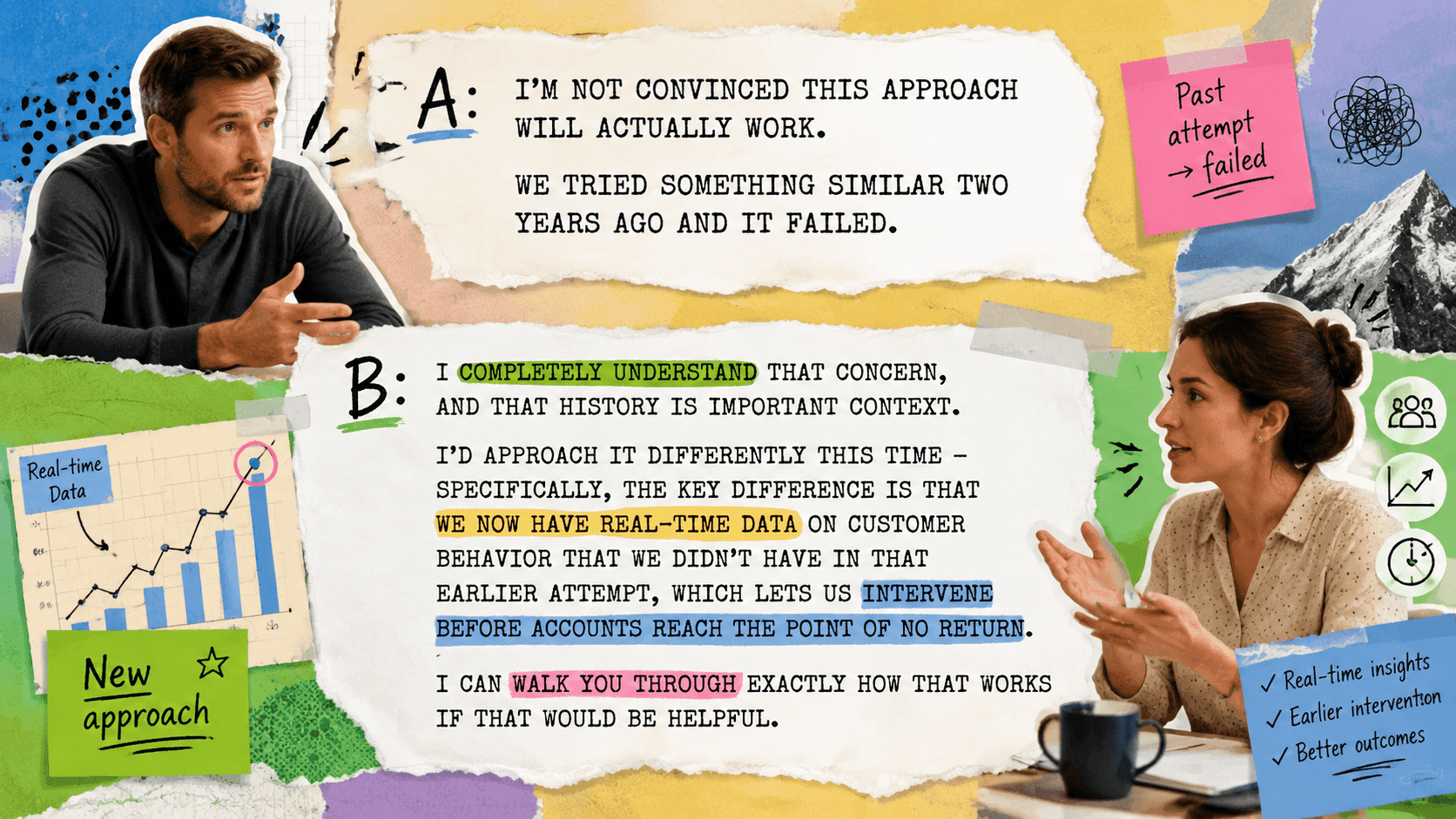
A:I'm not convinced this approach will actually work. We tried something similar two years ago and it failed.
我不太相信这个方法真的有效。两年前我们尝试过类似的东西,失败了。
B:I completely understand that concern, and that history is important context. I'd approach it differently this time — specifically, the key difference is that we now have real-time data on customer behavior that we didn't have in that earlier attempt, which lets us intervene before accounts reach the point of no return. I can walk you through exactly how that works if that would be helpful.
我完全理解这个顾虑,那段历史是重要的背景。这次我会采用不同的方式——具体来说,关键区别在于,我们现在拥有了之前那次尝试中没有的客户行为实时数据,这让我们能够在客户流失不可挽回之前就介入。如果有帮助,我可以详细介绍一下这是如何运作的。
涉及商业机密
有时候问题本身是合理的,但答案涉及公司内部的敏感信息,无法在公开场合详细回答。这种情况下,需要既不撒谎、也不造成尴尬的表达方式。
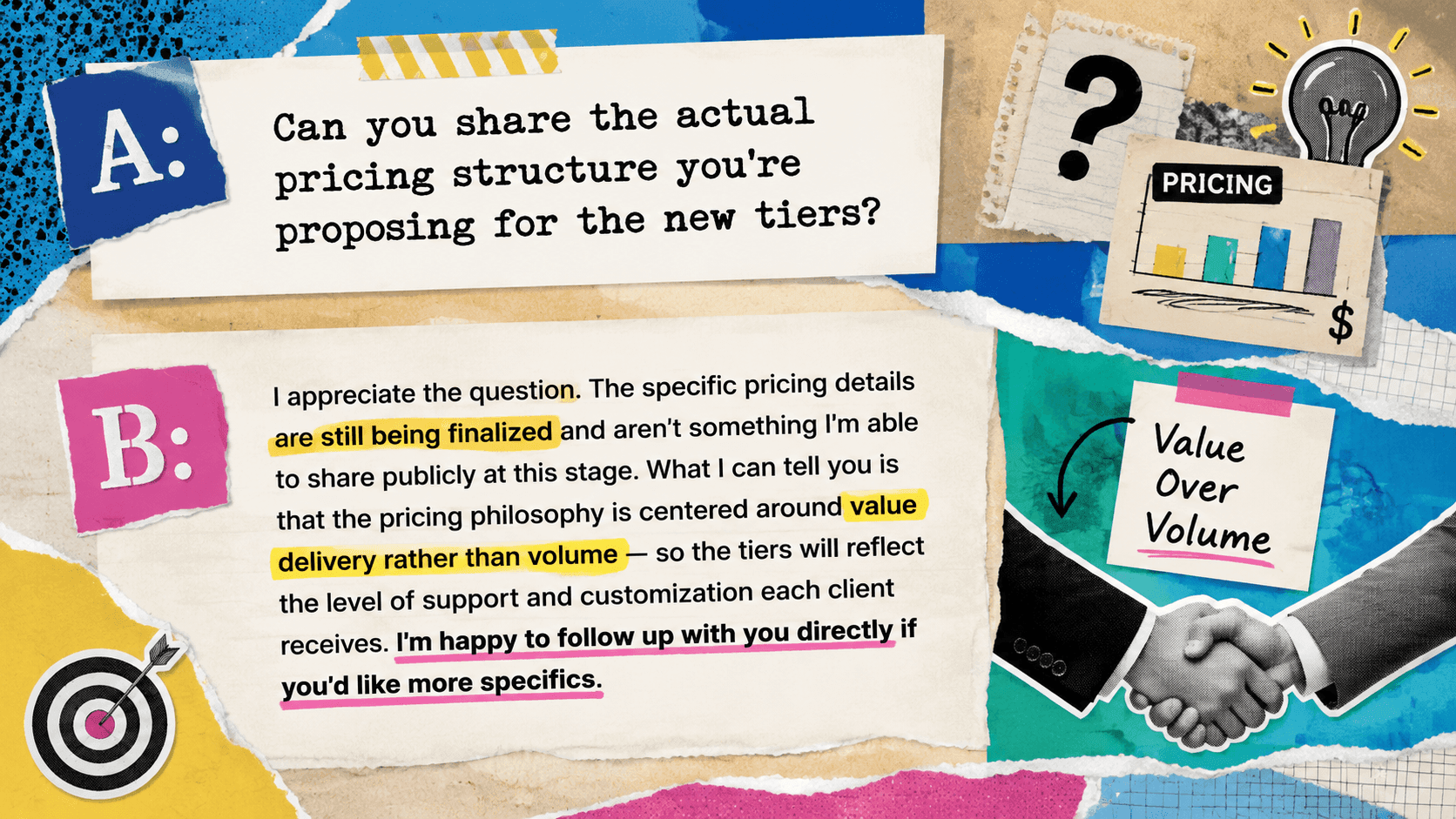
A:Can you share the actual pricing structure you're proposing for the new tiers?
你能分享你为新层级提议的实际定价结构吗?
B:I appreciate the question. The specific pricing details are still being finalized and aren't something I'm able to share publicly at this stage. What I can tell you is that the pricing philosophy is centered around value delivery rather than volume — so the tiers will reflect the level of support and customization each client receives. I'm happy to follow up with you directly if you'd like more specifics.
感谢提问。具体的定价细节目前还在最终确认中,在这个阶段我还不能公开分享。我能告诉你的是,定价理念以价值传递为核心,而非以数量为导向——因此定价层级将反映每位客户获得的支持和定制化程度。如果你想了解更多具体信息,我很乐意私下与你跟进。
演示结尾与 Q&A 场景对话
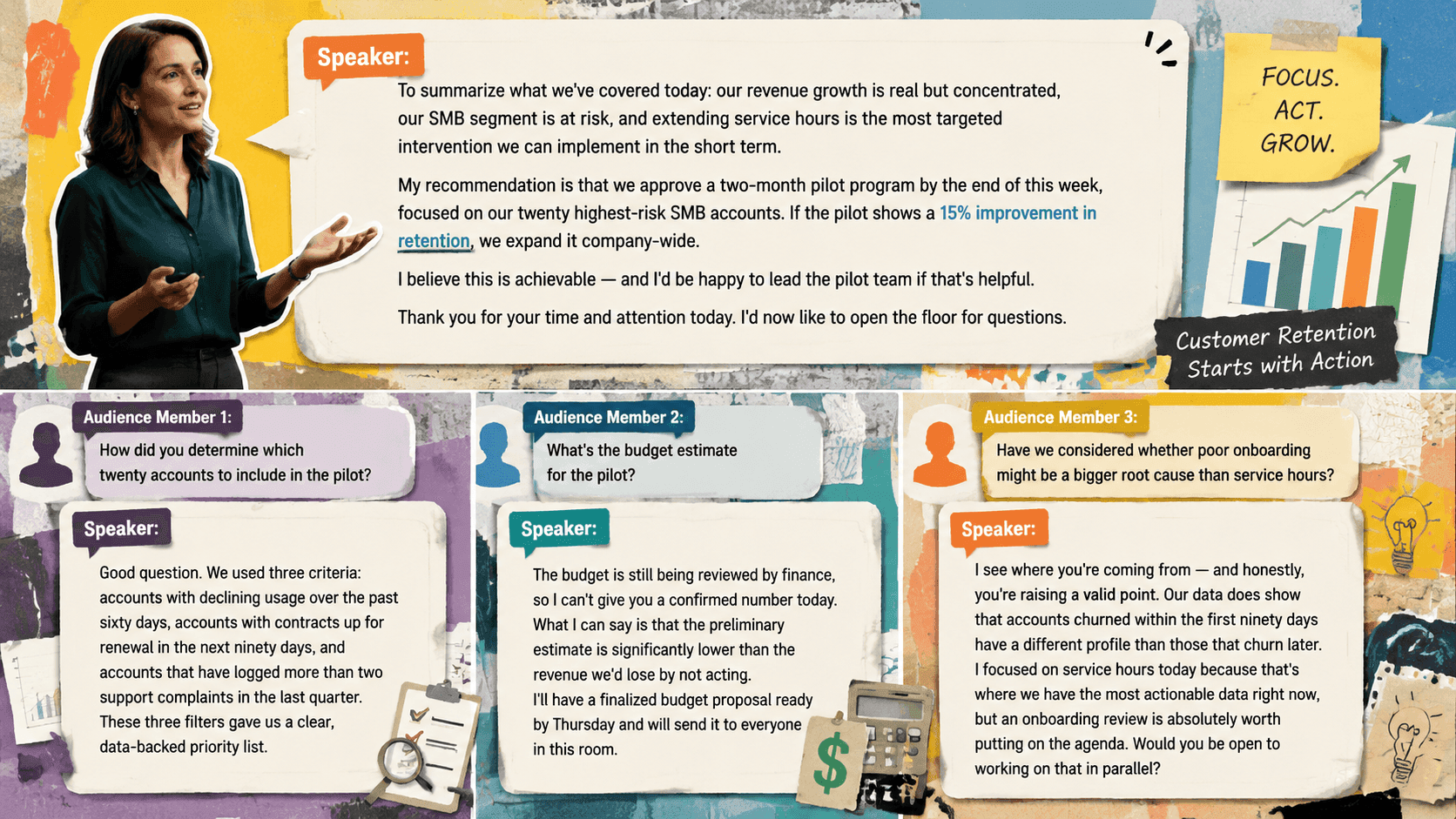
以下是演示结尾加 Q&A 场景,展示如何将前面所学的所有工具整合在一起。
Speaker:To summarize what we've covered today: our revenue growth is real but concentrated, our SMB segment is at risk, and extending service hours is the most targeted intervention we can implement in the short term. My recommendation is that we approve a two-month pilot program by the end of this week, focused on our twenty highest-risk SMB accounts. If the pilot shows a 15% improvement in retention, we expand it company-wide. I believe this is achievable — and I'd be happy to lead the pilot team if that's helpful. Thank you for your time and attention today. I'd now like to open the floor for questions.
演讲者:总结今天涵盖的内容:我们的收入增长是真实的,但过于集中;我们的中小企业客户板块面临风险;延长服务时间是我们短期内能够实施的最具针对性的干预措施。我的建议是,我们在本周末前批准一个为期两个月的试点项目,重点针对我们风险最高的二十个中小企业客户。如果试点显示留存率提高了15%,我们就全公司推广。我相信这是可以实现的——如果有帮助,我也很乐意带领试点团队。感谢大家今天的时间和关注。现在我想开放提问环节。
Audience Member 1:How did you determine which twenty accounts to include in the pilot?
听众1:你是如何确定哪二十个客户进入试点的?
Speaker:Good question. We used three criteria: accounts with declining usage over the past sixty days, accounts with contracts up for renewal in the next ninety days, and accounts that have logged more than two support complaints in the last quarter. These three filters gave us a clear, data-backed priority list.
演讲者:好问题。我们使用了三个标准:过去60天内使用量下降的客户、未来90天内合同到期续签的客户,以及上季度提交了超过两次支持投诉的客户。这三个筛选条件给了我们一个清晰的、有数据支撑的优先级列表。
Audience Member 2:What's the budget estimate for the pilot?
听众2:试点的预算估计是多少?
Speaker:The budget is still being reviewed by finance, so I can't give you a confirmed number today. What I can say is that the preliminary estimate is significantly lower than the revenue we'd lose by not acting. I'll have a finalized budget proposal ready by Thursday and will send it to everyone in this room.
演讲者:预算目前还在财务部门审核,所以今天我无法给出确认的数字。我能说的是,初步估计远低于我们不采取行动所会损失的收入。我将在周四前准备好最终的预算提案,并发送给在场的所有人。
Audience Member 3:Have we considered whether poor onboarding might be a bigger root cause than service hours?
听众3:我们是否考虑过,糟糕的入职流程可能比服务时间是更大的根本原因?
Speaker:I see where you're coming from — and honestly, you're raising a valid point. Our data does show that accounts churned within the first ninety days have a different profile than those that churn later. I focused on service hours today because that's where we have the most actionable data right now, but an onboarding review is absolutely worth putting on the agenda. Would you be open to working on that in parallel?
演讲者:我理解你的出发点——说实话,你提出了一个有道理的观点。我们的数据确实显示,前90天内流失的客户与之后流失的客户有不同的特征。今天我聚焦在服务时间上,是因为我们目前在这方面拥有最具可操作性的数据,但入职流程的审查绝对值得提上议程。你愿意并行推进这项工作吗?
练习题
第1题【知识点:结尾三重功能】
以下哪个演示结尾最完整地体现了“总结内容 + 激励行动 + 留下好印象”三重功能?
A. That's all I have for today. Any questions?
B. In conclusion, thank you for listening to my presentation.
C. To wrap up: we've identified three key gaps, and my recommendation is to address gap one by Q3. I'm excited about where this can take us, and I'd love to hear your thoughts in the Q&A.
D. Those are all the slides I prepared. I hope this was useful.
第2题【知识点:处理不知道答案的情况】
在 Q&A 中,有人问了你一个你当场不知道答案的问题。以下哪个回答最合适?
A. That's not really relevant to today's presentation.
B. I'm not sure, maybe 20%? Let me just estimate for now.
C. Great question. I don't have that specific data with me right now, but I'll look it up and send you a follow-up email by tomorrow.
D. That's a very complicated question. It's hard to answer.
第3题【知识点:PREP 结构】
某人被问道:“你认为我们应该在亚太区还是欧洲区优先投资?”以下哪个回答最完整地体现了 PREP 结构?
A. I think Asia-Pacific is better.
B. Asia-Pacific. The market is bigger. We should invest there.
C. My view is that Asia-Pacific should be the priority. The reason is that the market is growing three times faster than Europe, and our brand recognition there is already strong. For example, in Q2 we saw a 40% organic growth in Southeast Asia with minimal marketing spend. So, given the data, Asia-Pacific looks promising, although we need cost data to compare returns on investment.
D. This depends on many factors and it's difficult to say without more analysis.
第4题【知识点:处理挑战性问题】
听众说:“我不认为这个方案会成功,之前类似的尝试都失败了。”以下哪个回答最恰当?
A. I disagree. Those previous attempts were different and yours is a bad comparison.
B. You might be right. Maybe we shouldn't try this.
C. I completely understand that concern. The key difference this time is that we have real-time data and a smaller pilot scope, which means we can course-correct early if things aren't working. I'd be happy to walk you through how we've built in those safeguards.
D. That's a fair point. Let's move on to the next question.
第5题【知识点:综合 Q&A 场景】
情景:你刚做完一场关于“数字化转型路线图”的演示,进入 Q&A 环节。一位高管问:“这个路线图听起来很全面,但我们公司真的有执行能力吗?”这个问题的潜台词是对内部执行力的质疑。请选出最有效的回应策略:
A. 直接反驳,说公司执行力很强,不需要担心。
B. 承认这是一个合理的顾虑,然后列举团队已有的能力和过往成功案例,最后说明路线图中内置了分阶段执行和里程碑评估机制,以降低执行风险。
C. 说这个问题超出了今天演示的范围,建议另行讨论。
D. 说“这是一个很好的问题”,然后重复演示中已经说过的内容。